





AI
AI/ML
 Chand Prakash
07 October 2026
Chand Prakash
07 October 2026
Multi-Agent Orchestration Patterns for Enterprise Workflows
 Chand Prakash
The year 2026 marks the breakthrough moment for multi-agent AI frameworks. Systems are transitioning from isolated chatbots that only offer visibility into autonomous architectures that execute multi-step logic. The core difference between a basic assistant and an autonomous workflow is agency.
A basic assistant requires a human to guide every step, whereas an agent built through proper AI agent development investigates, plans, and acts independently based on predefined constraints. The adoption rate reflects this operational shift. Gartner predicts that 40% of enterprise applications will embed task-specific agents by the end of 2026, an eightfold jump from less than 5% in 2025.
For engineering teams building custom AI automation solutions, success depends on selecting the correct AI orchestration framework. Currently, the three best AI agent frameworks dominate the enterprise market. LangChain offers deterministic control over complex state machines, CrewAI provides rapid role-based deployment, and the Claude Agent SDK secures execution within strict Anthropic environments. Choosing correctly separates scalable AI software development services from cancelled pilots.
Transitioning from an experimental AI assistant to a production-ready AI workflow automation framework requires moving past simple chatbots to systems capable of multi-step reasoning, robust state management, and strict governance. A production-ready AI agent architecture is not just about the model you use; it is fundamentally about how that model is orchestrated to prevent uncontrolled actions and ensure predictable outputs.
When evaluating an AI agent development company or building internally, the framework you choose dictates critical aspects of your infrastructure:
This operational gap highlights that while many experiment, only a few achieve true workflow automation. The goal of choosing between LangChain vs CrewAI vs Claude Agent SDK is to find the right balance between rapid deployment and the rigorous control required for business automation.
Selecting the best AI framework for autonomous agents requires aligning its architecture with your specific business requirements and technical resources.
| Feature | LangChain (LangGraph) | CrewAI | Claude Agent SDK |
|---|---|---|---|
| Primary Architecture | Graph-based state machines | Role-based persona orchestration | Sandbox-isolated execution |
| Best For | Complex multi-model pipelines | Rapid prototyping and delegation | Secure Anthropic-native applications |
| Learning Curve | High | Low to Medium | Medium |
| Multi-Model Support | Excellent (Agnostic) | Excellent (Agnostic) | None (Anthropic models only) |
| Vendor Lock-in Risk | Low | Low | High |
| State Management | Explicit state graph cycles | Process-based task context | Environment state persistence |
| Agent Coordination | Node and edge transitions | Sequential or hierarchical tasks | Direct tool and file hooks |
| Security & Isolation | Developer-managed sandbox | Developer-managed sandbox | Native isolated runtime sandbox |
| Ecosystem & Community | Massive open-source library | Fast-growing open-source community | Proprietary Anthropic ecosystem |
The LangChain framework is the best AI framework for autonomous agents requiring multi-model flexibility and deterministic state management. Through LangGraph, engineering teams construct explicit state machines that govern complex reasoning cycles.
This architectural control ensures predictable execution during critical enterprise operations. It transforms unpredictable model behavior into reliable system components.
Complex business automation requires handling multi-step retrieval and cyclic decision loops. LangGraph structures workflows as stateful graphs where nodes execute actions and edges define routing logic. This setup enables agents to pause for human approval, correct mistakes, and persist state across long tasks.
Production systems maintain full governance over agent behavior without sacrificing reasoning depth. Developers can inspect, debug, and modify every transition point across the agent lifecycle.
Leading open-source AI frameworks must integrate easily with existing technical infrastructure. LangChain provides hundreds of pre-built integrations for vector databases, external tool APIs, and diverse model providers. This broad compatibility eliminates vendor lock-in during custom AI agent development.
System architects can evaluate top LLM agent frameworks and swap base models as performance requirements shift. It provides the foundational tools required for long-term scalability and system maintenance.
When considering how to deploy an AI workflow automation framework, speed to prototype is often the deciding factor. You should choose the CrewAI framework when your engineering team needs to build and validate working multi-agent systems rapidly, without getting bogged down in complex state architectures.
CrewAI has emerged as the strongest framework for demo-to-prototype ergonomics because of how it abstracts the complexity of agent coordination.
CrewAI uses an intuitive, role-based mental model that groups AI agents into collaborative “teams”. Instead of coding complex graph transitions, developers define agents by giving them a specific role, a goal, and an assigned persona or backstory. These specialized agents operate within a sequential or hierarchical process, allowing a manager agent to intelligently delegate subtasks to worker agents.
This structure perfectly suits enterprise use cases like automated research teams or marketing asset generation, where different personas handle data gathering, drafting, and final editorial review.
The primary advantage of this role-based multi-agent AI framework is its development speed. A workflow that might require hundreds of lines of glue code in other frameworks can often be rewritten and deployed in a fraction of the time using CrewAI. It abstracts the message passing and tool execution, allowing teams to focus on the business logic rather than the underlying infrastructure. Importantly, this speed does not sacrifice multi-model support.
The framework remains agnostic, allowing teams to route complex reasoning tasks to frontier models while assigning simpler delegation tasks to faster, cheaper models within the same workflow. This flexibility accelerates custom AI agent development significantly.
The Claude Agent SDK is the premier choice for platform builders who prioritize out-of-the-box sandbox isolation, built-in file editing, and native security over multi-model flexibility. While other frameworks focus on connecting dozens of different models, the Claude Agent SDK is built specifically to give Anthropic models a secure environment to execute code and interact with systems directly.
The core philosophy of the Claude Agent SDK is that autonomy requires a secure execution environment. Instead of just passing text back and forth, the SDK provides the agent with native bash execution and file system access within an isolated sandbox, which is essential for custom AI agent development services. This prevents uncontrolled actions from affecting the broader host system. This level of security is increasingly critical for enterprise AI agent development.
According to an April 2026 press release by Gartner, 25% of all enterprise generative AI applications will experience at least five minor security incidents per year by 2028, largely driven by the adoption of agentic technologies and immature security practices.
The SDK natively supports the Model Context Protocol (MCP), establishing a standardized, secure connection between the agent and your enterprise data. For engineering teams seeking zero-infrastructure deployments, Anthropic also offers “Managed Agents”, which contrasts with the self-hosted SDK by handling all backend infrastructure automatically.
This allows developers to deploy secure, autonomous agents without managing the underlying compute environment. This combination of strict isolation and standardized data access makes it the most robust choice for high-stakes business automation.
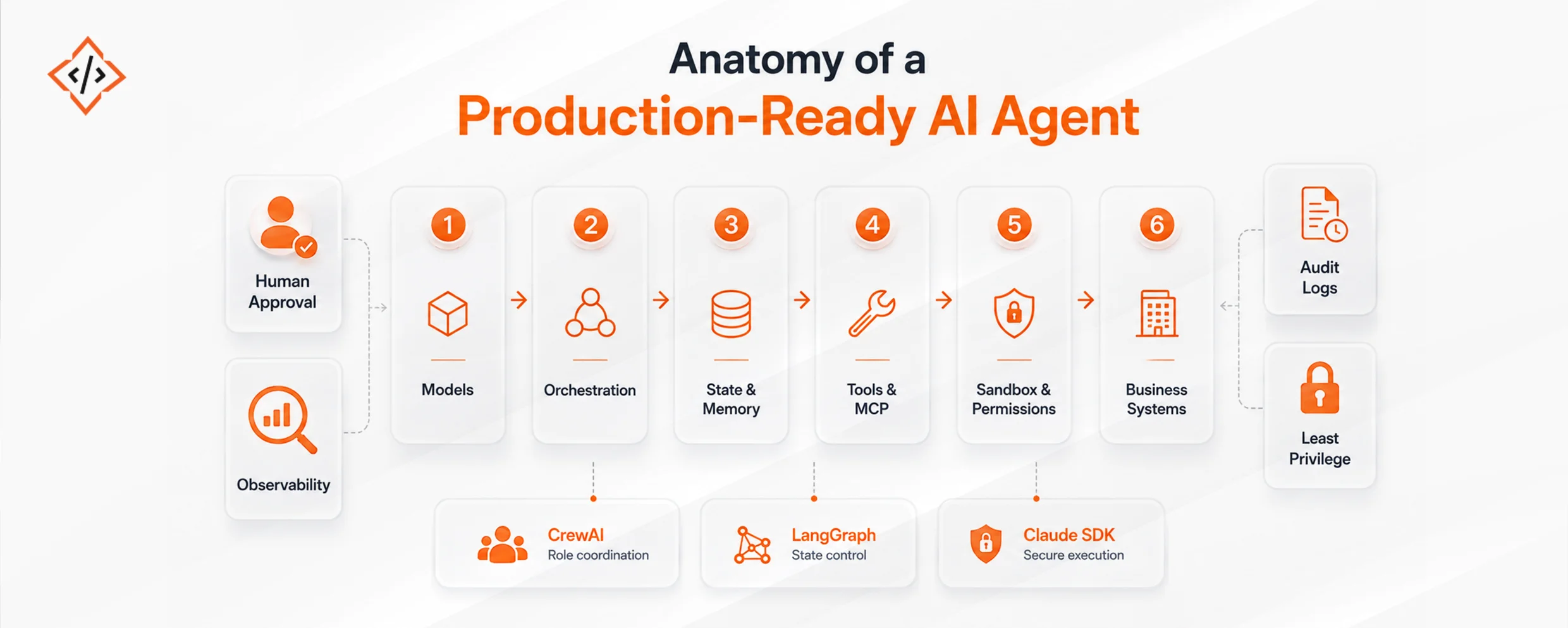
Building a production-ready AI agent architecture is no longer about proving basic model capabilities. Success in AI development services depends on selecting a resilient framework that scales without compounding technical debt. Avoiding the high failure rate of experimental pilots requires a structured implementation strategy matching framework strengths to team capabilities. The industry is moving rapidly toward dynamic multi-agent ecosystems governed by strict security and explicit state management.
Evaluating an AI agent frameworks comparison is only the initial step toward autonomous operations. Translating architectural designs into reliable business automation demands deep engineering expertise and rigorous security controls.
As an experienced AI agent development company, CodeTrade delivers custom AI agent development tailored to your existing tech stack. Engineering leaders partner with CodeTrade for enterprise AI agent development to build scalable AI software development services that eliminate technical debt.
 Chand Prakash
 Chand Prakash
 Chand Prakash
 Chand Prakash
 Chand Prakash