






Odoo Development
ERP
 Hardik Soni
29 September 2026
Hardik Soni
29 September 2026
How US Enterprises Can Execute A Flawless Odoo ERP Migration Without Operational Downtime?
 Hardik Soni
Moving to an agentic AI ERP setup replaces passive data logging with active system orchestration. Traditional platforms require manual inputs for every minor workflow step. An agentic model detects operational friction and resolves it independently without any human prompting. This transition shifts the focus from basic AI assistants to autonomous systems managing multi-step execution.
Gartner predicts that forty percent of enterprise applications will feature task-specific AI agents by 2026. This rapid growth occurs because ERP AI agents allow companies to scale internal operations effectively. Firms can process higher transaction volumes without proportionally increasing their back-office headcount. These AI-powered ERP systems remove the dependency on human supervisors for daily operational adjustments.
Autonomous systems actively investigate backend errors and formulate structural corrections entirely on their own. Business leaders use enterprise AI development services to separate revenue growth from manual coordination constraints. This guide covers the top ten enterprise platforms and six functional solutions available today.
Enterprise software is moving beyond passive data logging. An agentic AI ERP platform converts these traditional repositories into an active, autonomous workforce. These advanced systems execute complex business goals entirely on their own. Standard copilots typically pause to require human confirmation before taking any final action.
True enterprise AI agents instead complete end-to-end tasks independently without manual intervention. This evolution shifts system functionality directly toward active operational orchestration.
This structural shift is driving massive investments across the corporate software landscape. According to IDC, ninety-five percent of enterprises worldwide now run at least one agent-enabled workflow in production as of 2026. Such rapid adoption highlights how agentic automation in ERP solves fundamental operational bottlenecks.
Organizations can now rely on software to formulate plans and execute immediate systemic corrections. Business leaders use these AI-powered ERP systems to realize immediate value across every department.
Companies no longer wait for lengthy software upgrades to see tangible efficiency gains. AI agents for business processes allow firms to achieve immediate operational agility. These systems continuously adjust supply chains and reconcile finances while adapting to new constraints. Businesses can scale their transaction capacity while maintaining a lean back-office team.
The best AI ERP software landscape is led by major enterprise vendors and highly customizable open-source frameworks. These platforms natively support autonomous agents to handle complex business processes efficiently. IT leaders rely on these systems to transition from rule-based task execution toward active operational environments. Agentic AI ERP systems process vast amounts of unstructured data to solve deep operational problems.
SAP utilizes its intelligent agent network to coordinate cross-departmental workflows. The system eliminates manual data transfers between finance and global logistics departments. Joule detects inventory shortages and processes continuous supply chain adjustments autonomously. The agent replaces static performance dashboards with active problem resolution capabilities.
This agentic AI ERP approach maintains strict operational continuity across all international regions. The software adjusts purchase orders when external vendors report sudden raw material delays. SAP ensures that production schedules align perfectly with incoming freight deliveries. Enterprise directors appreciate how this system reduces the need for constant managerial supervision.
Oracle integrates ERP AI agents directly into its core corporate financial modules. The software handles real-time ledger management without requiring manual data entry tasks. These autonomous agents detect unusual transaction patterns to ensure complete financial compliance. Finance teams use this sophisticated feature to speed up the month-end closing cycle.
It minimizes reporting errors and guarantees accurate balance sheets across multiple corporate entities. This AI-powered enterprise resource planning solution separates accounting accuracy from manual oversight. The system flags tax inconsistencies long before the final reporting deadline arrives. Oracle provides deep visibility into cash flow variations without any manual spreadsheet reconciliation.
Microsoft Dynamics 365 bridges the gap between basic Copilot assistance and autonomous agent frameworks. The system features native integrations with existing enterprise data lakes. It pulls raw data and executes cross-functional workflows automatically across the entire business. These enterprise AI agents update customer records and allocate warehouse resources simultaneously.
Operations directors prefer this platform for its deep integration with common office tools. The agentic structure allows businesses to process higher volumes of daily administrative tasks. Microsoft simplifies the transition to AI automation in ERP for mid-market organizations. Users experience a massive reduction in the time spent toggling between separate applications.
Workday applies agentic ERP systems strictly to human capital and corporate financial planning. The platform manages resource allocation by analyzing personnel data continuously and securely. Its agents possess the capacity to autonomously resolve complex payroll discrepancies. The software flags tax inconsistencies and applies correct deductions prior to final processing.
HR administrators spend less time verifying spreadsheets because the system self-corrects basic errors. This AI ERP software directly improves employee satisfaction through reliable administrative automation. Workday handles talent acquisition by screening candidates and scheduling initial interview rounds automatically. The platform ensures that corporate staffing levels always align with projected quarterly budgets.
Odoo stands as the premier choice for custom AI agent development and modular enterprise integrations. Developers map task-specific agents directly to the modular architecture of Odoo. This flexibility allows companies to execute precise inventory and complex accounting actions. The platform adapts easily to unique manufacturing workflows or retail distribution needs.
Organizations can deploy highly specialized agents without overhauling their entire IT infrastructure. Agentic automation in ERP becomes highly accessible for growing firms using Odoo. The open-source nature means developers can tailor the AI agents for business processes perfectly. This adaptable environment provides a cost-effective path toward fully autonomous daily operations.
NetSuite brings powerful generative AI ERP capabilities to rapidly scaling mid-market organizations. The platform focuses heavily on automated text generation and autonomous data entry tasks. These agents populate sales orders and update client profiles across multiple software modules. NetSuite helps scaling businesses maintain accurate financial records during periods of rapid growth.
The system reviews vendor invoices against established purchase orders in real time. This proactive data management reduces the hidden costs of manual administrative labor significantly. NetSuite resolves order fulfillment delays by locating alternative shipping providers automatically. The platform keeps the entire supply chain moving without requiring constant managerial input.
Infor CloudSuite utilizes Coleman AI specifically for heavy manufacturing and distribution environments. The platform operates as a highly intelligent and autonomous supply chain dispatcher. Coleman analyzes machine telemetry data to predict equipment failures before they happen. The system reroutes factory floor schedules to maintain continuous production targets smoothly.
Logistics managers rely on this capable solution to minimize expensive operational downtime. These AI agents in ERP ensure essential raw materials arrive exactly when required. Infor CloudSuite prevents production bottlenecks by ordering replacement parts immediately upon detecting faults. The software adapts to sudden labor shortages by reassigning available shift workers automatically.
Salesforce successfully bridges the gap between CRM data and backend resource planning. The platform deploys autonomous customer service agents to manage complex client requests. These customer-facing agents are fully capable of initiating internal supply chain adjustments directly. If a client reports a missing item, the agent schedules a replacement automatically.
It checks warehouse availability and updates shipping logs without any human approval. This continuous system integration defines the immediate future of AI in ERP. Salesforce ensures that sales teams always have accurate visibility into current production timelines. The platform eliminates the traditional communication silos between front-office sales and back-office logistics.
Epicor focuses heavily on AI-powered enterprise resource planning for complex shop-floor management. The Prism AI framework monitors equipment performance to schedule predictive maintenance autonomously. The software prevents factory bottlenecks by adjusting machine scheduling based on current workloads. These intelligent systems read telemetry signals to organize daily production runs optimally.
Factory supervisors use this ERP automation with AI to maximize daily output volume. The platform keeps industrial operations running smoothly regardless of sudden external demand shifts. Epicor minimizes material waste by calculating exact cutting specifications for each unique production run. The system adapts rapidly to new product designs without requiring extensive manual reprogramming.
Asset-heavy industries utilize IFS Cloud to manage their extensive global service networks. The platform uses AI agents in ERP to manage complex field service dispatches. It assigns technicians based on their specific skills and current geographical proximity. The system also monitors physical asset lifecycles automatically to suggest timely hardware replacements.
This proactive maintenance strategy reduces unexpected equipment failures across remote construction work sites. Industrial leaders choose IFS to ensure maximum reliability for their critical public infrastructure. The platform optimizes spare parts inventory by predicting exactly which components will fail next. IFS ensures that field technicians always arrive with the correct tools and knowledge.
AI agents for business processes move beyond basic alerts by actively investigating errors, formulating corrections, and executing systemic changes autonomously. These solutions transform passive monitoring into active operational management.
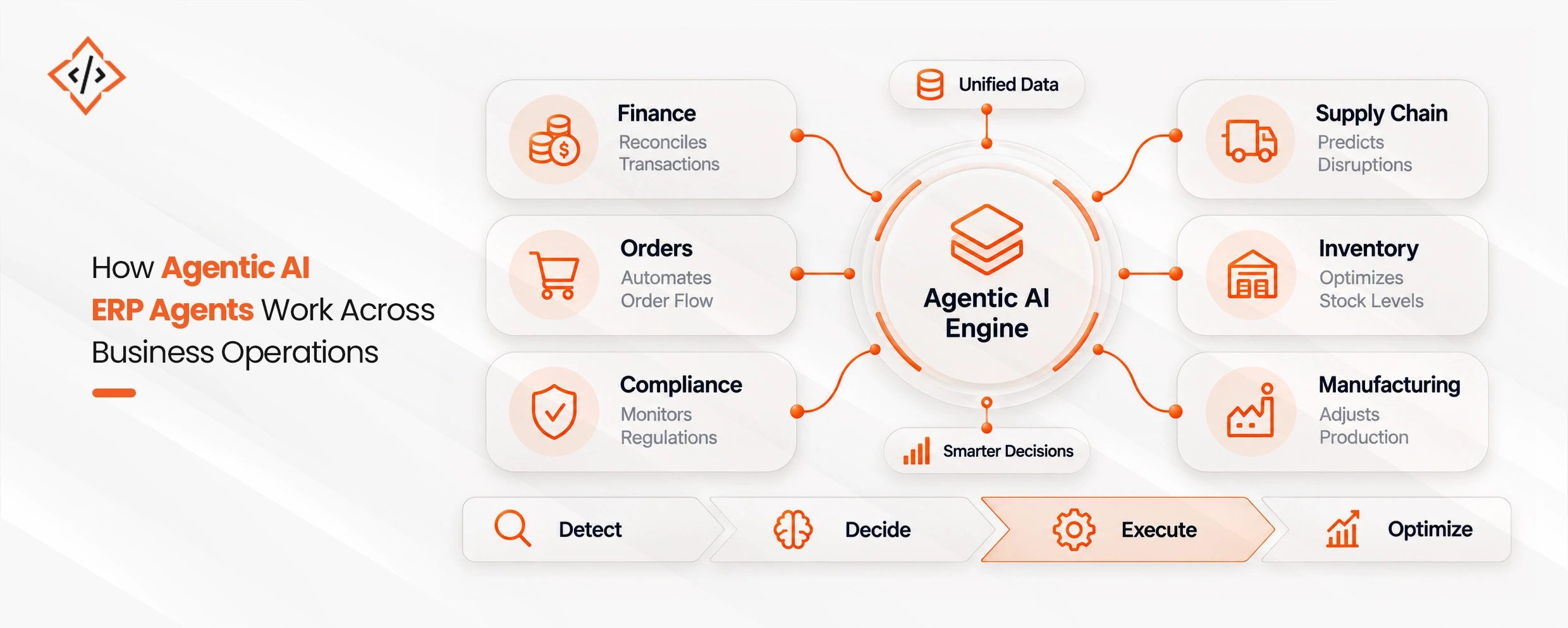
Financial agents continuously match incoming vendor invoices against established purchase orders and daily bank feeds. The software actively investigates discrepancies instead of merely flagging them for human review. S&P Global Market Intelligence reports that 31% of enterprises run AI agents in production as of mid-2026, with banking leading. This adoption ensures faster and completely error-free financial closing cycles.
Autonomous agents monitor external data feeds like global weather patterns and real-time port congestion metrics continuously. The system reroutes incoming freight shipments entirely on its own before a physical delay actually materializes. This proactive AI automation in ERP prevents minor logistical disruptions from snowballing into massive production bottlenecks.
Agentic AI ERP systems manage the entire order-to-cash lifecycle without requiring any manual data entry. The system performs autonomous credit checking, generates accurate client invoices, and executes automated payment collection processes. This uninterrupted financial flow allows businesses to accelerate their overall revenue realization cycle securely.
The system dynamically adjusts safety stock levels across multiple warehouses based on predictive seasonal demand spikes. These intelligent ERP AI agents completely eliminate the need for expensive and tedious manual warehouse cycle counts. Supply chain directors rely on this capability to prevent expensive overstocking while fulfilling customer orders quickly.
Agentic ERP systems continuously monitor complex cross-border transactions for strict international regulatory compliance. The software applies autonomous tax rates accurately and flags critical errors prior to final ledger posting. Multinational corporations use this generative AI ERP feature to avoid heavy financial penalties and ensure audit readiness.
Shop-floor operations adapt instantly to unexpected machine downtime or sudden labor shortages using autonomous scheduling agents. AI automation in ERP maximizes daily factory output by reassigning available workers and rerouting active production lines. This continuous optimization guarantees that manufacturing targets remain intact despite any unexpected operational friction.
The future of AI in ERP centers on operational resilience and separating revenue growth from back-office headcount constraints. Adopting an agentic AI ERP framework allows companies to retain intellectual property while utilizing advanced algorithms to handle routine friction points. This setup ensures that internal processes evolve without completely overhauling existing data structures.
Automated decision-making removes the dependency on human supervisors for daily operational adjustments. Enterprise AI agents resolve supply chain disruptions and coordinate cross-departmental workflows autonomously. By shifting to ERP automation with AI organizations achieve immediate execution capabilities and sustain long-term business agility.
The window to gain a competitive advantage through autonomous operations is narrowing quickly. Agent-driven software has rapidly become the new standard across the industrial and corporate sectors. Enterprise leaders must evaluate their most manual workflows immediately to remain competitive. They should initiate a targeted pilot program using custom integrations over a stable ERP framework.
This structured approach minimizes operational risks while proving the direct financial value of early automation. Businesses can scale these intelligent capabilities confidently once the initial framework proves successful.
CodeTrade specializes in building and deploying secure agentic AI ERP systems for modern enterprises. Through advanced generative AI development, certified engineering teams design custom solutions that integrate naturally with existing corporate data structures. This dedicated technical expertise ensures every transition toward fully autonomous operations remains smooth, profitable, and highly scalable.

 Hardik Soni
 Hardik Soni
 Chand Prakash
 Chand Prakash
 Chand Prakash