






AI
 Chand Prakash
09 September 2026
Chand Prakash
09 September 2026
AI Adoption Framework: A Complete Guide for Enterprise AI Success
 Chand Prakash
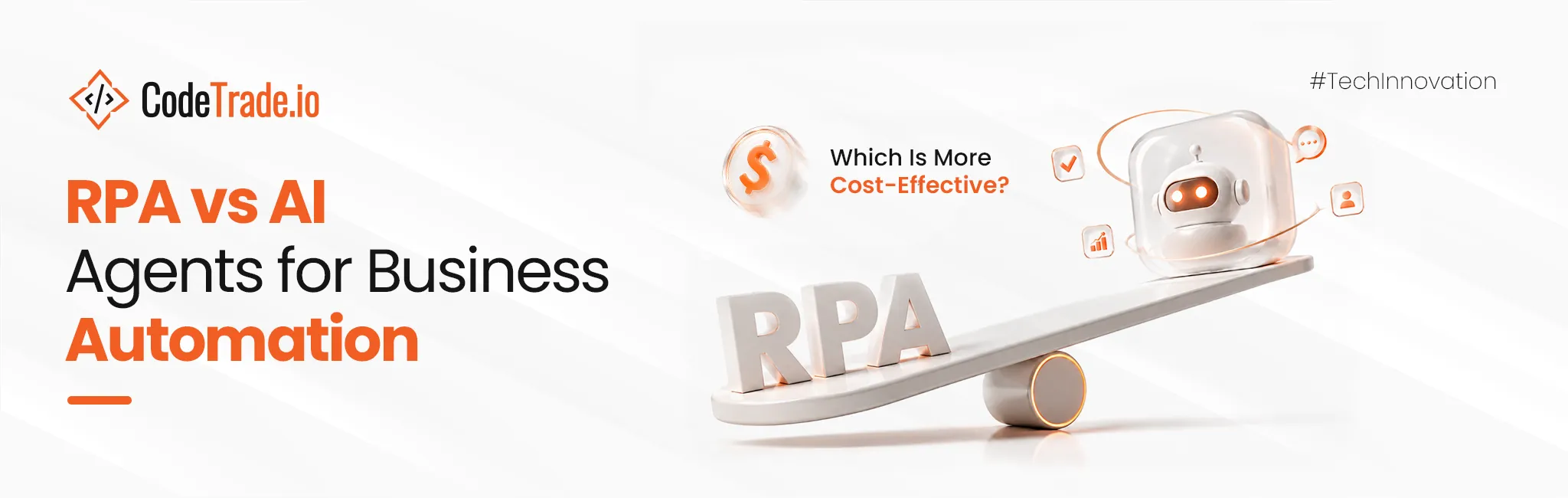
Evaluating enterprise software deployment structures requires looking past superficial price tags. RPA is more cost-effective for stable and repetitive tasks. Meanwhile, AI agents are more cost-effective when businesses need automation that can reason, adapt, and manage exceptions.
Most technical decision-makers evaluate upfront software licensing fees alone when building a long-term business automation strategy. This narrow focus miscalculates actual structural value across corporate operations. True optimization requires assessing hidden maintenance engineering costs alongside transaction volume capacities. The vital inquiry is never which software tool features a lower initial entry price.
Instead, leaders must conduct a comprehensive cost comparison to determine which system costs less over the full workflow lifecycle. A Gartner study reports that forty percent of enterprise business automation tools will embed task-specific agents by 2026.
This massive adoption curve proves that modern corporate technology budgeting now prioritizes operational resilience over initial setup investments.
Evaluating an enterprise automation strategy requires understanding the structural differences between software bots and autonomous intelligence layers.
Standard RPA software operates strictly within fixed steps, structured data templates, and highly repetitive tasks. Typical corporate operations include invoice entry, form filling, report generation, system updates, and simple data transfer between distinct applications. A 2025 ResearchGate comparative study confirmed that traditional bots perform better in speed and reliability for these repetitive, stable workflows.
Modern AI agents for business automation dynamically interpret user requests, cross-check internal data, make operational decisions, and complete multi-step workflows autonomously.
These cognitive systems utilize natural language processing to navigate changing parameters without manual engineering re-configurations. This approach significantly reduces initial development effort while allowing enterprise infrastructure to adapt seamlessly to dynamic interface modifications.
A rule-based configuration becomes financially inefficient when corporate workflows change frequently due to high scripting repair expenses. Conversely, custom AI agents increase variable operational costs when deployed for basic tasks that do not require cognitive evaluation.
Balancing infrastructure expenses requires aligning system complexity with the correct architectural framework.
Deploying predictable corporate software blocks requires identifying the specific environmental parameters where rule-based execution maintains a distinct financial advantage. Traditional RPA implementation is cheaper when the target operational workflow remains entirely stable, contains high transaction volumes, and features exhaustive documentation.
Standard software bots function optimally when an identical business task repeats without any variations. This software layer requires zero contextual reasoning or human cognitive judgment to complete its pre-programmed data fields. Typical low-overhead operational scenarios include monthly invoice posting, routine payroll data transfer, structural CRM record updates, and basic order status updates.
A rules-based framework achieves maximum cost-effectiveness when a single configured bot repeats thousands of identical actions with minimal deviation. This structural scale spreads the initial development expenditures across millions of automated mouse clicks without increasing variable runtime fees.
This programmatic capacity allows expanding enterprise processing pipelines horizontally without incurring the heavy token processing expenses of custom AI agents.
Regulated corporate processing structures benefit financially from a fixed automation strategy due to strict linear rule enforcement. Every transactional task creates a definitive digital ledger entry that remains completely predictable and straightforward for internal teams to audit.
This fixed operational execution eliminates the corporate risk of non-deterministic model hallucinations while significantly accelerating annual regulatory compliance verification processes.
AI agents cost less when an enterprise workflow contains too many exceptions for traditional RPA to handle efficiently.
Standard database records present zero friction for older computational platforms, but real enterprise data rarely arrives in clean rows. Modern AI agents cost less when a company must consistently process unstructured communication formats like emails, unformatted PDFs, customer chats, unstructured notes, support tickets, and mixed-format contract files.
Intelligent systems handle these diverse inputs natively through tailored AI agent development services without requiring expensive third-party data scraping software or tedious manual pre-formatting pipelines.
Traditional rule-based scripts stall the moment an operational workflow deviates from a rigidly mapped path, spiking engineering maintenance costs. Conversely, goal-driven AI automation manages unexpected data anomalies autonomously by applying contextual reasoning rather than throwing a system error.
This adaptive AI-powered business automation capability reduces the human capital expenses typically dedicated to manual correction work. McKinsey & Company notes that agentic AI creates its highest financial value when organizations fundamentally redesign entire workflows from scratch, rather than simply bolting an agent onto legacy processes.
Enterprise information frequently remains locked inside siloed databases, requiring complex cross-referencing before executing a single business process. Autonomous software layers securely navigate multiple decoupled platforms to synthesize real-time data before recommending or executing an optimization action.
According to an IDC study, widespread enterprise adoption of cognitive workflows is projected to reduce routine structural data management tasks by nearly seventy percent by 2031. This rapid efficiency trajectory proves that cognitive agent infrastructure is quickly becoming the standard framework for complex corporate processing ecosystems.
A comprehensive cost comparison requires evaluating end-to-end architecture expenses rather than upfront software licensing fees or basic tool subscriptions.
| Cost Factor | RPA Architecture | AI Agent Infrastructure |
|---|---|---|
| Setup Cost | Features lower deployment budgets for well-documented, linear business automation tasks. | Requires higher initial capitalization for prompt engineering, workflow design, and structural system integrations. |
| Running Cost | Operating expenditures remain completely fixed and predictable per configured software bot license. | Generates variable operational costs driven by model inference token calls and continuous performance monitoring. |
| Change Cost | Expenses escalate sharply when underlying system user interfaces or fixed operational rules alter. | Adapts dynamically to system modifications when built with proper context layers and tool validation. |
| Error Cost | Disruptions stem strictly from broken operational scripts or unexpected platform updates. | Vulnerable to financial risks from poor dataset quality, weak prompt frameworks, or missing security guardrails. |
| Scalability | Achieves high capital efficiency strictly across predictable, repetitive data processing volumes. | Delivers exponential processing elasticity across highly variable and dynamic corporate enterprise workflows. |
| Governance | Provides straightforward digital audit trails due to deterministic, rule-based algorithmic steps. | Demands rigorous runtime monitoring and continuous validation layers to maintain strict operational compliance. |
| Market Outlook | Remains a highly stable, non-speculative baseline for corporate task execution. | Gartner projects over 40% of projects face cancellation by 2027 due to escalating costs. |
| Best Operational Fit | Static business environments requiring absolute process repetition and rigid compliance. | Adaptive business processes requiring contextual reasoning and real-time operational decisions. |
Building a successful enterprise automation strategy requires matching every individual operational workflow type to the lowest-cost digital model.
RPA implementation delivers the highest financial returns when applied to entirely structured and stable corporate operations. These basic business process automation setups require zero subjective evaluation. Ideal workflow examples include repetitive data entry, monthly account reconciliation, bulk report downloads, and system-to-system updates.
This framework keeps transactional costs predictable. Using software bots for fixed rules protects the technology budget from high engineering re-scripting fees.
Enterprises should select advanced AI agents for business automation when tasks demand cognitive reasoning and deep customer context. These flexible systems manage complex document understanding, variable exception handling, and multi-step decisions seamlessly.
A 2025 arXiv research paper on corporate expense tracking showed that adding an automation agent reduced processing times by eighty percent. This cognitive capacity allows modern software to process unstructured data without human intervention.
Intelligent automation architectures achieve the best return on investment when leaders combine both tools into one unified pipeline. Traditional software bots execute the fixed terminal actions perfectly.
Meanwhile, modern AI workflow automation layers evaluate unstructured data to decide what action happens next. This balanced deployment strategy prevents overspending on expensive model processing fees. Coordinating both systems ensures that high-cost reasoning models only activate when processing anomalies occur.
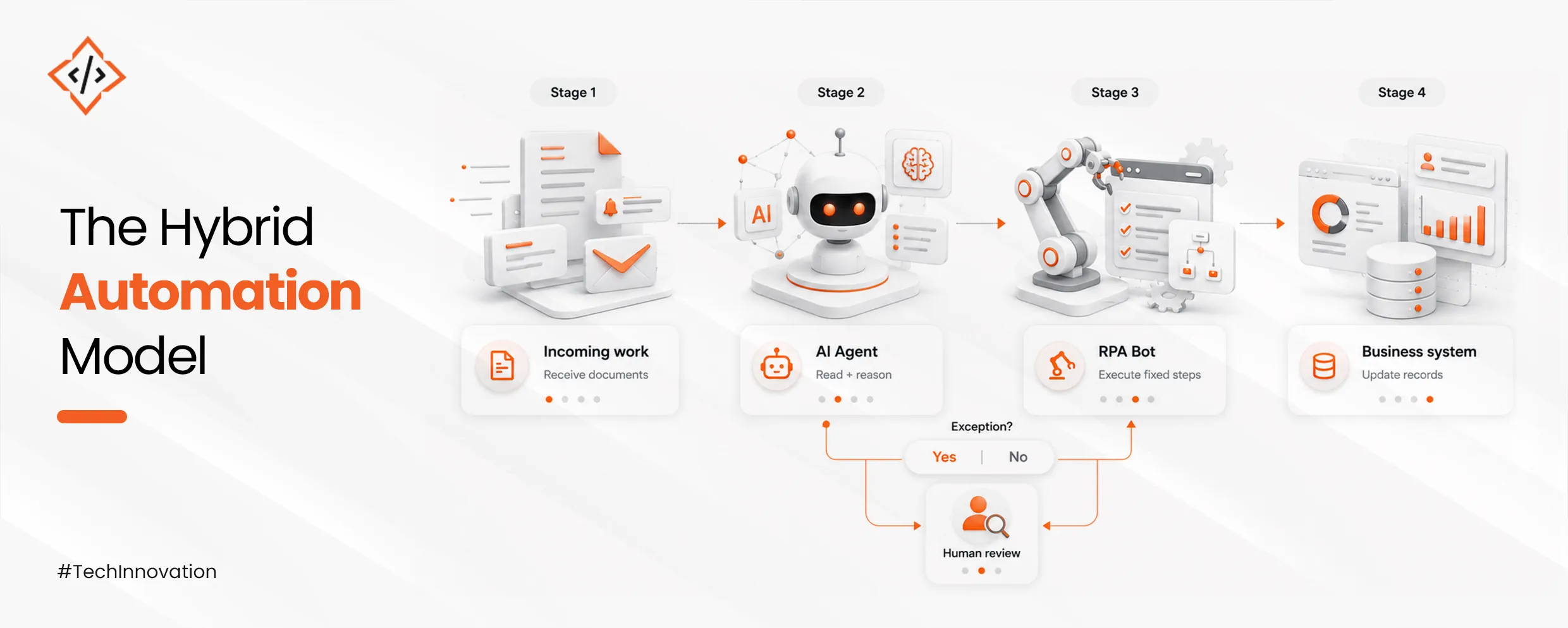
Choosing the best framework depends entirely on matching the cognitive demands of a workflow to the correct execution layer. Neither option wins everywhere. RPA wins on predictability while AI agents win on adaptability. A hybrid model wins when the business needs both scale and flexibility.
A rules-based framework dominates when an operational task remains completely stable over time. It delivers superior performance across fixed legacy systems and highly structured data models.
This layout operates with high repetition and demands zero human decision-making. Utilizing classic scripts in these static environments minimizes compute expenses while ensuring absolute algorithmic consistency across high-volume pipelines.
Advanced machine learning development structures become necessary when handling rapidly changing operational parameters. Intelligent systems process unstructured documents and execute complex cross-system work natively.
This architecture excels at judgment-heavy steps and exception-heavy workflows that stall traditional programs. Investing in custom AI agents shields corporate operations from high manual review costs when incoming data patterns fluctuate.
The most practical enterprise automation solutions connect both layers into a cohesive infrastructure. In a unified workflow, AI agents read, reason, and decide the appropriate path forward. Traditional software bots then receive the finalized data to execute the definitive terminal system actions. This balanced configuration prevents overspending on model tokens while maximizing overall digital transformation automation efficiency.
Balancing a corporate automation strategy requires evaluating full workflow lifecycle costs rather than upfront software licensing fees. RPA software remains the cost-effective choice for completely predictable tasks like data entry and fixed validation rules.
Turn to AI agents when manual exception handling and constant process changes become too expensive to maintain. Most growing enterprises do not need to replace their existing software infrastructure overnight.
The most profitable approach connects both technologies into a single unified business automation network. Software bots handle the terminal entry fields while intelligent components manage the initial reasoning steps.
CodeTrade provides specialized generative AI development services that combine stable script execution with custom AI agents. This balanced deployment setup optimizes your processing workflows without triggering unpredictable model inference fees.
 Chand Prakash
 Chand Prakash
 Chand Prakash
 Chand Prakash
 Chand Prakash