







AI
 Chand Prakash
11 September 2026
Chand Prakash
11 September 2026
Generative AI in Software Testing: Transforming QA and Test Automation
 Chand Prakash

Online shopping is moving beyond static search bars, fixed recommendation widgets, and generic product pages. Customers increasingly expect faster discovery, relevant suggestions, and answers that reflect what they are actually trying to buy. This is where generative AI in ecommerce is beginning to reshape both customer journeys and retail operations.
It can support conversational product discovery, improve catalog content, and make personalization more responsive to real-time intent. The commercial signal is becoming clearer as well. Adobe Analytics data reported by Reuters found that AI-referred U.S. retail visitors generated 53% more revenue per visit in May 2026 than non-AI traffic (Reuters).
However, AI in ecommerce creates value only when it connects with reliable product, customer, inventory, search, pricing, and transaction data. The real priority is building enterprise commerce solutions that reduce shopping friction and produce measurable business results.
Generative AI in ecommerce refers to using large language and multimodal models to understand shopper intent and create relevant responses. These systems can generate product copy, summaries, images, recommendations, and guided shopping interactions based on customer needs and context. They are useful when shoppers describe goals in natural language instead of searching with exact product terms.
Generative AI is not the same as every form of AI in ecommerce. Traditional recommendation and predictive models usually rank products, forecast demand, or estimate purchase likelihood from structured data. Mature ecommerce AI solutions combine these systems instead of asking one language model to handle every task.
For example, a shopping assistant can understand “running shoes for wet weather under $150” through an LLM. It should then retrieve suitable options from live catalog, inventory, search, and recommendation systems. This keeps the generative AI shopping experience relevant while grounding responses in current commerce data.
The strongest generative AI applications in ecommerce create value where shoppers face decision friction or teams handle repetitive content and service work. The goal is not adding AI everywhere. It is improving areas where better context, faster responses, or less manual effort can affect performance. For retailers, that makes value easier to connect with measurable customer and operational outcomes.
AI shopping assistants can move product discovery beyond exact keywords by understanding what a shopper is trying to solve. They can compare products against stated needs and summarize reviews or specifications. Follow-up questions can then narrow the options further.
McKinsey reported in 2026 that 63% of surveyed European consumers use AI tools to compare shopping options. Another 55% use them to learn about products. This behavior makes conversational discovery especially relevant for retailers with broad or complex catalogs.
AI personalization in ecommerce becomes more useful when it responds to current intent rather than relying only on past purchases. Systems can combine browsing behavior with customer history, product attributes, and conversational signals to shape recommendations.
This supports AI product recommendations, relevant bundles, dynamic discovery, and customer-specific messaging. Preference memory can add continuity when customers have given clear consent.
Generative AI for ecommerce also helps teams manage catalog content at scale without losing consistency across channels. It can draft product descriptions, complete missing attributes, support localization, and prepare product comparison summaries. It can also adapt merchandising copy for different categories or campaigns. Generated content still needs reliable product data and clear brand controls before publication.
AI ecommerce automation can continue after discovery by handling order questions, returns guidance, product support, policy queries, and response drafting. Unlike a basic FAQ chatbot, a connected system can use live order and policy data to resolve routine requests. It should also know when to escalate a case because information, authority, or human judgment is required.
The most valuable generative AI applications in ecommerce appear where shoppers struggle to decide or teams repeat high-volume work. These systems matter when they reduce search effort, improve product understanding, or make customer interactions more relevant.
The strongest AI ecommerce trends are therefore changing discovery, visibility, and the systems that support each purchase. For decision-makers, these shifts affect both customer acquisition and commerce architecture.
The generative AI shopping experience is moving from answering questions toward completing approved actions for the shopper. An assistant can compare products against several requirements, build a basket, monitor availability, or reorder routine purchases. It can also complete selected transaction steps when permissions and controls are clearly defined.
McKinsey estimates that 10% to 35% of ecommerce transactions could soon be initiated, influenced, or completed through AI-native experiences. This shift makes product data, transaction access, and clear action limits essential for retailers. It also changes what retailers must expose safely through APIs and product feeds.
Product discovery is also moving beyond typed queries. Shoppers can combine an image with natural-language instructions or search from a screenshot. Voice input can further narrow products by budget, size, use case, or preference. Multimodal systems can then compare visuals, specifications, reviews, and product descriptions within one interaction. Retailers therefore need product information that remains accurate across text, image, and voice-based discovery.
Product research increasingly begins inside external AI assistants rather than on a retailer’s search page. That changes how ecommerce visibility should be managed. Clear specifications, structured product data, consistent product identities, accurate pricing, and current availability become important inputs for AI-generated answers. Comparison content should also state meaningful differences clearly. This gives AI systems better information to interpret, reference, and recommend.
AI-powered ecommerce is moving beyond fixed segments toward experiences shaped by what a shopper needs during the current session. Systems can adjust recommendations, search results, bundles, product explanations, and merchandising messages as intent becomes clearer. A shopper researching gifts should not receive the same guidance as someone replacing a known product. AI personalization in ecommerce becomes more useful when current behavior guides the experience alongside trusted historical data.
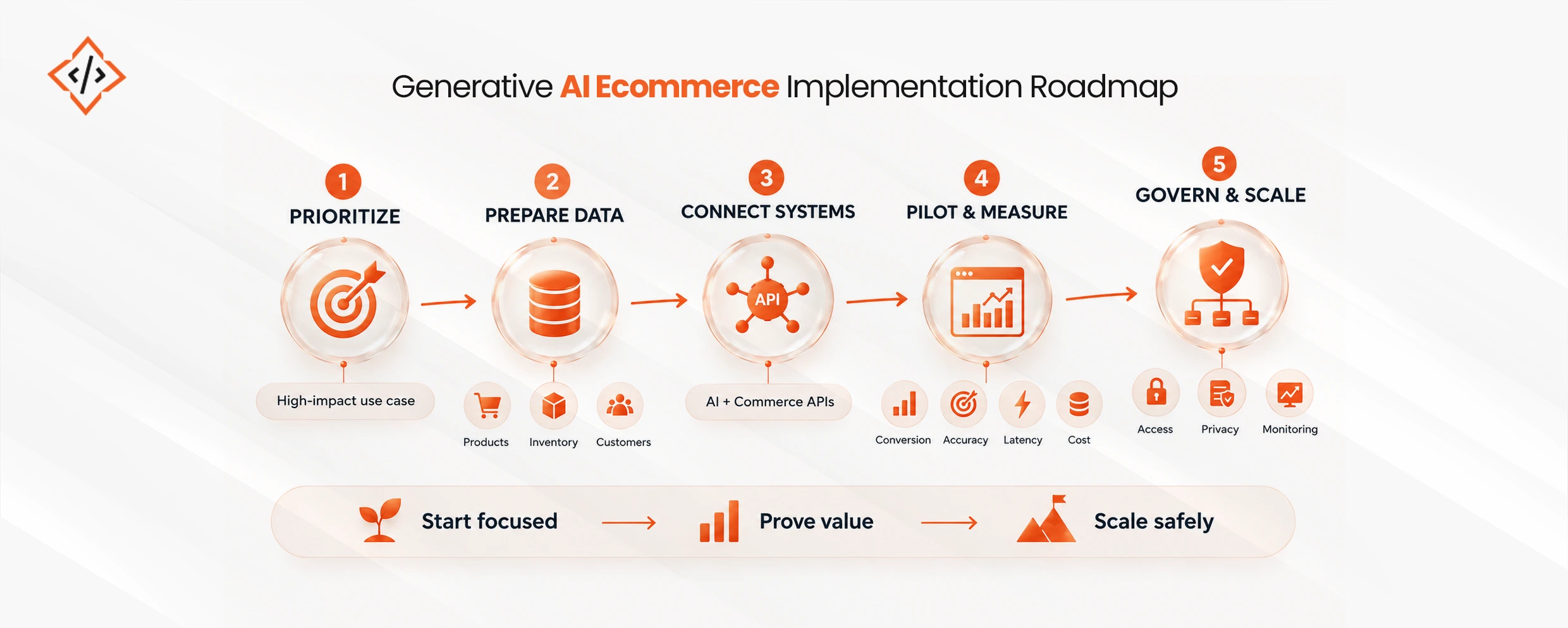
AI consulting services should start with a commercial problem, not with model selection. Teams need to define the outcome, identify the required data, and confirm which systems the AI must access. From there, the best approach is to test the smallest useful version before expanding scope. This keeps generative AI in ecommerce tied to measurable business value.
Start by comparing use cases against business impact, data readiness, integration effort, error tolerance, transaction frequency, and measurable return. A high-volume workflow with clear performance data is usually a stronger pilot than several disconnected experiments. Conversational product discovery, catalog enrichment, and support automation are practical starting points because their outcomes can be measured against existing benchmarks.
AI performance depends on the quality and freshness of the commerce data behind it. Product information, SKU attributes, pricing, inventory, customer profiles, orders, reviews, and store policies need consistent access and clear ownership. Consent rules also matter when customer data shapes responses. An assistant that recommends unavailable products or outdated prices can create more friction than it removes.
The architecture should separate language understanding from trusted commerce actions. A customer request can pass through an LLM or multimodal model before reaching search and retrieval systems. Those systems should connect with product data, customer records, and ecommerce APIs. Guardrails should control what the model can return or execute. Inventory checks, recommendations, and transactions should always use authoritative systems rather than generated knowledge.
Define success before the pilot goes live. Business metrics can include conversion rate, add-to-cart rate, revenue per visitor, average order value, search abandonment, and support resolution. Content teams may also track production time.
AI-specific measures should cover response accuracy, unsupported recommendations, latency, escalation rate, and cost per interaction. These measures show whether the system improves commerce performance rather than simply attracting usage.
A successful pilot needs stronger controls before it becomes a production system. Role-based access should limit which data and actions each workflow can use. Customer privacy, consent, model versions, and prompt changes also need clear ownership. Sensitive actions should include human review where the risk justifies it. Ongoing monitoring should track quality, cost, latency, and escalation patterns. Scaling AI in ecommerce depends on disciplined operating controls, not higher API volume.
Implementation usually fails when the AI experience is disconnected from reliable commerce data or given more authority than its controls can support. In ecommerce, even small errors can affect trust, conversion, and operating cost.
Reliable ecommerce AI solutions need accurate data, controlled permissions, and clear business metrics before they can scale safely.
The future of AI in ecommerce will depend less on isolated features and more on how well connected systems work together. The strongest systems will understand shopping intent, retrieve accurate commerce data, personalize decisions, and complete approved actions within the same journey. Businesses do not need to automate every customer interaction at once. A better starting point is one measurable use case supported by clean data and a clear business KPI.
That focused approach makes it easier to test accuracy, customer response, operating cost, and commercial impact before expanding the system. Once results are consistent, teams can extend generative AI in ecommerce across more products, channels, and customer workflows.
CodeTrade works across ecommerce software and AI development services, including recommendation engines, visual search, dynamic content, and inventory intelligence. Its ecommerce practice also covers platform development, systems integration, and long-term technical support. This combination helps retailers connect AI capabilities with the commerce systems required for dependable production use.
 Chand Prakash
 Chand Prakash
 Chand Prakash
 Chand Prakash
 Chand Prakash