







AI
Education & eLearning
 Chand Prakash
22 September 2026
Chand Prakash
22 September 2026
Future of Generative AI in Education: Use Cases and Trends
 Chand Prakash
The global generative AI in BFSI market size is projected to reach $2.62 billion in 2026. Financial institutions are definitively moving away from linear automation. Banks are now deploying generative models to handle highly complex reasoning tasks. These applications range from scanning long legal documents to analyzing real-time global market conditions.
Integrating generative AI into banking represents a fundamental shift in operational strategy. Organizations that rely solely on static software tools risk falling behind rapidly evolving compliance standards. A 2026 Fortune Business Insights report projects the fraud detection segment alone will capture 42.92% of this market share.
Technical leaders use AI in banking to process massive datasets and uncover hidden operational vulnerabilities instantly. Consequently, executives are rethinking how their enterprise teams function daily, often seeking specialized generative AI development services to build secure environments. This guide breaks down the most effective generative AI banking use cases. It also details the direct financial benefits institutions gain by adopting them.
Generative AI banking use cases center around high-volume knowledge work. The technology specifically handles fraud identification, complex document processing, and customer advisory services. Financial institutions no longer rely on rigid rule-based systems. They now deploy intelligent models to perform advanced analytical tasks.
This shift fundamentally optimizes back-office operations and customer-facing interactions. Enterprise leaders prioritize these deployments to maximize operational efficiency. Integrating generative AI use cases in banking provides measurable return on investment.
Technical teams focus on structural implementations rather than isolated experimental pilots. This strategic approach ensures long-term operational resilience. It also allows financial institutions to adapt quickly to changing market conditions.
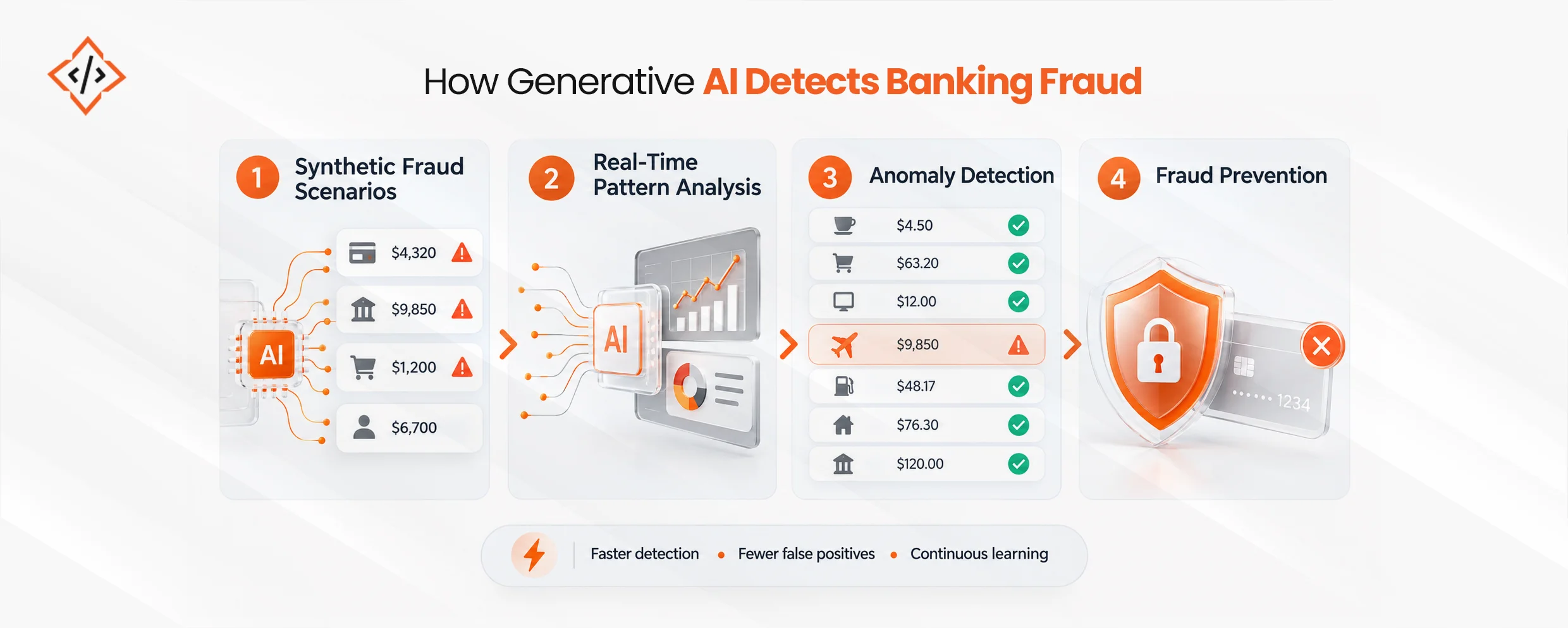
AI fraud detection in banking proactively identifies threats by generating synthetic datasets. This process simulates rare fraud scenarios to train detection models continuously, representing a core application of machine learning development. Mastercard recently launched a generative AI model to combat evolving cyber threats. This deployment boosts fraud detection rates by 20 percent across its network.
The system achieves this by analyzing massive transaction patterns in real time. It automatically flags anomalies instantly before any funds leave a customer account. This predictive capability prevents financial losses and reduces false positive alerts. Security teams use these insights to strengthen their entire operational perimeter. Consequently, customer trust in the digital infrastructure grows stronger.
AI banking applications replace static FAQ bots with highly capable virtual experts. Organizations train these intelligent assistants on complex proprietary policies. This targeted training allows the system to resolve intricate client disputes instantly. The technology synthesizes long documents containing unstructured information to deliver deep technical support.
By providing accurate answers immediately, these banking AI solutions drastically reduce human escalation rates. Customer satisfaction increases while operational contact center costs drop significantly. Support staff can then transition to handling high-value relationship management tasks. This structural change improves the overall client experience dramatically. Clients receive accurate financial guidance precisely when they need it most.
Generative AI for banks acts as a highly personalized research assistant for portfolio managers. Morgan Stanley currently uses an internal GPT-4 chatbot to assist over 16,000 financial advisors. This secure tool helps them quickly find answers from a massive internal knowledge base.
The AI platform seamlessly combines semantic search with dynamic content creation. Advisors can then tailor highly specific financial information for any client instantly. This eliminates hours of manual research and improves client engagement.
Portfolio managers deliver precise market insights exactly when clients request them. This operational speed provides a massive competitive advantage in fast-paced financial markets.
Generative AI financial services extract unstructured data directly from tax returns and bank statements. This capability fully automates the initial stages of credit decisioning. The technology accurately assesses borrower risk by summarizing complex financial histories in seconds. This rapid data processing drastically reduces the time required for loan approvals.
Underwriters receive a clear risk profile immediately rather than spending days reviewing paperwork. Financial institutions can scale their lending operations rapidly without increasing administrative headcount. This efficiency, driven by custom AI automation services, creates a frictionless borrowing experience for the end consumer. Faster loan processing directly translates into higher revenue generation for the bank.
Advanced generative AI in financial services automates the entire regulatory compliance lifecycle. The system scans thousands of daily transactions against constantly evolving global regulations. The model instantly flags potential compliance violations for immediate review. It then automatically drafts the necessary regulatory reporting documents for human oversight.
This proactive approach minimizes manual auditing errors and reduces the risk of costly fines. Compliance teams can finally focus on strategic governance rather than routine document sorting. AI automation in banking ensures institutions remain compliant across multiple complex jurisdictions simultaneously. This constant monitoring protects the financial organization’s core reputation.
Investing in generative AI for banks yields a direct reduction in operational overhead and significantly faster technology deployment cycles. Financial institutions operate in high-margin environments where friction directly degrades profitability. Traditional core systems struggle to keep pace with modern transaction volumes and evolving consumer expectations.
By embedding generative intelligence into daily workflows, banks transform static cost centers into agile operational hubs. This shift creates measurable value across both back-office operations and customer-facing channels.
The tangible benefits of generative AI in banking extend far beyond simple labor automation. Institutions gain unprecedented speed, structural resilience, and sharper competitive differentiation. Decision-makers must view this investment as foundational enterprise infrastructure.
Generative AI significantly cuts the heavy costs tied to routine back-office operations. Legacy processes historically demand immense manual effort for data entry and basic documentation tasks. By automating routine administrative workflows, banks free staff to handle complex high-margin client advisory roles.
Internal reporting cycles that once took days now complete in minutes. This shift lowers overhead costs while boosting employee output. Financial institutions handle rising account volumes without increasing their operational headcount. The bottom line improves through leaner staffing models and reduced human error rates.
Banks deploy generative models to generate clean application code directly from plain natural language. This development support allows engineering teams to build software features faster. The technology actively streamlines the migration of brittle legacy core systems. This architectural modernization lowers long-term technical debt and stability risks.
Engineering teams utilizing Custom AI development launch new digital banking products ahead of competing fintech offerings. Consequently, financial institutions respond rapidly to evolving consumer needs and regulatory updates. Faster deployment cycles turn slow IT departments into high-velocity engines.
Precision strategies must evolve from broad demographic grouping to dynamic, real-time customer personalization. Generative systems evaluate individual spending habits to produce bespoke financial product recommendations instantly. Leading banks using automated marketing decisioning models increase customer engagement by 20 to 30 percentage points.
The AI models draft tailored communication that reflects the exact financial situation of each depositor. This relevant messaging replaces generic mass promotions that modern banking customers routinely ignore. Tailored interactions build genuine client loyalty and drive sustainable deposit growth.
Generative models learn continuously from incoming traffic to identify sophisticated cyber threats in real time. Rather than relying on rigid firewall rules, these systems simulate realistic cyberattacks to stress test network resilience. Security teams uncover hidden system vulnerabilities before malicious actors can exploit them.
Technology detects fraudulent transaction patterns and unauthorized access attempts instantly. This proactive defensive posture protects proprietary banking data and customer assets from advanced breaches. Maintaining impenetrable digital security protects brand reputation and avoids catastrophic regulatory penalties.
Generative AI in banking helps institutions evaluate credit and market risks by analyzing massive data pools simultaneously. These advanced models read global news feeds and financial disclosures to forecast potential default scenarios. Risk managers receive proactive alerts about portfolio vulnerabilities long before traditional quarterly reporting catches them.
This speed ensures capital reserves stay aligned with market volatility. Lending committees make accurate, well-informed credit decisions based on comprehensive risk visibility. Rapid risk assessment protects the bank from unexpected balance sheet shocks.
The future of generative AI in banking will definitively shift from isolated pilot programs to enterprise-wide infrastructure. Financial leaders exploring Generative AI in Fintech can no longer afford to treat artificial intelligence as a simple experimental tool. A July 2026 Gartner report projects worldwide end-user spending on AI platforms and models will grow 63.4 percent. This massive global investment is expected to reach $64 billion by 2026.
Banks must now focus on high-velocity execution to match the rapid pace of continuous AI development. The overarching strategy is moving toward a highly efficient machine-first operational model. Robust banking AI solutions will manage all routine cognitive tasks and initial data processing.
Human professionals will provide critical oversight to ensure strict governance and regulatory compliance. This calculated approach ensures financial institutions maintain extreme operational agility. Ultimately, scaling these systems safely defines the complete future of generative AI in banking.
Generative AI in financial services is no longer an experimental technology. It is a fundamental requirement for maintaining a sustained competitive advantage. Financial institutions that adopt AI automation in banking operate with leaner back offices and highly resilient operational frameworks. The immediate priority for technical leadership is auditing legacy workflows to pinpoint high-yield deployment areas.
Bridging the gap between conceptual architecture and a live production environment requires careful systems engineering. Without robust data governance and expert AI consulting services, even well-funded digital initiatives struggle to deliver measurable financial value.
CodeTrade builds enterprise-grade banking AI solutions designed specifically for high-security financial environments. The team engineers scalable infrastructure that integrates cleanly with legacy core banking platforms. Partner with technical specialists who understand how to translate complex AI models into dependable production systems.
 Chand Prakash
 Chand Prakash
 Chand Prakash
 Chand Prakash
 Chand Prakash