







AI
 Chand Prakash
11 September 2026
Chand Prakash
11 September 2026
Generative AI in Software Testing: Transforming QA and Test Automation
 Chand Prakash
Mid-market and enterprise teams are no longer asking whether artificial intelligence can support corporate operations.
Policymakers are now identifying which specific operational workflows can be safely delegated to independent software networks. True business value emerges when these tools integrate deeply with internal databases, strict permissions, and measurable financial outcomes.
According to a Gartner research study, forty percent of enterprise applications will feature task-specific AI agents by the end of 2026. This rapid technological shift forces corporate technology leaders to transition immediately from basic conversational chatbots to specialized business process automation. Deploying tailored software infrastructure through custom AI agent development services enables companies to automate multi-step execution paths without security risks. This complete guide to custom AI software development provides engineering executives with an actionable framework to design, integrate, and govern secure corporate agent networks.
An AI agent is worth building when it removes repeated manual effort from a workflow affecting cost, speed, or accuracy. Effective custom AI agent development always begins with explicit business value rather than immediate model selection.
Core operational tasks must occur frequently enough to justify engineering deployment. High-frequency activities ensure that enterprise AI solutions provide compounding efficiency gains.
The targeted business process automation must follow predictable operational rules, structured decisions, and clear exception parameters.
The software node requires deep access to internal documentation, local records, or system databases to function effectively.
Management tracks final outcomes through time saved, reduced overhead, or avoided execution errors to prove the long-term ROI of AI agents.
Enterprises should choose custom AI agent development when off-the-shelf AI tools cannot handle their internal systems, process rules, data sensitivity, or governance requirements. Custom solutions mean designing the tool around how the company actually operates instead of overbuilding arbitrary technical features.
The operational workflow touches multiple platform spaces simultaneously, including corporate ERP software, customer CRMs, localized helpdesks, and legacy databases. Specialized AI agent solutions bridge these disconnected channels smoothly.
The software node manages confidential enterprise records, customer metrics, financial accounting, legal contracts, human resources, or operational data pipelines. Whether configuring a HIPAA compliant AI agent healthcare platform or a secure private infrastructure, proprietary enterprise AI solutions safeguard this intellectual property within private boundaries.
The targeted operational pipeline presents too many complex edge cases for traditional, fixed rule-based automation engines. When analyzing agentic AI vs RPA capabilities, dynamic AI workflow automation handles these shifting variations effectively.
Critical transactional actions demand structural human review before final systemic execution occurs. Experienced AI implementation services deploy secure authorization checkpoints directly into the agent architecture.
The strongest initial workflows are not futuristic experiments. They are the standard pipelines where teams lose valuable time every week. Custom AI automation works best when the target process is frequent, rule-supported, and connected directly to core business systems.
Custom software nodes handle outbound lead qualification, instant CRM database updates, customized proposal support, detailed target account research, and structured sales follow-ups. Deploying targeted AI agents for business removes routine administrative blocks from your front-line revenue teams.
Automated workflows manage complex ticket routing, case summaries, instant refund checks, customer history retrieval, and comprehensive escalation preparation before human agents step in. This deployment ensures faster resolution times across standard corporate service channels.
Intelligent systems execute automated invoice matching, secure vendor background checks, employee expense reviews, payment follow-ups, and baseline financial reporting support. These specialized AI automation services prevent costly accounting errors across enterprise departments.
Software assistants automate daily access requests, incident triage pipelines, internal knowledge base answers, and repetitive service desk automation tasks. This systemic approach optimizes internal resource distribution across mid-market technical teams.
Autonomous agents oversee order verification checks, live shipment status updates, warehouse coordination metrics, and proactive operational exception alerts. Integrating specialized AI agents for logistics pipelines helps companies build highly resilient supply networks without expanding back-office operational headcount. Integrating deep AI workflow automation helps companies build highly resilient logistics networks without expanding back-office operational headcount. This structural shift transitions legacy corporate models into modern business process automation.
Custom AI agents must be designed from the workflow backward instead of starting from the model forward. Deciding between open-source vs proprietary AI models matters less than establishing a strategic design that defines exactly what the system owns, what data it accesses, what actions it can execute, and when it must stop.
Architects must outline the precise scope of work the software node handles. Setting rigid boundaries ensures that custom AI agent development remains focused on specific execution parameters rather than broad contextual tasks.
Engineering teams must map every corporate document, database, and system trigger the node requires. Connecting these endpoints enables the tool to process real-time information accurately without manual compilation gaps.
Management must establish whether the system can suggest options, prepare drafts, modify records, escalate tickets, or execute final actions. According to a study by McKinsey, defining clear operational autonomy levels allows enterprises to scale generative AI development safely across core business units.
High-impact decisions require mandatory human-in-the-loop validation gates before final systemic changes occur. Experienced AI copilots for business utilize these checkpoints to protect data integrity and manage compliance risks within legacy platforms.
Performance tracking focuses heavily on speed improvements, reduction in error rates, transactional throughput, and final user adoption metrics. Clear measurement frameworks demonstrate clear financial returns for companies utilizing specialized AI-powered workflow automation.
Reliable AI agent solutions need more than a language model. They need a controlled architecture for data, tools, permissions, validation, and monitoring.
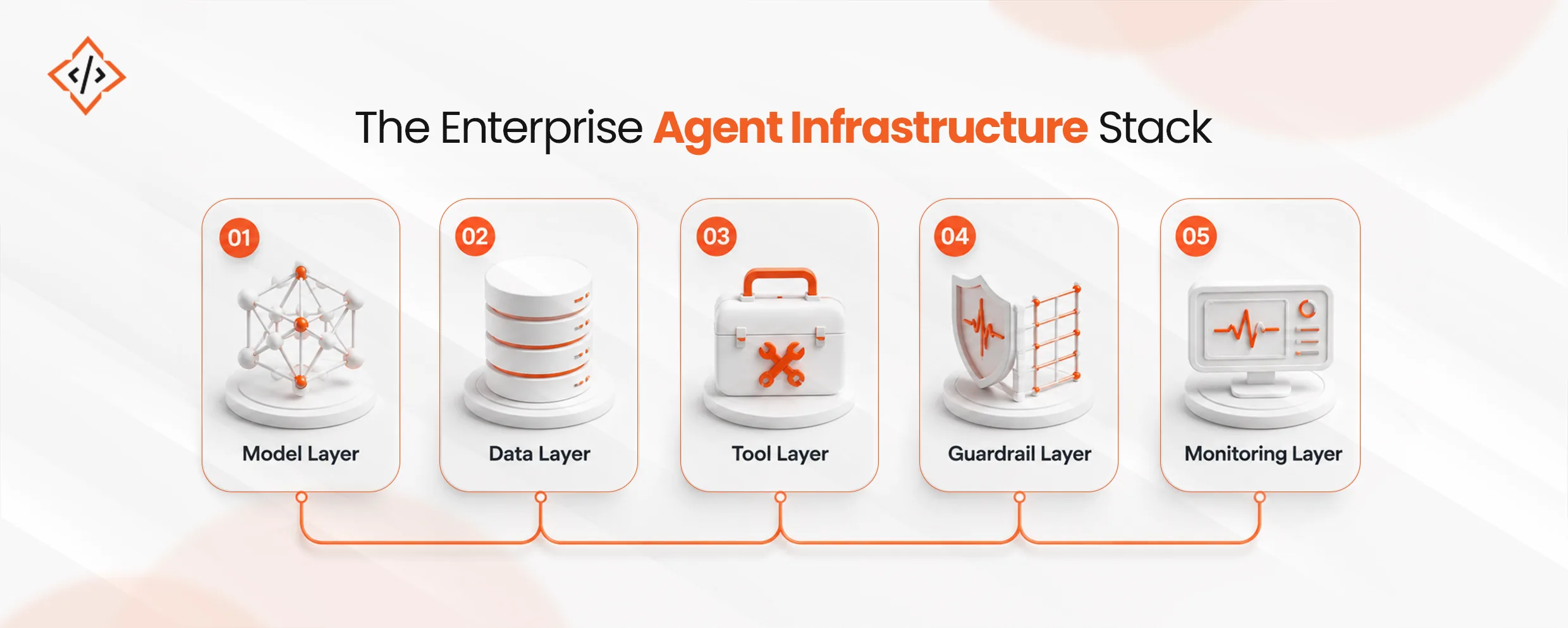
The core reasoning foundation executes contextual task processing and strategic problem solving. Selecting the best AI agent framework 2026 architecture allows this foundational engine to process complex corporate requests and determine appropriate execution sequences. This setup guarantees logical stability during complex business processing.
Internal knowledge bases, unstructured business documents, databases, and semantic retrieval systems feed secure data to the running model. According to Gartner, poor data quality stops thirty percent of generative AI projects from moving past proof of concept stages. Clean information architecture guarantees accurate output generation.
Approved APIs and custom software integrations connect the assistant to ERP records, CRM data, and helpdesk systems. These active connections allow the software node to update live records automatically. This technical layer replaces tedious manual information updates across departments.
Systemic operational boundaries govern user permissions, restrict unsafe actions, require manager verification, and activate clear fallback processing paths. These security layers prevent data corruption across legacy corporate platforms. Enterprises maintain complete control over automated execution steps.
Engineering teams track systemic precision, failed processing attempts, model latency, token costs, and detailed audit logs. Clear evaluation dashboards ensure long-term visibility into corporate workflow health metrics. Supervisors quickly identify technical bottlenecks before errors cascade.
AI copilots for business are often the first step toward AI-powered workflow automation, but they are not the final stage. While generative AI development establishes the baseline intelligence, dedicated AI implementation services turn that foundation into measurable, workflow-level corporate value.
The software assistant summarizes complex case histories, drafts operational communications, searches unstructured internal documents, and recommends appropriate resolutions to human workers. This level improves individual worker efficiency but still relies heavily on manual prompts to complete everyday tasks.
The system updates system records, generates structured tasks, verifies data accuracy across endpoints, and prepares multi-step operational paths. This transition allows custom AI automation to interact directly to internal databases, minimizing manual data management loops.
The architecture enforces strict role-based permissions, logs system actions, and escalates complex exceptions to managers immediately. This structural enforcement guarantees total compliance security during complex business process automation initiatives across multiple enterprise departments.
Risk should be controlled before the agent enters a live workflow, not after mistakes appear. The biggest hazard stems from unclear authority. If an operational node acts without defined limits, small processing errors quickly corrupt customer, financial, or operational systems. According to Gartner, forty percent of agent initiatives will fail by 2027 due to weak policy controls.
Engineers must restrict what the node reads, writes, or updates. Limiting data access contains localized model anomalies.
Managers must require manual verification for vendor payments or compliance choices. Deploying specific protocols, such as AI agents for banking compliance audits, requires these strict policy validation checkpoints.
The platform logs every decision, system source, and engineering escalation. Unalterable records preserve absolute system transparency.
Developers define exactly when the node must stop, retry, or alert a person. Graceful degradation protects core corporate pipelines.
AI agent development services should cover the full path from use-case validation to deployment, integration, governance, and optimization. To know how to choose an AI implementation partner, enterprise technology buyers must evaluate vendor capabilities based on a comprehensive engineering lifecycle rather than simple model configuration.
Engineers confirm whether the targeted corporate pipeline is ready for an autonomous agent. A reliable AI agent development company filters workflows based on data availability and clear process repeatability.
Architects document every operational decision, internal software system, team handoff, and manager approval checkpoint. This structural map prevents logical gaps during execution.
Developers construct the core reasoning parameters, multi-agent orchestration paths, specialized tool attachments, data retrieval frameworks, and live system actions. This phase forms the technical core of custom AI agent development services.
Technical teams securely connect the active node with existing corporate ERP suites, customer CRMs, isolated databases, internal helpdesk software, and production communication interfaces.
Supervisors continuously monitor production precision metrics, transactional execution costs, employee feedback logs, and task accuracy curves. Ongoing refinement maintains elite performance levels for your custom AI automation assets.
ROI should be measured at the workflow level, not the model level. Technology executives secure definitive operational proof by tracking concrete systemic improvements rather than speculative technological benchmarks.
Management monitors the direct reduction in task handling duration or broader process cycle times. Shorter execution loops across the AI implementation timeline validate the efficiency of deployed AI agent solutions.
Enterprises track diminished manual engineering labor, fewer data rework cycles, and decreased departmental coordination efforts. This fiscal decline proves the financial value of targeted custom AI automation.
Operations teams calculate the drop in missed execution steps, incorrect data inputs, and structural compliance gaps. Eliminating these errors protects vital data across corporate systems.
Supervisors observe whether internal departments actively utilize and trust the automated workflows during daily operations. High user retention proves that specialized AI-powered workflow automation has successfully integrated into corporate culture.
Teams should start with one target workflow where business value is clear, risk is manageable, and outcomes are verified quickly to offset the typical AI project failure rate. Managing the initial AI agent development cost becomes simple when enterprises avoid disconnected AI pilots that stall during proof-of-concept stages.
Modern operations require tailored software infrastructure that fits existing enterprise systems, follows corporate rules, and improves how daily work gets done. CodeTrade acts as a dedicated engineering partner, providing premium Custom AI Agent Development Services to transform complex pipelines into scalable assets.
The engineering firm designs secure Enterprise AI solutions built specifically around your governance models. This architectural focus allows mid-market organizations to launch dependable AI-powered workflow automation that scales operational capacity with absolute precision.
 Chand Prakash
 Chand Prakash
 Chand Prakash
 Chand Prakash
 Chand Prakash