







AI
FinTech & Banking
 Chand Prakash
22 September 2026
Chand Prakash
22 September 2026
Generative AI in Banking Key Use Cases & Benefits
 Chand Prakash
Generative AI in education is moving from an optional study aid into systems that support teaching, learning, and academic operations. Its role now extends beyond essay drafting and basic question answering. Schools and universities are exploring custom eLearning development services that support tutoring, lesson adaptation, feedback, accessibility, and routine faculty tasks. Adoption is already widespread.
Stanford’s 2026 AI Index reports that over 80% of U.S. high school and college students now use AI for schoolwork. (Stanford HAI) The next shift matters more than rising usage. Institutions are moving toward education-specific systems that can use curriculum context, student progress data, and clear institutional controls. This changes the conversation around AI in education from simple tool access to purposeful implementation.
The future of generative AI in education will depend on where it improves learning outcomes. It will also depend on how generative AI trends in education reshape teaching, assessment, and digital learning systems.
The most valuable AI use cases in education improve learning support while keeping educators involved in decisions that require professional judgment. Generative systems can adapt content, guide students, and reduce repetitive work across teaching and academic operations.
Generative AI can adjust explanations, examples, exercises, and difficulty based on how each student performs over time. Instead of making one recommendation, the system can create the next activity after identifying a specific mastery gap.
Curriculum grounding keeps these changes aligned with course objectives, approved material, and learning outcomes defined by educators. This makes personalization an ongoing process rather than a fixed learning recommendation.
AI tutors can provide round-the-clock help with questions, revision, concept explanations, and guided problem-solving. The stronger approach uses Socratic guidance, where students receive prompts and hints before seeing a complete answer.
Course-specific tutors can also draw from approved textbooks, lecture notes, and institutional resources instead of unrestricted web content. This gives students relevant support without separating tutoring from the curriculum they are expected to follow.
Teacher-facing tools can support lesson drafts, differentiated worksheets, quiz creation, parent communication, and content adaptation for different learner levels. Evidence already shows where this support can reduce workload.
In 2025, Gallup found that 60% of U.S. public K-12 teachers used AI for work. Weekly users estimated average time savings of 5.9 hours per week. The value lies in giving educators more time for planning, feedback, and direct student support.
Generative AI applications in education can make formative assessment faster and more responsive to recent learning. Systems can create short quizzes, provide rubric-linked first-pass feedback, and detect recurring concept gaps across assignments.
They can then recommend focused revision exercises based on those gaps. High-stakes grading still requires teacher validation because context, judgment, and academic standards should remain under educator oversight.
AI-powered education can present the same concept through text, diagrams, audio, video explanations, or interactive examples. This gives instructional teams more ways to match content with the learner, subject, and learning objective.
A difficult science process may need a diagram, while language practice may work better through audio and guided conversation. The format can change without changing the intended learning outcome.
Generative AI for education can make course material easier to access across languages, locations, and different learning needs. It can support real-time translation, captioning, transcription, simplified explanations, text-to-speech, and speech-to-text.
It can also create alternative descriptions and formats when standard material is difficult to use. The goal is not separate content for different learners. It is broader access to the same curriculum and learning outcomes.
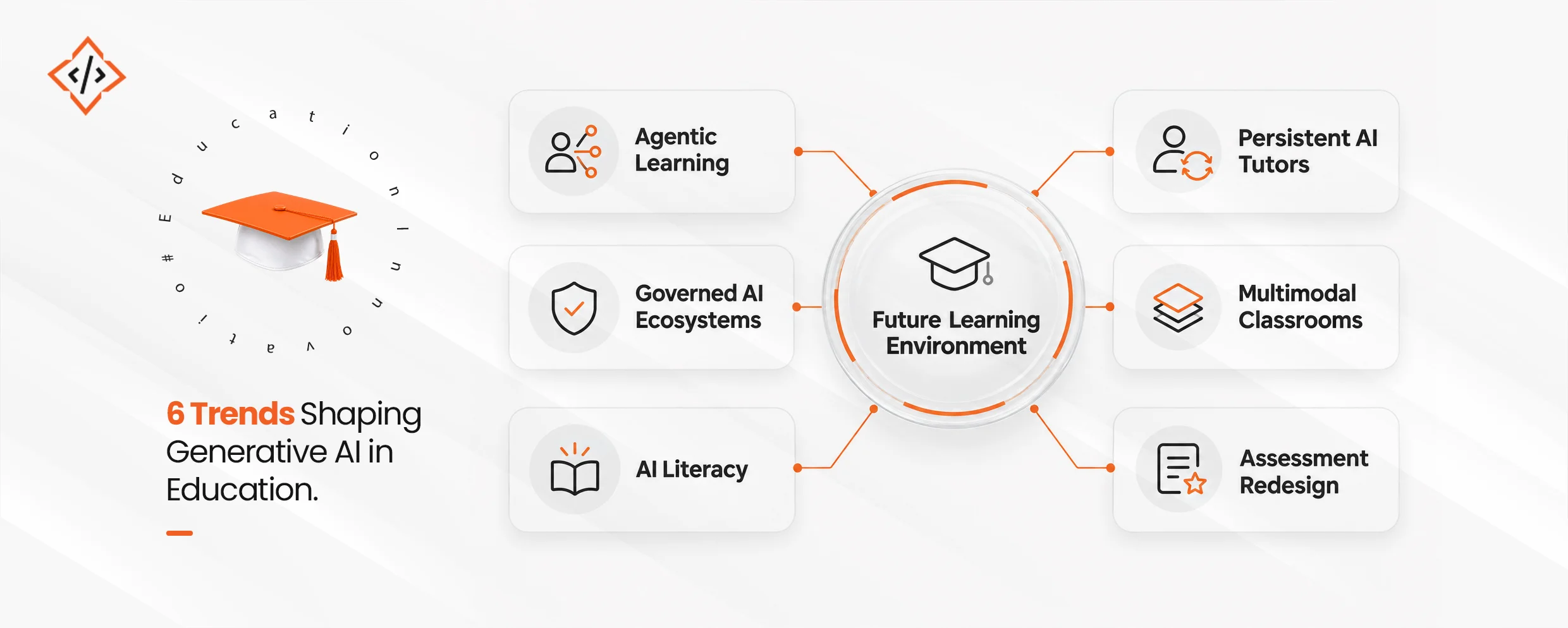
The next phase of generative AI trends in education will be shaped by larger or faster language models. AI development services can help institutions build systems that retain context, take controlled actions, work across formats, and follow institutional rules. These changes will move AI from isolated tools toward a more structured role in teaching and learning.
Agentic systems can move beyond answering prompts and manage connected learning tasks from start to finish. An education agent could spot a knowledge gap, select approved material, create practice questions, and review the learner’s progress.
It could then adjust the next activity without restarting the process. Teacher-defined rules should still decide which actions can run independently and which require review.
AI tutors are likely to become more useful when they understand a learner across an entire course. They could remember topics already covered, recurring knowledge gaps, learning goals, preferred formats, and progress over time.
That context can make support more relevant than a one-session chatbot. However, persistent personalization also requires clear policies for student consent, data access, and retention.
AI education technology trends are moving toward learning experiences that combine text, speech, images, documents, diagrams, and interactive media. A student could discuss a diagram aloud or upload an experiment result for guided analysis.
AI could respond in the format best suited to the task. This makes multimodal systems part of everyday learning design rather than a separate technology layer.
Assessment will need to measure more than a student’s ability to produce a polished final answer. Institutions are likely to place greater weight on reasoning, oral defence, project work, classroom application, iterative drafts, and AI-use disclosure. In 2025, HEPI reported that 88% of surveyed UK undergraduates had used generative AI for assessments. Assessment design therefore needs to reflect how students actually work with these tools.
AI literacy will increasingly become a taught capability rather than an assumed digital skill. Students need to learn how to evaluate outputs, write useful prompts, verify claims, recognise bias, and understand model limits. Stanford’s 2025 AI Index found that 81% of surveyed U.S. computer science teachers supported foundational AI learning. Yet fewer than half felt equipped to teach it. This gap makes teacher preparation as important as student access.
Generative AI in education is also moving from individually chosen tools toward institution-managed systems. Schools and universities will need approved models, privacy controls, LMS or Odoo Education ERP integration, output monitoring, and clear acceptable-use policies. California State University showed the scale of this shift in 2025. Its ChatGPT Edu rollout covered about 500,000 students and faculty across 23 campuses. The future of AI in education will depend increasingly on governance as well as model capability.
The future of generative AI in education is likely to be AI-assisted rather than fully automated. Today, students and teachers mainly use standalone tools for drafting, tutoring, research, and lesson preparation. The next phase will connect AI with curricula, learning management systems, institutional knowledge, and individual progress data. This connection will make responses more relevant to each course and learner.
Over time, these systems will become more proactive, multimodal, and capable of managing several learning steps. They may recommend content, create practice tasks, track progress, and adjust support as students move through a course. Educators should still remain responsible for learning design, assessment, and decisions that affect academic outcomes.
UNESCO’s 2025 work on AI and education supports this human-centred direction. It highlights opportunities for personalized learning and wider access while warning about privacy, safety, inequality, and weak governance. The benefits of generative AI in education will therefore depend on more than model capability.
Strong results will require reliable educational content, sound pedagogy, clear teacher oversight, and safeguards for student data. Institutions need these foundations before AI can become a dependable part of learning. It should support educators rather than substitute for them.
Generative AI is moving from an optional productivity tool into the technology that supports how education is designed, delivered, and improved. The strongest institutions will not succeed by simply adding more AI tools. They will define where AI improves learning and where teacher judgment remains essential.
Student data and academic integrity must also stay protected. Generative AI applications will become more personalized and contextual as systems gain stronger curriculum awareness and multimodal capabilities. Teachers will still own pedagogy, human interaction, assessment standards, and decisions that require professional judgment.
The future of generative AI in education will depend on how thoughtfully these capabilities fit into real learning environments. Institutions and EdTech teams need systems that support learning goals, existing platforms, governance requirements, and day-to-day academic workflows.
CodeTrade combines generative AI development, AI consulting services, and Open edX capabilities for education and eLearning environments. Its teams build domain-specific assistants, RAG systems, and AI agents that can connect with existing digital platforms. This approach helps education teams move from use-case validation to practical implementation with the right technical controls.
 Chand Prakash
 Chand Prakash
 Chand Prakash
 Chand Prakash
 Chand Prakash