






AI
ERP
 Chand Prakash
05 October 2026
Chand Prakash
05 October 2026
What Are The Top 10 Agentic AI ERP Systems And Autonomous Solutions?
 Chand Prakash
Count the agents in your next Multi-Modal AI System architecture diagram. Then count how many actually make decisions that change subsequent actions. That second number usually stops at one or two. The remaining components merely transform or summarize data. A simple tool call handles those tasks perfectly without demanding complex multi-agent orchestration.
Every unnecessary agent introduces a risky system handoff. Handoffs cause dropped context fields and silent error compounding. One central agent equipped with five tools often performs the exact same job safely. This reality does not invalidate multi-agent architecture entirely. It simply argues for adopting AI agent orchestration deliberately rather than by default.
Multiple agents genuinely help when enterprise workflows span isolated domains requiring strict guardrails. They also excel when specific steps run parallel across independent data. This guide covers four specific AI orchestration patterns that actually survive production environments.
It explores exactly how to choose between them and avoid catastrophic multi-agent failure modes. Teams needing single-agent design guidance should consult the Odoo AI agent architecture guide first.
Four specific conditions justify architectural separation. Meeting fewer than two means a single agent remains the better system choice.
Engineering teams need better tools rather than more agents if none of these conditions apply.
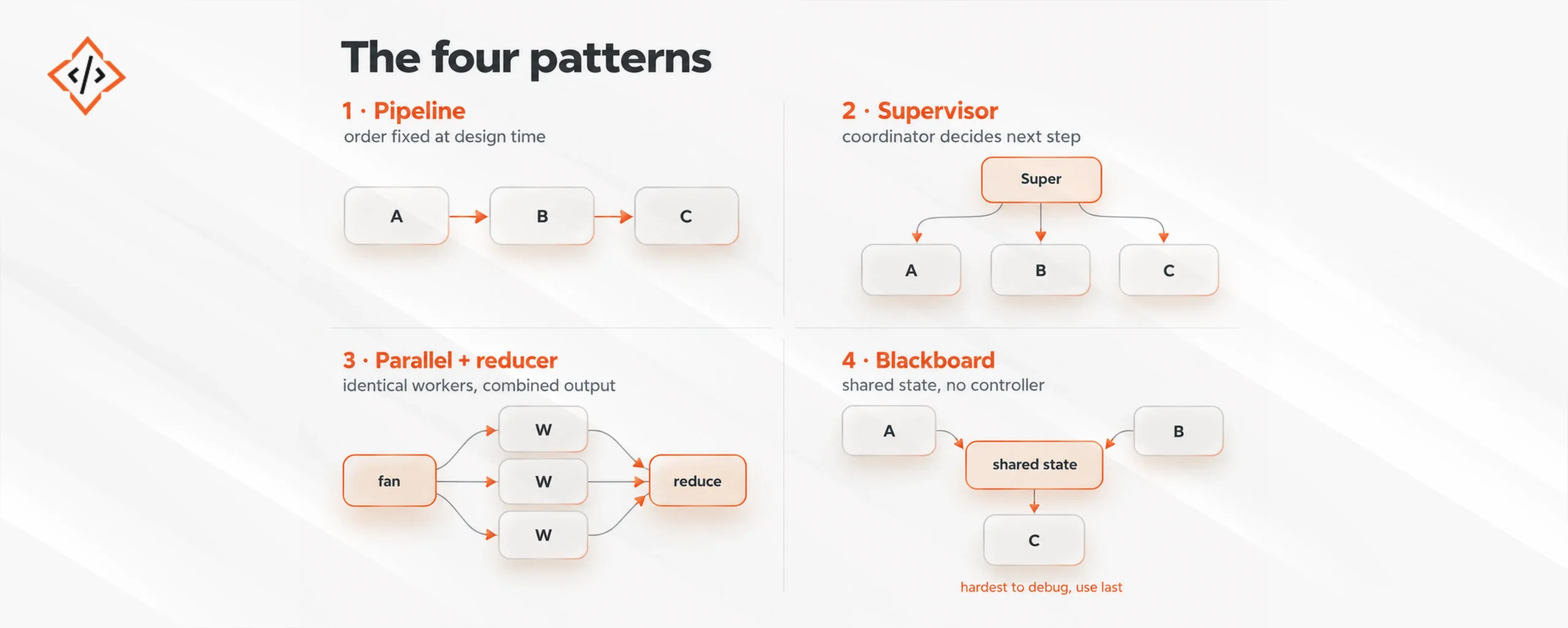
These four multi-agent orchestration patterns are ordered by their freedom to decide internal control flows.
Agents execute a fixed sequence decided entirely at design time. Each agent transforms the direct output of the previous step.
This works best for document processing and strict validation chains. It offers predictable costs and trivial traceability across agentic AI workflows. Teams can test it easily stage by stage.
Rigidity remains its primary limitation. Pipelines cannot skip steps or revisit earlier actions. Workflows requiring real branching quickly become tangled conditionals.
A central coordinating agent decides which specialist to invoke next. It evaluates returned data and determines if execution should continue.
Supervisor agent architecture fits workflows spanning multiple domains where input dictates the sequence. Complex customer requests needing distinct technical or billing investigations fit perfectly here.
The supervisor quickly becomes a vulnerable single point of quality. Misjudging which specialist to call produces confident wrong answers through healthy specialists. Supervisors require the tightest technical evaluation possible.
A single dispatcher fans identical tasks across multiple workers. A dedicated reducer then intelligently combines all returned results.
Parallel agent architecture handles genuine map-reduce shapes perfectly. It reviews massive contract backlogs and generates candidate options efficiently. Overall latency matches the slowest single item rather than the sum.
Quality is strictly won or lost at the reducer stage. Naive concatenation completely wastes this specific pattern. A reducer that genuinely deduplicates and resolves contradictions performs the actual work.
Agents continuously read from and write to a shared state. They act only when the state requires their specific contribution without central control.
This suits open-ended investigations where useful sequences remain entirely unpredictable. It remains the hardest multi-agent system design to debug or bound properly. It is highly prone to infinite loops.
Engineering teams should implement this pattern last. It requires strict hard limits on total iterations and maximum API spend.
Selecting the correct orchestration pattern directly prevents catastrophic failures and controls costs across your enterprise AI systems.
| Pattern | Control Flow Decided By | Cost Predictability | Traceability | Reach For It When |
|---|---|---|---|---|
| Pipeline | Design time | High | High | Stages are known and stable |
| Supervisor | Coordinator at runtime | Moderate | Moderate | Sequence depends on input |
| Parallel + reducer | Design time and runtime fan-out | High | High | Work is independent and uniform |
| Blackboard | Emergent | Low | Low | Sequence genuinely unknowable |
These specific multi-agent failure modes never exist with a single agent. All five appear reliably once enterprise AI agents begin coordinating.
Organizations building their first agent should avoid designing complex multi-agent architecture immediately. Build one single agent with excellent tools first. Ship that initial product and discover its exact technical limitations.
Identifying specific failure cases creates a much stronger technical brief than blindly requesting multi-agent AI systems. This measured approach ultimately saves enterprise budgets significantly.
This logic applies equally to standard pipeline workloads. Fixed-sequence document processing completely avoids needing specialized AI agent orchestration expertise. It merely requires standard message queues and robust error handling. Existing internal engineering teams can build those components easily.
External AI agent development services become valuable only after deploying active agents into production. Teams must first identify a highly specific coordination problem. System traffic must also reach volumes where multi-agent failure modes cause measurable financial costs.
AI agent handoffs represent the actual system architecture. The agents matter significantly less than the strict technical contracts between them.
Industry consensus suggests supervisor agent architecture requires the strongest available model. The initial routing decision carries massive operational leverage. Incorrect routing guarantees that perfectly healthy specialists will produce confident wrong answers.
However, supervisors represent the highest-frequency call within any multi-agent architecture. They execute on every single request while downstream specialists run selectively. Deploying the most expensive model here dominates overall operating costs quickly. This expense becomes extremely hard to justify when standard routing accuracy already reaches 97 percent.
Engineering teams must establish clear measurement protocols rather than relying on strict universal rules. Measure routing accuracy completely separately from overall end-to-end system accuracy before finalizing architectural decisions. These two specific metrics consistently diverge much more than technical teams initially expect.
Always ask your AI development services if your current setup truly requires a second agent before expanding. Distinct tool domains and independent verification justify multi-agent orchestration. Otherwise your existing single agent simply needs much better tools.
When architectural separation remains strictly necessary choose the most constrained pattern available. Select pipeline structures for known stages or parallel agent architecture for independent tasks. Reserve supervisor setups for input-dependent sequences and utilize blackboard systems last.
Engineering teams must treat AI agent handoffs as the actual system architecture. Demand structured state passing and explicit required-context contracts at every strict boundary. Enforce hard API spend ceilings and maximum depth limits directly in code.
Building individual models remains the absolute easiest phase of enterprise agentic AI. Mastering these strict multi-agent workflows ultimately determines your long-term operational success.
 Chand Prakash
 Chand Prakash
 Chand Prakash
 Chand Prakash
 Chand Prakash