






AI
 Chand Prakash
09 September 2026
Chand Prakash
09 September 2026
AI Adoption Framework: A Complete Guide for Enterprise AI Success
 Chand Prakash
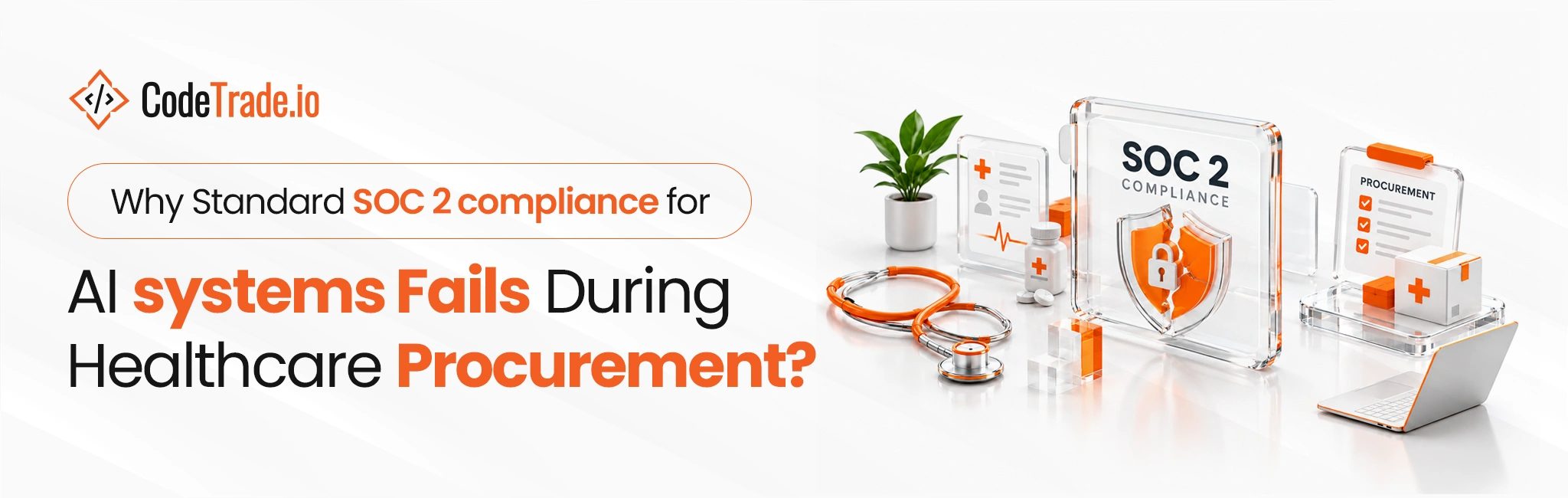
Enterprise buyers always ask if specific AI components fall inside the actual audit boundary. This narrow technical question quickly decides lucrative healthcare deals. Vendors frequently supply a completely clean security report to satisfy procurement. Buyer safety teams discover a massive architectural gap.
The audited boundary typically covers only basic web applications and standard databases. Critical elements like the model inference path and prompt logs sit entirely outside it. This documentation is never fraudulent but fails to answer the core question. This explains why standard SOC 2 compliance for AI systems frequently fails enterprise evaluation. This comprehensive guide details what US enterprise buyers actually assess during strict procurement cycles.
It clearly explains where soc 2 AI compliance and healthcare regulations fundamentally diverge. Readers will learn exactly what specific technical evidence modern auditors now demand. This knowledge establishes true AI audit readiness before development begins.
This guide outlines which architectural decisions guarantee secure AI development for regulated environments. Think of it as the security chapter of the broader evaluation in the buyer’s guide to choosing an AI development company.
SOC 2 represents an independent auditor attestation rather than a strict certification possessing fixed checklists. It verifies that a defined system met specific trust-services criteria over a defined period. Three distinct variables within that definition dictate actual custom AI compliance.
Enterprise procurement teams must ask highly specific questions to verify genuine AI audit readiness during vendor security evaluations.
| Ask | Weak answer | What good looks like |
|---|---|---|
| The full SOC 2 Type II report, not the certificate | A logo or one-page summary | The complete report including the system description and exceptions |
| Confirmation that AI components are in scope | “We are SOC 2 compliant” | System description naming inference, vector store, and prompt/response logging |
| Which trust-services criteria are covered | “All of them” (rarely true) | A named list, ideally including processing integrity |
| Subservice organization treatment | Silence about model providers | Carve-out or inclusive method stated, with provider reports referenced |
| Exceptions and management responses | “No exceptions” | Exceptions disclosed with remediation. A wholly clean report on a complex system invites scrutiny |
The subservice question deserves significant attention for AI security compliance. Most custom AI deployments depend heavily upon third-party foundation model APIs. That provider acts as a subservice organization. The final report must state whether auditors carved out or included those specific controls. A standard carve-out remains completely normal and acceptable. However, procurement teams then require the provider’s own direct attestation.
These frameworks answer completely different questions. Satisfying one framework leaves significant operational gaps in the other. SOC 2 compliant AI development asks whether specific controls protect the underlying system. HIPAA instead asks whether protected health information is handled lawfully. It imposes specific legal obligations that standard trust-services criteria never mention.
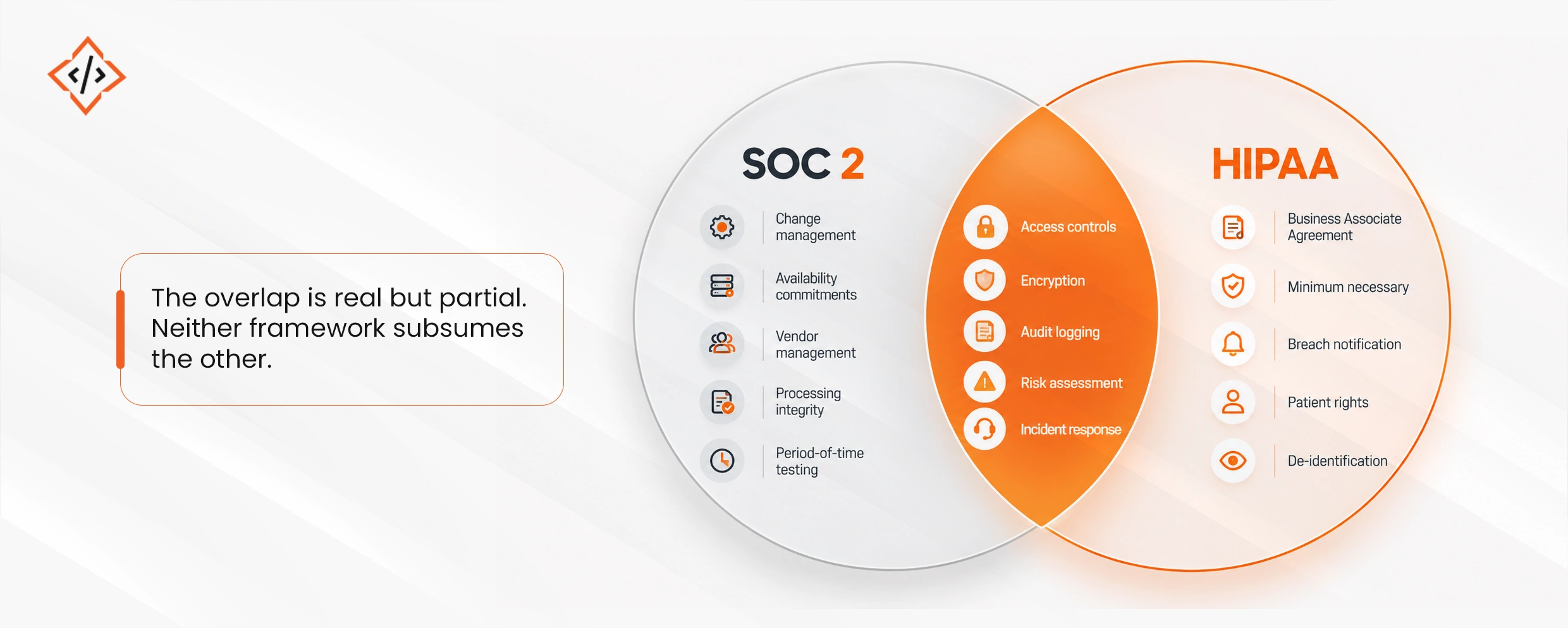
Shared controls exist in the middle. The distinct regulatory obligations on either side frequently trip vendors up.
Early-stage startups lacking enterprise deals should avoid purchasing complex compliance programs. Obtain a narrowly scoped Type I report initially. Keep system logging completely clean. Revisit comprehensive enterprise AI security when actual buyers request it. Type II reports require strict uncompressed observation periods. Paying for AI audit readiness months before real audits wastes valuable capital.
Organizations seeking only basic certification should hire dedicated audit-readiness firms. These specialized firms handle simple documentation significantly better and cheaper. Professional engineering partners become necessary for secure AI development. This specifically applies when systems require actual built-in architectural controls rather than basic documentation.
Companies handling protected health information must engage specialized legal counsel first. Development teams can build architecture fulfilling specific BAA requirements. Engineers cannot legally dictate specific terms within those critical healthcare agreements.
Standard trust-services criteria significantly predate modern production artificial intelligence. Auditors have actively adapted by requiring evidence that maps onto existing frameworks. Four critical areas arise consistently during strict security reviews.
Continuous system monitoring and rigid zero-trust security postures represent absolute baseline expectations today. They no longer serve as competitive differentiators during enterprise procurement. Proper AI audit readiness requires engineering these controls directly into the architecture.
Four specific architectural decisions remain cheap during initial design but become prohibitively expensive later. Each decision touches numerous code paths simultaneously. Retrofitting these specific controls literally means completely revisiting the entire system architecture.
Determine exactly which data classes may legally cross specific system boundaries. This includes foundation model provider APIs, vector stores, system logs, and evaluation datasets. Enforce these strict boundaries at one single chokepoint rather than individual call sites. Systems deciding this too late inevitably scatter sensitive data unintentionally. Auditors always discover these massive enterprise AI security failures eventually.
Structure all system logs to answer strict auditor questions directly. Include exact model versions alongside prompt hashes rather than raw prompts when classification demands it. Always record data classification tags, human reviewer identities, and final decision outcomes. Debug-style logging that dumps full payloads creates massive legal liability rather than valuable audit evidence.
Prompt and model changes must move through strict review, staging, and rollback disciplines identical to application code. This rigorous engineering process completely satisfies mandatory change management requirements. Separately, this strict versioning remains the only reliable method for explaining specific behavior changes retroactively.
Organizing internal operations around the NIST AI risk management framework proves incredibly efficient. Mapping its functions directly to SOC 2 criteria and strict HIPAA safeguards avoids maintaining parallel control sets. These major compliance frameworks overlap significantly more than they diverge. Operating one unified control catalog with multiple mappings ensures highly efficient SOC 2 and HIPAA compliance for AI systems.
The industry lacks established consensus regarding actual AI component scope at the system boundary. When systems call foundation model APIs, defining exact scope remains highly challenging. Is the model itself directly in scope? Perhaps only the API client falls inside while carving out the model as a subservice. Different auditors provide completely conflicting answers regarding this custom AI compliance. Buyer safety teams also assess these technical limits.
Current AICPA guidance has not caught up with modern AI security compliance. The most practical approach involves describing system boundaries explicitly using plain language. This allows enterprise buyers to determine if the architecture satisfies their specific requirements. Procurement teams perceive technical vagueness strictly as deliberate evasion. Buyers pushing back on clearly defined boundaries merely starts a healthy technical conversation. Presenting vague architectural boundaries immediately results in lost enterprise deals.
Security reviews represent the longest stage of enterprise AI procurement. Their duration depends heavily upon vendor preparedness rather than buyer strictness.
Vendors arriving with complete Type II reports naming specific AI components move through reviews quickly. They also require healthcare BAA templates and clear model lineage documentation. Evidence of continuous quality monitoring accelerates this evaluation process further. Vendors assembling these documents reactively spend months trapped in tedious questionnaire cycles. The underlying software quality cannot overcome poor AI audit readiness.
Proper compliance readiness functions as a massive sales asset rather than mere overhead. This immense strategic value scales perfectly alongside enterprise deal sizes. Procurement teams must treat crisp scope answers as strong indicators of overall engineering maturity. Strict auditors mostly demand controls that well-run production systems already possess natively.
Budget for it too. It’s one of the costs most commonly missing from initial estimates, a pattern covered in what mid-market buyers underestimate about custom AI cost.
Standard security reports frequently fail during rigorous healthcare procurement cycles because SOC 2 and HIPAA address entirely different requirements. Holding one attestation never automatically satisfies the other. For custom AI systems, the decisive factor remains whether actual AI components sit inside the audited system scope.
A seemingly valid report can entirely exclude the core model alongside vector stores and prompt logs. Proper healthcare deployments require both a comprehensive Type II report and a specific Business Associate Agreement. This legal agreement must strictly cover the entire inference pipeline and any foundation model providers. The minimum necessary rule always applies directly to prompt contents.
Furthermore, system logs containing protected health information represent legal medical records themselves. The exact controls making soc 2 AI compliance tractable represent the same safeguards disciplined engineering teams need anyway.
Proper model versioning, continuous quality monitoring, and strictly classified inference logging establish true AI audit readiness. Designing these controls early transforms complex enterprise security reviews into massive competitive differentiators.
 Chand Prakash
 Chand Prakash
 Chand Prakash
 Chand Prakash
 Chand Prakash