







AI
 Chand Prakash
23 October 2026
Chand Prakash
23 October 2026
AI in DevOps: how to automate software testing, deployment, and monitoring
 Chand Prakash
Hospital networks facing shrinking margins and severe staffing shortages must treat generative AI in healthcare as a mandatory system component. The technology has evolved well beyond basic chatbots. These advanced models now execute complex reasoning tasks natively. They easily parse messy and unstructured Electronic Health Record (EHR) data.
A 2026 McKinsey report projects this technology could produce over $1 trillion in healthcare value by the decade’s end. This financial impact occurs directly through widespread operational automation and much faster clinical outcomes. Implementing these advanced tools eliminates tedious manual data entry across clinical workflows. This transition immediately reduces physician burnout while improving overall diagnostic precision.
Healthcare executives must integrate these systems directly into daily revenue cycles rather than running isolated pilot programs. Prioritizing structured generative AI development today ensures long-term operational survival and strict patient data compliance.
Medical data infrastructure is currently undergoing a massive shift. The vast majority of medical records consist of unstructured formats like doctor notes, PDF lab reports, and DICOM imaging files. Traditional software architectures cannot read or interpret this fragmented information. This creates severe bottlenecks across clinical and administrative departments.
Advanced generative models solve this structural problem directly. They process this unstructured data natively without requiring manual tagging. This capability bridges the critical gap between raw patient information and actionable medical insights. Healthcare AI solutions now synthesize decades of patient history into precise summaries instantly.
Integrating generative AI for healthcare into daily operations provides immediate and measurable advantages. It reduces administrative overhead costs significantly and improves the speed of medical diagnosis. The benefits of generative AI in healthcare ensure hospitals maintain high patient care standards despite ongoing staffing shortages.
The most profitable generative AI healthcare applications focus on replacing repetitive knowledge work rather than replacing physician judgment. Healthcare systems deploy these models to manage heavy data processing tasks across clinical and administrative operations. By handling repetitive documentation, billing audits, and diagnostic reviews, intelligent models allow clinical teams to focus entirely on direct patient care.
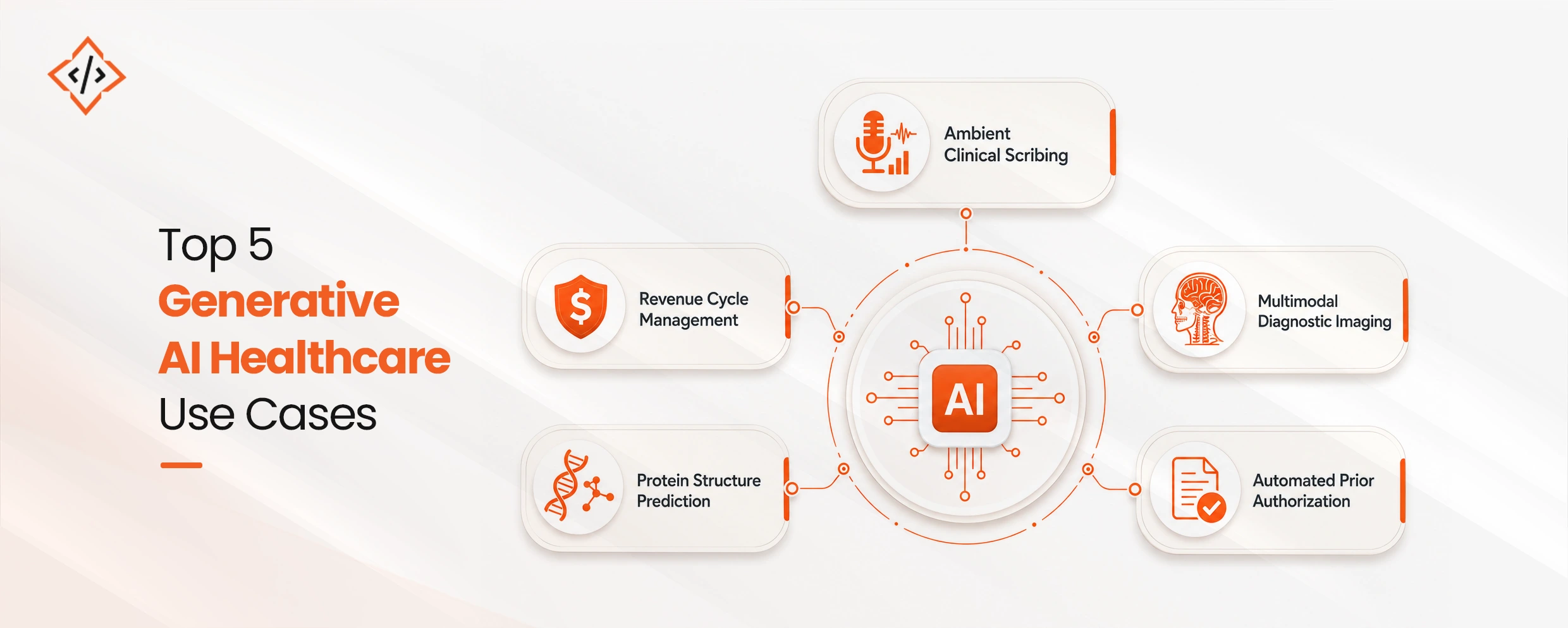
Clinical ambient scribing tools listen to real-time doctor-patient interactions and convert spoken dialogue into structured clinical notes. These models accurately format the entire conversation into standardized Subjective, Objective, Assessment, and Plan (SOAP) notes. The system connects directly to the hospital electronic health record system to update patient files without manual typing.
This practical application directly resolves the growing issue of physician burnout. Doctors routinely spend two or three hours finishing clinical notes after their regular shifts end. Ambient scribing completely eliminates this documentation backlog. Physicians finish their administrative tasks during the actual consultation, which improves workplace satisfaction and face-to-face patient engagement.
Medical billing errors cost hospital networks millions of dollars in delayed payments and claim rejections every year. Generative AI agents audit medical claims against complex insurer rulebooks before billing teams submit them. The system checks patient records, diagnostic codes, and procedural notes to confirm complete billing accuracy.
Proactive auditing prevents claim denials and shortens the reimbursement cycle for hospital networks. The AI flags missing documentation or coding mismatches immediately for internal review. By automating routine revenue cycle checks, healthcare organizations secure faster payments and reduce the administrative labor tied to manual claim appeals.
Generative AI medical applications are fundamentally transforming early-stage pharmaceutical research. Specialized neural networks predict complex 3D molecular folding and biological target binding digitally. Researchers test how billions of synthetic molecules interact with disease targets inside virtual simulations before conducting physical lab work.
This computational capability cuts the pre-clinical drug discovery phase down from years to mere months. Pharmaceutical teams identify viable therapeutic candidates with fewer costly lab iterations. The technology significantly lowers development expenses while speeding up the discovery of targeted therapies for rare and complex diseases.
Generative AI in medical diagnosis analyzes radiology scans alongside a patient’s comprehensive written medical history simultaneously. Traditional image analysis tools only review pixels within a single scan. In contrast, multimodal systems cross-reference MRI scans, CT images, blood work, and physician notes to find subtle clinical correlations.
Cross-referencing text records with medical imaging surfaces anomalies that single-mode software frequently misses. The system highlights early markers of disease, such as micro-fractures or early tumor growth. Radiologists review these AI-generated findings to improve diagnostic speed without compromising clinical accuracy.
Prior authorization remains one of the most frustrating administrative bottlenecks delaying essential patient care. Insurance carriers require detailed clinical proof before approving specialized treatments, medications, or surgical procedures. Generative models scan patient charts and medical histories to extract the exact clinical evidence required by specific payers automatically.
The system generates compliant authorization packets and submits them directly through payer portals. This automation reduces authorization turnaround times from weeks to minutes. Patients receive critical medical treatments much faster, while administrative staff avoid spending endless hours tracking down paperwork and managing phone inquiries.
AI-powered healthcare platforms synthesize genomic sequences, past medication responses, and current diagnostic reports to generate highly customized care plans. Standard medical guidelines often rely on broad population averages that do not suit every individual patient. Generative models evaluate specific patient variables to highlight the most effective therapeutic pathways.
This shift replaces one-size-fits-all treatments with precise, individualized medicine. Oncologists and specialists use these detailed recommendations to tailor drug combinations and chemotherapy dosages for individual genetic profiles. The result is better treatment efficacy, fewer adverse drug reactions, and higher overall patient survival rates.
Real-world generative AI in healthcare examples demonstrate live, enterprise-grade deployments delivering measurable financial and clinical returns today. Health systems no longer treat AI models as speculative experiments. Instead, major healthcare networks integrate these autonomous tools directly into daily clinical workflows to eliminate administrative waste and elevate diagnostic accuracy.
Leading hospital networks widely deploy Nuance’s Dragon Ambient eXperience (DAX) Copilot embedded directly into Epic Electronic Health Record software. The system operates unobtrusively in the background during clinical visits. It automatically converts natural spoken dialogue into comprehensive, structured medical documentation without physician intervention.
A 2025 multi-center clinical study revealed that physicians using DAX Copilot save an average of 7 minutes per patient consultation. Clinicians report finishing all documentation before leaving the examination room. This widespread adoption cuts clinical documentation backlogs, restores work-life balance for healthcare providers, and allows clinicians to maintain direct eye contact with patients.
Google DeepMind’s AlphaFold 3 serves as the benchmark deployment for AI in the global pharmaceutical research sector. The system predicts the 3D structures and complex interactions of proteins, DNA, RNA, and small therapeutic molecules with atomic precision.
Global biopharmaceutical enterprises use this computational engine to model protein-ligand interactions entirely inside digital environments. This digital modeling skips months of physical assays in biological laboratories. Research teams identify viable drug candidates substantially faster, reducing capital expenditure while discovering targeted therapies for challenging oncological conditions.
Leading billing departments utilize modern healthcare software solutions like Waystar to eliminate costly insurance denials before claims reach payers. The platform applies generative intelligence to historical billing data and dynamic payer rulebooks.
The system autonomously analyzes clinical documentation against diagnostic codes to predict potential rejection risks. When documentation errors occur, the software suggests precise billing code corrections before submission. This automated validation ensures significantly higher first-pass payment rates and shortens revenue collection cycles for hospital networks.
Mayo Clinic integrates advanced generative algorithms into clinical radiology workflows to detect subtle pathological patterns inside echocardiograms and MRI scans. Standard diagnostic imaging tools often struggle to highlight minute tissue changes during the initial stages of disease development.
Deployed clinical models analyze subtle structural shifts in cardiac imaging to identify early signs of heart failure years before patients show symptoms. Radiologists use these AI-generated diagnostic insights to initiate preventive clinical treatments early. This proactive imaging analysis improves long-term patient outcomes and lowers costly emergency hospital admissions.
Precision oncology platform Tempus uses generative AI medical applications to parse massive volumes of unstructured clinical notes and pathology reports. The model extracts critical biomarker data and complex genomic profiles from disjointed medical charts across oncology clinics.
The platform continuously matches cancer patients with active clinical trials that fit their precise molecular profiles. This automated matching connects patients to life-saving experimental therapies in days rather than months. Oncologists bypass manual clinical trial registries, ensuring patients receive individualized therapeutic options without administrative delays.
UCSF Health deploys generative language models directly within the MyChart patient messaging portal to manage heavy digital communication volumes. Primary care physicians often receive hundreds of patient inquiries daily, creating severe administrative fatigue.
The AI assistant reads patient inquiries, reviews relevant chart history, and generates clear, empathetic draft replies for physician review. Doctors verify and approve these draft responses before sending them to patients. This human-in-the-loop workflow cuts digital inbox management time in half while maintaining high clinical communication standards.
The Future of Enterprise Healthcare AI The window to treat generative AI in healthcare as an experimental side project is closing rapidly. Healthcare organizations that fail to integrate AI-powered healthcare infrastructure will face unsustainable administrative costs and physician turnover by 2027.
Technical leaders must audit their clinical workflows now to identify high-friction administrative tasks. Deploying targeted AI agents immediately secures a vital operational advantage and protects clinical capacity. Moving from isolated concepts to full production requires secure system architecture, reliable model governance, and deep clinical integration.
Partnering with an experienced AI development company to build this foundational layer separates high-performing systems from costly integration failures.
CodeTrade engineers secure, HIPAA-compliant generative AI healthcare applications tailored to enterprise hospital systems and specialized health-tech platforms. Our AI development teams design custom agentic pipelines that automate complex data workflows while protecting sensitive patient information.
 Chand Prakash
 Hardik Soni
 Chand Prakash
 Chand Prakash
 Chand Prakash