






AI
Healthcare Solutions
 Chand Prakash
01 September 2026
Chand Prakash
01 September 2026
What Are The Key Generative AI In Healthcare Use Cases Reshaping Modern Hospitals?
 Chand Prakash

Corporate data ecosystems are expanding far faster than traditional retrieval tools can process them. Legacy systems consistently force employees to waste valuable hours navigating irrelevant results, creating massive operational friction and delaying critical workflows. AI powered search is a mandatory architectural component for modern businesses. It replaces rigid keyword rules with cognitive systems that deeply understand user context.
According to a 2026 McKinsey report, 44 percent of organizations are now utilizing AI development services to scale these capabilities across their entire enterprise. Upgrading to enterprise AI search represents the necessary next step to maximize these existing technology investments and eliminate ongoing data silos. This guide strictly breaks down how advanced AI search technology functions, the algorithms driving it, and the concrete commercial benefits it provides.
You will also learn exactly how organizations can execute AI search optimization effectively without disrupting daily operations. This knowledge precisely prepares your digital infrastructure for the future of AI search.
AI powered search is an advanced information retrieval system. It uses machine learning and natural language processing to comprehend the true meaning behind a user query. Traditional search tools simply match exact text characters against static database records.
Modern AI search technology instead interprets semantic context, user intent, and complex corporate taxonomy. This architectural shift allows systems to extract actionable intelligence from vast amounts of unstructured enterprise data. It transforms internal search bars from passive index lookups into active knowledge discovery platforms.
Legacy retrieval tools rely strictly on exact text matching. They fail whenever an employee inputs a minor spelling error or uses a synonym not present in the indexed document. When syntax does not align perfectly, traditional systems return empty screens or irrelevant files.
Advanced AI search algorithms resolve this constraint by mapping conceptual relationships within high-dimensional vector spaces. They evaluate the mathematical distance between ideas rather than comparing literal letters. As a result, the system identifies the user’s underlying goal. It consistently surfaces accurate files even when the query phrasing differs completely from the stored source text.
The shift from lexical searching to semantic analysis fundamentally changes how enterprises interact with internal knowledge. Modern AI-powered search engines do not merely return a generic list of document links. Instead, they evaluate the specific role, project scope, and behavioral patterns of the user to determine true intent.
Combining this context with generative AI search allows platforms to synthesize information across multiple business applications. Technical teams and executives receive direct, factual answers compiled from verified internal repositories. This approach eliminates the productivity loss caused by manual file reviews.
AI search algorithms operate in three distinct phases involving ingestion, intent analysis, and dynamic generation. Traditional tools only check for verbatim text matches within fixed database columns.
Modern AI search technology systematically converts raw corporate information into semantic representations. This transformation allows the retrieval engine to evaluate data points based on their actual contextual meaning.
The ingestion process begins by converting diverse document formats into structured numerical embeddings. The algorithm scans, tags, and vectorizes massive datasets across PDFs, databases, and emails to build a unified neural index. Each enterprise data asset is mapped as a high-dimensional vector in a shared mathematical space.
Proximity between vectors reflects contextual relationships rather than superficial lexical similarities. This dense vector architecture allows the search engine to navigate complex enterprise knowledge graphs without manual tagging.
The moment an employee submits a query, the system transforms the input string into a contextual vector. Rather than isolating individual keywords, the algorithm parses the phrasing to evaluate user intent, department role, and geographical parameters. It references recent query history to disambiguate vague technical terms before searching the database. By analyzing syntax and semantic structure simultaneously, the engine determines the user’s operational goal in milliseconds.
Driven by generative AI development, the final phase combines neural ranking with dynamic content synthesis to deliver precise answers. Instead of returning a generic list of blue links, generative AI search extracts relevant text snippets across multiple vectors. The model cross-references these source passages against verified corporate repositories to ensure factual accuracy.
It then synthesizes the retrieved information into a clear summary with direct citations to original files. This streamlined workflow eliminates manual file sorting for technical teams.
The primary benefits of AI powered search center on saving time, reducing operational friction, and increasing user satisfaction. By interpreting conversational queries, this technology eliminates technical barriers and allows employees to receive immediate, accurate insights. Implementing these intelligent systems fundamentally shifts how business users interact with complex corporate data.
Legacy keyword tools frequently return empty screens when users input minor spelling errors or use unexpected terminology. Understanding semantic context eliminates the irrelevant results that constantly plague traditional search systems. The algorithm accurately identifies the underlying intent instead of demanding exact character matches. This cognitive capability directly decreases the dead ends that cause users to abandon a website or internal portal out of frustration.
Modern AI search technology actively remembers user history and preferences to tailor the retrieved results dynamically. Rather than delivering the exact same file list to everyone, the generative engine evaluates the person requesting the information. For example, a developer and a marketer searching the exact same term should get results weighted heavily toward their specific departmental roles.
Upgrading to AI search for businesses drastically reduces the hours employees spend hunting down scattered internal documents. Natural language processing breaks down complex conversational questions and immediately maps them to relevant enterprise data sources. This immediate data retrieval improves overall workplace efficiency and speeds up critical internal decision making without constantly requiring technical support.
Corporate data is constantly expanding and scattering across disconnected software platforms. Crucial business intelligence remains deeply trapped inside CRMs, ERPs, email threads, and cloud storage accounts. Employees waste valuable hours navigating these fragmented repositories just to locate basic operational information.
Implementing AI powered search solves this core problem by unifying knowledge access across the entire corporate technology stack. It transforms scattered files into an accessible intelligence network.
Enterprise AI search acts as a cognitive bridge connecting disparate internal systems. It eliminates the need for employees to manually log into multiple applications to find specific data. A single conversational query retrieves a unified, accurate answer compiled from across the entire corporate tech stack. Recognizing this massive operational advantage, companies are heavily funding these architectural upgrades.
Gartner projects that worldwide AI-optimized infrastructure spending will grow 96.4% in 2026 to reach $42.3 billion. This immense investment highlights how critical intelligent data connectivity has become for modern business continuity.
Unlike public AI tools, internal search platforms strictly respect existing corporate permission levels. Data security and strict compliance remain absolute priorities during any system implementation. The AI search algorithms ensure that sensitive information remains completely hidden from unauthorized employees.
For instance, highly confidential HR salary data will never surface in an engineering query. The system actively verifies user credentials before generative AI search synthesizes any document summary. This strict access control enforcement safely protects proprietary data while providing immediate answers to cleared personnel.
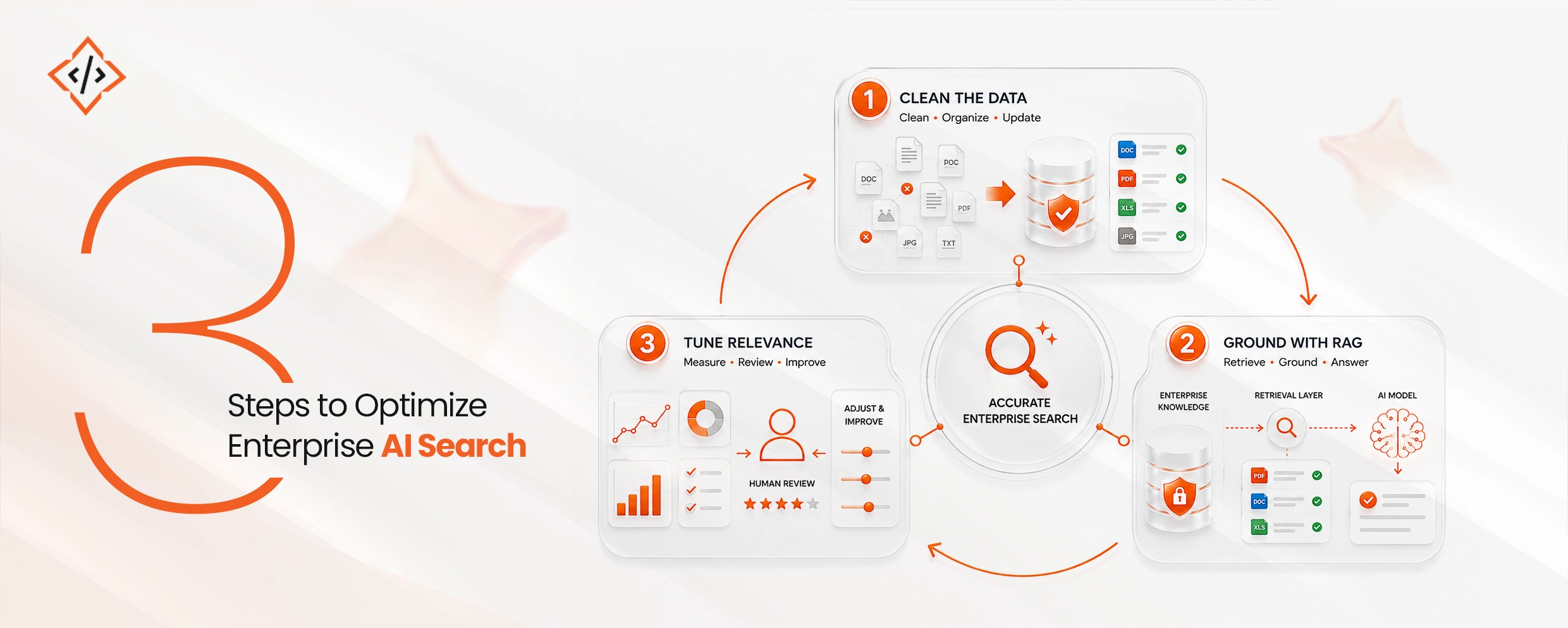
AI search optimization requires a strict, structured deployment strategy rather than simply plugging in an external API. Organizations must deliberately architect their internal systems before expecting intelligent retrieval. Launching generative AI search over chaotic data will only amplify existing corporate misinformation and confuse employees.
Organizations must ruthlessly clean their data before launching any cognitive search project. Artificial intelligence will only generate accurate results if the underlying documentation is highly organized, explicitly tagged, and completely up to date. Archiving obsolete files prevents the algorithm from pulling outdated compliance rules or deprecated product specs. This mandatory cleansing step ensures the neural index relies strictly on the single source of truth.
Integrating Retrieval-Augmented Generation grounds the new AI search technology securely in proprietary company data. This specific architectural framework strictly limits the model to internal facts, preventing dangerous hallucinations and ensuring factual accuracy. According to a 2025 Forrester report, every major cloud hyperscaler will launch retrieval-augmented generation solutions to guarantee enterprise accuracy. Implementing this pipeline ensures corporate answers remain both secure and verifiable.
An intelligent retrieval system requires consistent maintenance long after the initial launch phase. Organizations must establish strict human-in-the-loop review cycles to evaluate ongoing answer quality. Subject matter experts track baseline accuracy rates and routinely correct minor model assumptions.
This continuous relevance tuning refines the underlying AI-powered search engines over time. It guarantees the internal platform adapts naturally as corporate terminology and strategic objectives evolve.
According to a recent Gartner report, rapid advancements in AI agents development will result in 40 percent of enterprise applications featuring task-specific assistants by 2026. This is a massive jump from less than 5 percent in 2025. This market shift proves that businesses are definitively abandoning rigid legacy keyword tools.
The future of AI search relies on dynamic cognitive systems. These platforms will actively orchestrate complex internal tasks rather than simply returning static documents to the user.
The next immediate evolution in generative AI search depends heavily on multimodal capabilities. Future systems will simultaneously process and blend text, image, and voice inputs to retrieve complex data. For example, an engineer could upload a photo of a damaged server component while verbally asking for its warranty status.
The underlying AI search algorithms will immediately analyze both the visual and audio inputs. The system will then extract the exact maintenance manual directly from secured corporate storage.
Enterprise AI search will also shift entirely from reactive queries to proactive data delivery. Modern platforms will continuously monitor ongoing employee workflows to anticipate their exact informational needs. The system will automatically surface the correct project document or compliance guideline on the screen before the user even types a query.
This predictive AI search technology completely eliminates the manual retrieval process. It keeps technical teams focused purely on high-level execution instead of wasting hours on administrative digging.
Transitioning to AI powered search is a mandatory step for companies wanting to remain competitive. You must stop relying on outdated keyword tools immediately. Begin auditing your internal data readiness today to prepare for these cognitive systems. The future of AI search demands exceptionally clean data and a highly structured deployment strategy.
Moving from legacy databases to generative AI search requires careful architectural planning across departments. Proper execution matters just as much as the underlying AI search technology itself. Building this intelligent infrastructure correctly prevents costly operational disruptions down the line.
CodeTrade specializes in building custom enterprise AI search ecosystems for complex corporate environments. Our expert engineering teams deploy secure AI automation solutions that strictly respect your internal access controls. We ensure your internal platforms adapt flawlessly to modern information retrieval demands.
 Chand Prakash
 Chand Prakash
 Chand Prakash
 Chand Prakash
 Chand Prakash