






AI
AI/ML
 Chand Prakash
07 September 2026
Chand Prakash
07 September 2026
AI Agent Observability: How to Monitor Agents in Production
 Chand Prakash
Enterprises spending on AI automation solutions is rising faster than most organizations can turn experiments into repeatable business value. The challenge is no longer gaining access to models, platforms, or technical talent. It is deciding which use cases deserve investment and moving the right ones into production with control.
Gartner found that only 22% of organizations had scaled AI across multiple business units or adopted an AI-first approach in 2026. At the same time, 85% of functional leaders planned to increase AI spending, widening the gap between investment and execution.
An AI adoption framework gives enterprises a practical structure for closing that gap. It connects business value with an AI readiness assessment before major resources are committed. It also brings governance, ownership, deployment standards, and performance measures into the same decision process.
For enterprise AI adoption, this discipline matters because successful pilots alone do not create enterprise value. A clear AI adoption strategy helps organizations scale what works and stop what does not.
An AI adoption framework is a repeatable enterprise structure for deciding where AI should be used and how it should scale. It defines readiness checks, decision rights, governance controls, and production standards before deployment begins.
McKinsey found that 88% of organizations used AI in at least one business function in 2025. Only 7% had fully scaled AI enterprise-wide. That gap shows why enterprises need structure around adoption, not simply more pilots.
This keeps enterprise AI implementation tied to business value, risk, and readiness.
Enterprise AI adoption stalls when organizations scale pilots without fixing the operating conditions needed for repeatable business value. The issue is rarely model access. It is usually fragmented decisions, weak readiness, and unclear accountability. McKinsey found that 88% of respondents used AI in at least one business function in 2025. Yet nearly two-thirds had not started scaling AI across the enterprise, and only 39% reported enterprise-level EBIT impact.
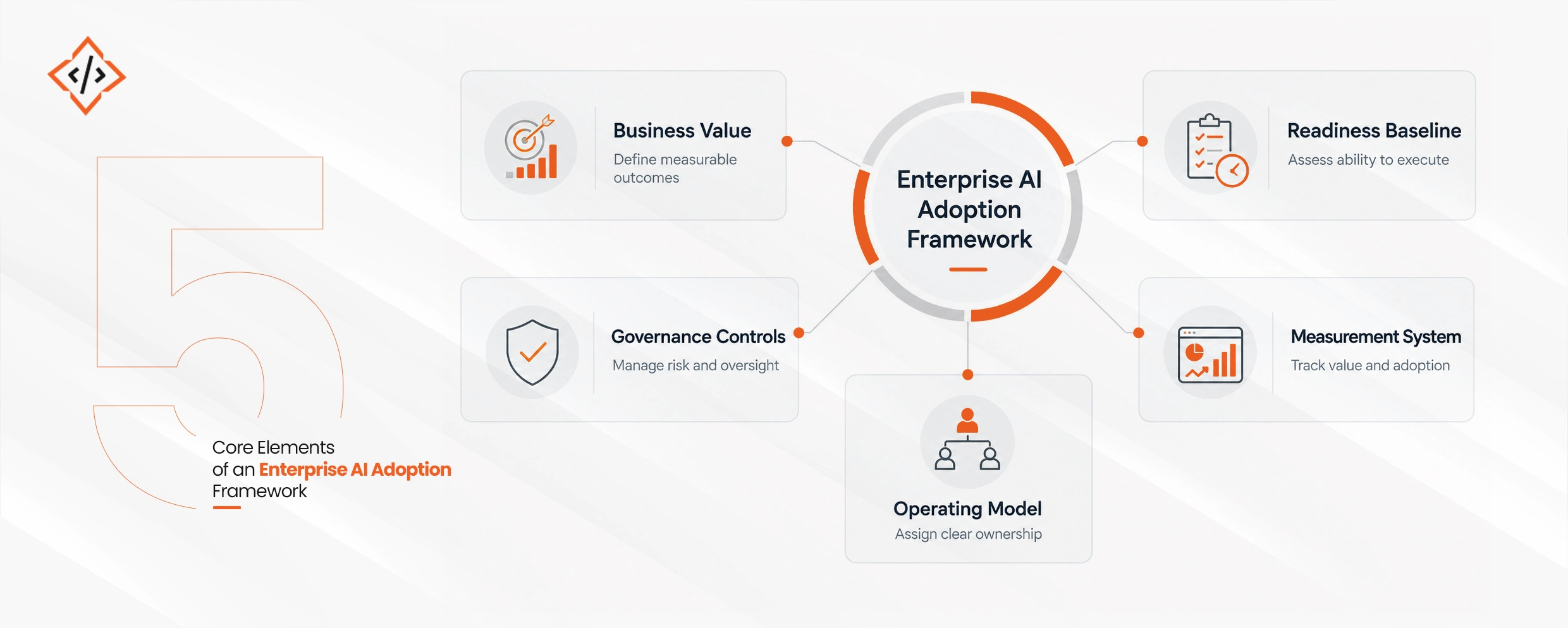
A strong AI adoption framework must answer more than which technology to use. It should define value, readiness, ownership, risk controls, and measurable success. That structure keeps enterprise AI adoption tied to business priorities instead of isolated experiments.
Every initiative should start with a clear business problem, not a preferred model or platform. Define the expected outcome and measure the current baseline first. Assign a named business owner who is accountable for results. The value case should connect to revenue, cost, productivity, customer experience, or risk reduction.
Readiness should be assessed for each use case rather than reduced to one enterprise-wide score. Review data quality, integration capability, infrastructure, skills, and process maturity. An AI readiness assessment should show what is ready and what must improve before implementation begins.
An AI governance framework should define risk levels, data policies, model rules, security requirements, and compliance ownership. It should also set human review points and approval thresholds. These controls belong inside deployment planning, not at the end of the project.
Clear ownership prevents delays once a pilot moves toward production. The operating model should assign responsibility for funding, product decisions, data, model performance, risk, and production support. Business and technology teams need shared accountability for enterprise AI implementation.
Each use case needs business, technical, and operational KPIs. Set a baseline, target, owner, and review schedule before deployment. Leaders should also define when to continue, change, scale, or stop the initiative based on evidence.
An AI readiness assessment should confirm whether a specific use case can succeed before major implementation spending begins. It tests practical conditions, not broad maturity labels. This makes it a critical checkpoint within an AI adoption framework.
Check whether the required data exists, is accurate, and has clear ownership. Review access permissions, lineage, retrieval speed, and coverage. The data must reflect the real process the AI system is expected to support.
Assess APIs, AI agents integration capabilities, compute capacity, identity controls, and monitoring requirements. Confirm whether cloud or on-premise infrastructure can support the planned workload. Enterprise AI implementation also depends on reliable connections with existing business systems.
Employees need to understand where AI fits within daily work. They should know when human review is required and who handles exceptions. Skills gaps should be identified before deployment.
Review privacy, security, regulatory exposure, bias, explainability, model risk, and vendor dependencies before approval. Gartner reported that 45% of high-AI-maturity organizations kept AI initiatives operational for at least three years in 2025. Only 20% of low-maturity organizations achieved the same result. This reinforces why readiness needs to be tested before scaling.
An AI adoption roadmap should work as a series of decision gates, not a fixed project checklist. Each stage should prove business value, technical fit, adoption readiness, and acceptable risk before further investment.
Start by ranking use cases against business impact, technical feasibility, data readiness, risk, time to value, and reuse potential. Favor problems where AI can produce a measurable improvement over the current process. This keeps the AI adoption strategy focused on outcomes instead of experimentation.
Before development begins, confirm data access and map the integrations the solution will depend on. Establish current performance so future gains can be measured properly. Estimate build and operating costs, review compliance limits, and set clear success thresholds. This turns an AI transformation strategy into a practical investment decision.
Test one well-defined process instead of building a broad pilot with unclear goals. Set acceptance criteria before the pilot starts. The trial should prove that performance improves, users can work with the system, and costs remain controlled. It should also confirm that identified risks can be managed in practice.
A successful prototype is not yet production-ready. An AI deployment strategy should cover system integration, access controls, monitoring, logging, human escalation, cost tracking, and version management. Production support must also have a named owner. These controls are essential for reliable enterprise AI implementation.
Scale only after the pilot shows measurable value, stable performance, real user adoption, manageable risk, and acceptable operating economics. Then identify reusable data pipelines, infrastructure, governance controls, and integration patterns. Reusing proven components makes the next implementation faster while keeping the AI adoption roadmap disciplined.
An AI governance framework should operate inside enterprise AI adoption, not sit outside implementation as a separate policy exercise. It should make ownership, oversight, and risk controls part of everyday AI decisions.
Gartner found in 2025 that organizations conducting regular AI performance and compliance assessments were over three times more likely to report high GenAI value. This shows that governance can support business value while controlling risk.
This approach makes governance part of a scalable AI deployment strategy rather than a final compliance checkpoint.
Enterprise AI success should show whether AI improves the business process it was introduced to change. Model accuracy in machine learning development matters, but it is only one part of the measurement system. A strong AI adoption framework connects technical performance with business outcomes and user adoption.
Start with a clear pre-AI baseline. Track revenue contribution, operating cost, cycle time, conversion, error reduction, customer satisfaction, or risk reduction. The selected metric should reflect the original business problem and show whether performance improves after deployment.
Measure active users, workflow usage, task completion, repeat usage, human override rates, and employee acceptance. A technically strong solution has limited value if employees avoid it or keep returning to manual processes. These signals show whether enterprise AI adoption is working in practice.
Track accuracy, error rates, latency, reliability, cost per task, drift, and escalation rates. These measures should always connect back to business impact. Technical performance is useful only when it supports better outcomes, stable operations, and confident enterprise AI implementation.
AI adoption will become less about running more pilots and more about choosing which problems deserve long-term investment. Enterprises need a consistent way to approve, stop, or scale initiatives using evidence rather than enthusiasm.
An AI adoption framework should remain active throughout the program, not disappear after planning is complete. It should guide new use cases, production decisions, governance reviews, and scaling priorities as business needs change.
That shift requires more than an AI adoption roadmap on paper. It needs a repeatable operating model that business and technology teams can apply to every new AI investment.
As an experienced AI development company, CodeTrade supports enterprises through AI consulting, readiness assessment, use-case planning, development, integration, and production deployment. Its AI development approach focuses on high-impact use cases, data readiness, practical roadmaps, and measurable business outcomes. For enterprises shaping an AI adoption strategy, the next step is to identify priority use cases and assess readiness.
 Chand Prakash
 Chand Prakash
 Chand Prakash
 Chand Prakash
 Chand Prakash