






AI
 Chand Prakash
24 November 2026
Multi-Agent AI Systems: Architecture, Use Cases, Costs, and Implementation
 Chand Prakash

AI agent observability matters because production agents can fail without producing errors, slow responses, or obvious system alerts. A documentation update can leave the vector index stale while the agent continues answering from outdated information. Retrieval still returns documents, the model still responds, and every trace can appear healthy.
The failure only becomes visible when a customer notices that the answer is wrong. This is why AI agent monitoring cannot rely on the same signals used for traditional services. Gartner’s 2026 CIO and Technology Executive Survey found that only 17% of organizations have deployed AI agents so far. More than 60% expect to do so within two years.
As adoption grows, AI agent failure detection will become a production requirement rather than an optional safeguard. This guide explains what to instrument during AI agent development and how to structure review so quality decay is caught early. It continues from the 90-day PoC to production playbook, shifting the focus from launch to reliable AI agent observability in production.
Application performance monitoring was built on a simple assumption: a system either works or returns an error. AI agents break that assumption in four ways.
Adoption data supports this operational pattern. Around 31% of enterprises have at least one agent in production. Banking and insurance lead at 47%, while healthcare and government trail at 18% and 14%.
The leaders are not necessarily the industries with the best models. They are the ones that already had model risk management, audit logging, and human review structures supporting AI agent governance.
Effective AI agent observability depends on monitoring four connected layers, from execution behavior through quality signals and unit economics. Build them in sequence. Each layer answers a question the one below it cannot.
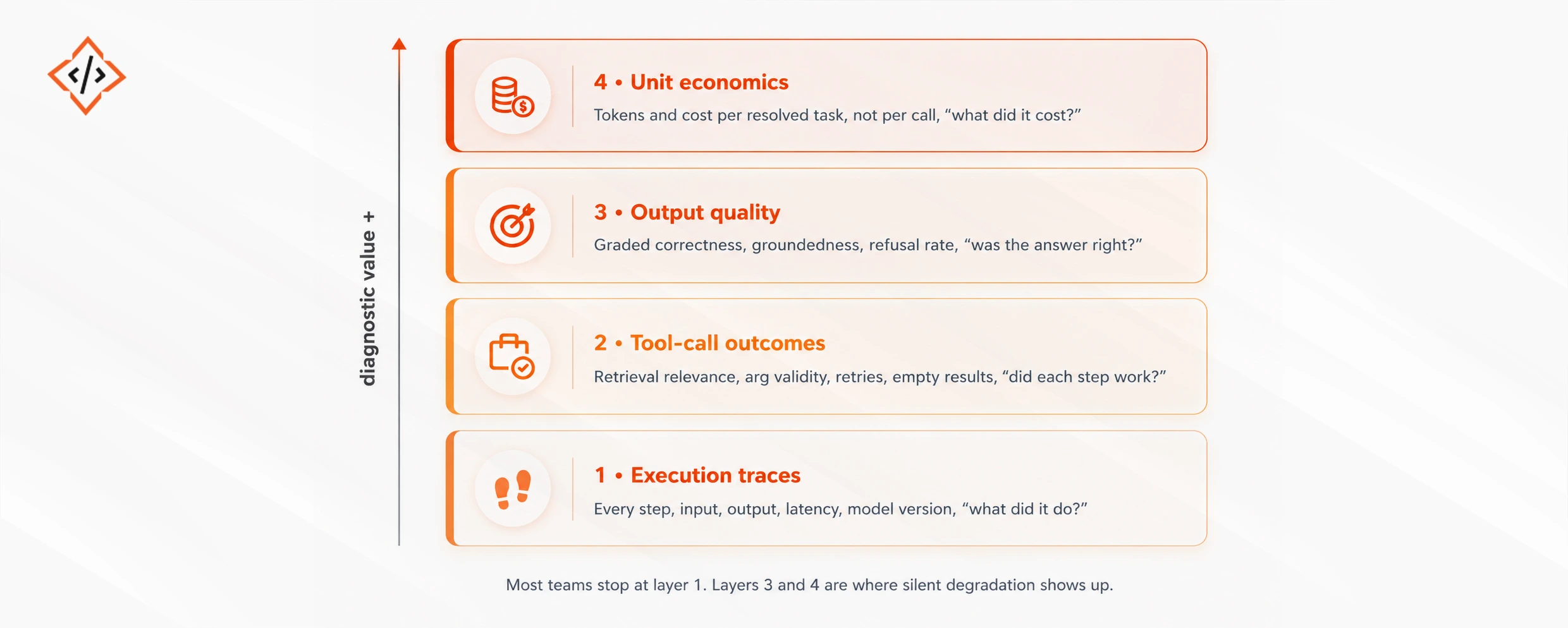
Build upward. Each layer answers a question the layer below cannot.
Every agent run should emit a structured trace covering the full decision path. This includes the triggering input, each reasoning step, every tool invocation with arguments, each result, the final output, and the model and prompt versions used.
Version capture is the part most often skipped, yet it is frequently the most important. Without it, comparing this week’s AI agent execution traces with last month’s behavior becomes guesswork.
Tool calls can succeed at the transport layer while failing at the semantic layer. Key signals worth capturing include:
The eleven-day failure would have been caught by the first signal. Retrieval relevance had collapsed for one product-tier query pattern while remaining stable elsewhere. It was measured in aggregate rather than by pattern, so the change never became significant enough to trigger attention.
This is the hardest layer and the one that matters most. Three mechanisms together provide stronger AI agent quality assurance than any one method alone.
Measure cost per resolved task, not per API call. An agent that costs less per call but requires four times as many calls is more expensive, while a per-call dashboard may suggest improvement.
AI agent cost monitoring should track the distribution rather than the mean. The p95 and p99 are where runaway loops usually appear.
Some metrics shift before quality visibly drops. These signals are worth tracking as part of AI agent monitoring.
| Signal | What a rise usually means | Alert on |
|---|---|---|
| Empty retrieval rate | Index staleness, or new question types | Absolute threshold plus week-over-week change |
| Tool-call count per task | Agent can’t make progress, reasoning degraded | p95, not mean |
| Refusal or escalation rate | Guardrails firing more, or a real capability gap | Sudden change in either direction |
| Groundedness score | Model filling gaps from memory instead of context | Downward trend over 7 days |
| Output length variance | Prompt or model change altering behavior | Distribution shift |
| Human-review disagreement | Grader has drifted from real quality | Any sustained divergence |
The counterintuitive signal is refusal rate falling. Teams may celebrate it as improved capability. Often, it means guardrails have stopped firing correctly, and the agent is now answering requests it should decline.
If you’re running one agent on a narrow task, with a human reviewing every output before it reaches a customer, you don’t need an AI agent observability program. A spreadsheet and a weekly review are enough. Buying AI automation solutions at that stage means paying for complexity you do not yet need.
The same applies if you’re pre-launch. Instrument execution traces, yes. But building graders and a regression suite before you have production traffic means calibrating them against traffic you created. Wait for real requests.
CodeTrade becomes relevant once agents are taking actions without a human in the loop and you lack a reliable way to compare quality from one week to the next.
Sampled review is the backbone of AI agent quality assurance, yet many organizations structure it poorly by making the process reactive.
Three practices hold up.
For agents embedded in ERP workflows, review needs one more dimension: the business consequence of the action taken. The Odoo AI agent architecture guide explains where approval gates should sit so reversible and irreversible actions are treated differently.
Automated grading still has a genuine limitation, and there is no complete solution yet.
Automated graders are usually models themselves. When the grader and agent come from the same model family, they can share the same failure modes and confidence patterns. They may also respond similarly to fluent and well-structured output. This creates a blind spot in AI agent quality assurance. A grader can score a confident and well-written answer highly even when the answer is wrong.
The risk can be reduced. Use a different model family for grading, give human review more weight, and build the regression suite from confirmed failures rather than grader scores. These steps reduce the correlation but do not remove it completely.
When the cost of a confident wrong answer is high, AI agent governance should include more human review than automated tooling alone may suggest. That remains the safer operating position.
A well-run agent program shows a clear set of operational patterns.
There is a regression suite built from real production traces rather than written in advance. Every incident adds a new case. That suite, not a benchmark score, gives teams the confidence to change a prompt or upgrade a model.
Model and prompt changes follow the same release discipline as code, with version pinning, staged rollout, and rollback. Teams that edit prompts directly in production cannot reliably explain later changes in AI agent performance.
Cost per resolved task is tracked, owned, and reviewed monthly alongside quality. Cost and quality constantly affect each other, so separating these discussions leads to weaker decisions in both areas.
Someone is also accountable for AI agent quality by name. Diffuse ownership is one of the strongest signals of the slow degradation that can eventually lead to cancellation.
AI agent observability matters because production failures rarely arrive as obvious outages or clean error messages. Agents can keep responding while retrieval, reasoning, or quality has already degraded. That makes AI agent monitoring a continuous operational requirement, not a post-launch check.
Gartner projects that 40% of agentic AI projects will be cancelled by the end of 2027. Much of that risk comes from degradation that remains invisible for weeks or months. The monitoring order matters. Start with AI agent execution traces so behavior can be reconstructed clearly. Then track tool-call outcomes because semantic failures can hide behind successful requests.
Add output quality checks through graders, groundedness reviews, and sampled human review. Measure AI agent cost monitoring per resolved task rather than per API call. Finally, Custom AI Agent Development needs a named owner for quality and a regression suite built from real production failures. That operating discipline is what keeps agents reliable, measurable, and trusted after deployment.
 Chand Prakash
 Chand Prakash
 Chand Prakash
 Chand Prakash
 Chand Prakash