






AI
AI/ML
 Chand Prakash
07 October 2026
Chand Prakash
07 October 2026
Multi-Agent Orchestration Patterns for Enterprise Workflows
 Chand Prakash

Mid-market technology leaders rarely underestimate AI because they ignore complexity. Budget overruns happen because most vendor proposals focus on development costs while leaving out the operational expenses that follow deployment, creating an incomplete view of overall AI Cost.
In 2026, avoiding custom AI is no longer a practical strategy for businesses that want to remain competitive. The greater risk is funding the initial build while overlooking data preparation, AI system integration, governance requirements, and long-term infrastructure needs. This gap often separates a successful proof of concept from a system that delivers measurable business value.
According to Gartner, at least 30% of generative AI projects will be abandoned after the proof-of-concept stage by the end of 2025. Poor data quality, inadequate risk controls, rising costs, and unclear business value are expected to be the primary reasons. This highlights a challenge many mid-market companies face when planning AI investments.
Understanding the full custom AI development cost requires looking beyond the initial proposal. Technology leaders need visibility into the engineering, operational, and scaling requirements that shape long-term success before selecting an AI software development company.
Calculating a definitive custom AI cost 2026 is exceptionally difficult because financial demands stem from operational complexity rather than developer hours. Traditional software models rely on clear visible milestones but enterprise AI development introduces deep structural variables that fluctuate after launch.
For instance, initial AI development pricing remains highly dependent on your specific industrial use case and required accuracy levels. Mid-market systems introduce extra friction due to legacy database architectures and fragmented departmental workflows.
These internal bottlenecks trigger unexpected AI system integration expenses that generic estimates never cover. Consequently, rigid fixed-cost models fail because machine learning requires continuous refinement and adaptive data pipelines. Technology leaders must realize that long-term custom AI implementation cost depends heavily on post-deployment engineering support rather than upfront coding.
Relying on specialized AI consulting services helps uncover these structural dependencies before making major capital commitments.
Initial software vendor quotes routinely understate foundational preparation work because they focus primarily on active engineering timelines. Your true custom AI implementation cost accumulates rapidly before a single line of code is engineered.
Raw corporate databases require extensive cleaning and structural standardization before ingestion into specialized machine learning architectures. Early vendor estimates frequently ignore underlying expenses associated with access permissions configuration and continuous pipeline sanitation. These database engineering tasks expand your overall custom AI development cost significantly if discovered mid-project.
Algorithmic business AI solutions demand granular process documentation and precise business rule mapping across legacy enterprise frameworks. Failing to align data structures with your operational parameters creates severe functionality gaps during initial testing phases. Resolving these operational bottlenecks later requires costly diagnostic support from your chosen AI software development company.
A successful generative AI implementation requires profound internal team alignment along with intensive technical workflow restructuring. Operational friction occurs when staff resistance delays deployment and reduces overall software utility. True organizational readiness depends on continuous post-launch optimization rather than basic software delivery.
Algorithmic architecture must connect with core enterprise databases rather than running inside an isolated technical environment. This operational dependency alters engineering timelines.
Connecting deep learning algorithms to institutional inventory platforms requires custom API development and specialized middleware layers. Legacy software limitations frequently restrict automated data movement or trigger architecture failures during processing. Resolving these real-time data sync errors introduces substantial engineering overhead to your final project invoice.
Extracting contextual customer information requires uniform pipeline structures that span across reporting platforms and consumer databases. Engineering teams spend weeks designing adaptive processing scripts to handle variable record formats without breaking live cross-system dependencies. This comprehensive backend tuning directly affects standard AI development pricing.
Enterprise data movement requires intensive network vulnerability testing alongside strict end-to-end encryption protocols. Compliance officers must conduct exhaustive multi-system security reviews before authorizing your broad generative AI implementation. These mandatory protective configurations expand production budgets long before deployment.
Initial production deployment marks the beginning of an iterative operational cycle rather than the end of your financial commitments.
Predictive accuracy declines naturally over time as real-world market dynamics and operational variables shift away from initial training baselines. Continuous accuracy monitoring is essential to catch these subtle algorithmic deviations before they impact client-facing business AI solutions negatively. Engineers must run regular diagnostics to prevent performance degradation from disrupting automated workplace processes.
Incorporating new data updates requires structured computational pipelines to facilitate ongoing domain-specific retraining sessions. Production teams must invest in iterative prompt improvement strategies to keep conversational tools aligned with evolving industry compliance standards. These technical maintenance schedules alter long-term AI model training costs long after the initial engineering phase concludes.
Sustaining system reliability relies on continuous human validation protocols to correct statistical anomalies and refine underlying algorithmic decision trees. Establishing clear feedback loops helps spot processing errors that automated monitoring software might miss entirely during daily enterprise operations. This specialized oversight remains a critical component of custom AI solutions managed by enterprise tech teams.
Expanding operational software across multiple departments shifts financial realities considerably because small infrastructure inefficiencies multiply exponentially at scale. A localized pilot may look highly affordable but broad corporate deployment introduces complex AI scalability challenges that expand operational overhead quickly.
When multiple business divisions begin interacting with automated machine learning workflows, background transactional volume swells. This expanding utilization triggers higher external API usage fees along with extensive departmental-level customization requests to fit varied business goals. These combined compounding requests alter baseline software service estimates and drive up your overall custom AI implementation cost.
Processing expansive real-time database transactions requires massive backend cloud infrastructure growth and continuous pipeline monitoring to ensure systemic reliability. Consequently, elevated computational demands alter core production overhead and reshape standard AI development pricing. Technology buyers must plan for these operational compute burdens before committing to long-term enterprise AI development.
Scaling automated applications across an organization demands precise user access control matrices and clear structural reporting needs to meet regional auditing standards. According to Gartner, more than 40% of agentic AI projects are expected to be cancelled by the end of 2027. The primary reasons include rising deployment costs, unclear business value, and weak risk controls.
Mitigating these multi-department compliance risks requires comprehensive architectural planning from an experienced AI software development company.
Enterprise technology buyers need a structural framework to project capital requirements accurately before finalizing software vendor contracts or selecting a suitable resource-based engagement model.
The primary engineering quote covers introductory user interface design along with standard application logic configuration. Corporate buyers frequently evaluate these narrow benchmarks when trying to project baseline custom AI development cost expectations. However, this preliminary milestone represents just a fraction of your absolute financial commitment.
Maintaining operational functionality requires continuous data preparation pipelines and regular machine learning diagnostic checks. System maintenance personnel must routinely monitor information processing streams to avoid unexpected system degradation issues. These ongoing monitoring tasks reshape standard custom AI solutions operational realities after launch.
Expanding application access to multiple corporate divisions introduces complex database configuration requirements across your infrastructure. Adding departments increases computational resource strain and requires comprehensive administrative access management protocols. Planning for these infrastructure expansions protects long-term business AI solutions investments.
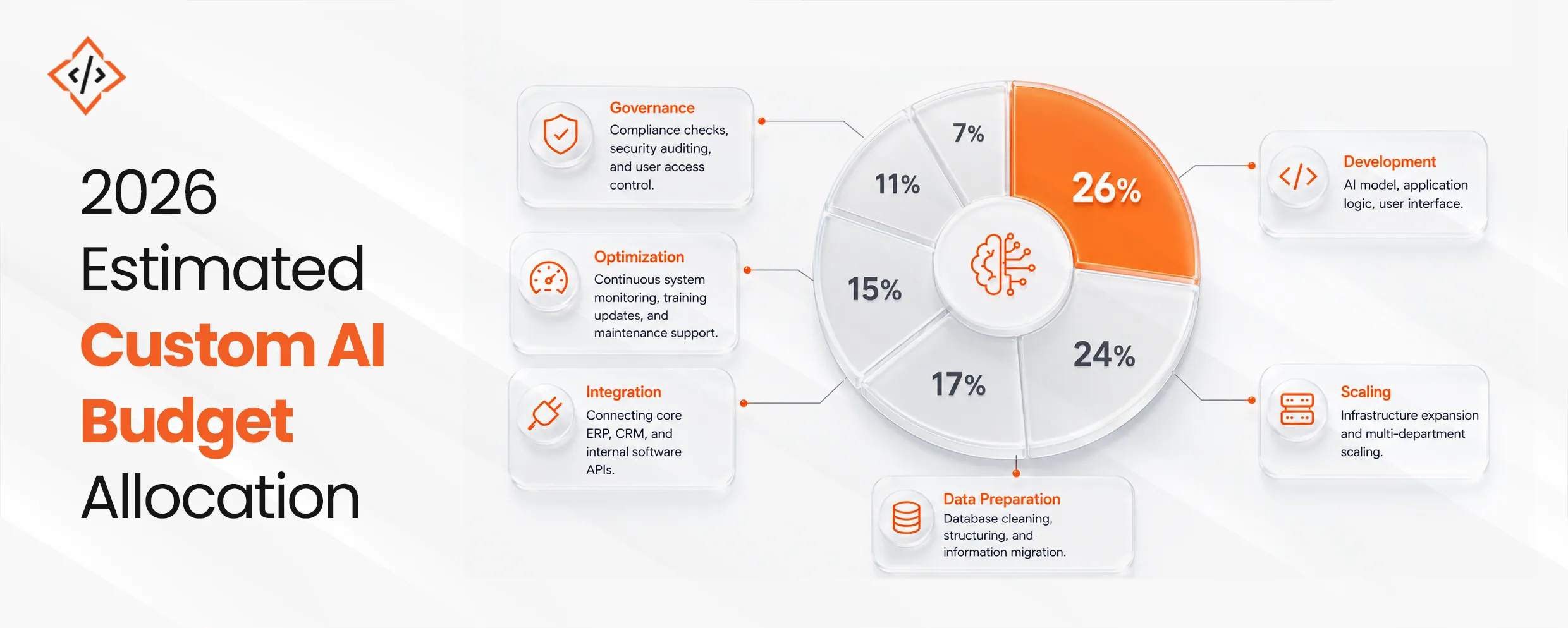
| Cost Area | What It Includes | Budget Allocation (Estimated Range in 2026) |
|---|---|---|
| Development | AI model, app logic, interface | $45,000 – $85,000 |
| Data Preparation | Cleaning, structuring, migration | $30,000 – $60,000 |
| Integration | ERP, CRM, APIs, internal systems | $25,000 – $55,000 |
| Governance | Security, compliance, access control | $15,000 – $35,000 |
| Optimization | Monitoring, retraining, support | $20,000 – $40,000 |
| Scaling | Infrastructure, users, departments | $40,000 – $90,000 |
Enterprise technology procurement teams must present targeted qualification questions to surface structural project vulnerabilities before entering contract agreements.
Corporate buyers should determine what specific costs are completely excluded from the proposal and what operational integrations are assumed. Leaders must explicitly ask what extensive data preparation is required from their internal teams before engineering workflows commence. Clarifying these baseline computational dependencies ensures your final custom AI development cost remains entirely transparent and predictable.
Identifying who handles complex post-launch monitoring helps prevent systemic performance drops and accuracy issues within live business AI solutions. Executives should discover exactly how continuous algorithmic model updates are priced before committing capital to long-term enterprise AI development. Establishing these maintenance agreements secures stable application reliability without generating sudden financial overhead.
Technology buyers need to assess what happens to baseline hosting infrastructure expenses when active organizational user usage increases significantly. Uncovering these hidden operational limits allows enterprise teams to map long-term custom AI implementation cost projections with extreme accuracy. Addressing these infrastructure adjustments early prepares your internal ecosystem to navigate unpredictable AI scalability challenges smoothly.
Sustainable computational engineering requires mid-market enterprises to view algorithms as continuous operational systems rather than isolated software installations. A high custom AI development cost rarely stems from base model complexity alone. Instead, financial inflation happens when leadership teams overlook the entire technical infrastructure surrounding those machine learning models.
Budgets yield better returns when financial projections integrate post-launch monitoring, adaptive compliance protocols, and stable infrastructure scaling parameters from day one. Enterprise deployment success depends entirely on planning for long-term operational viability rather than rushing toward initial prototype completion.
CodeTrade provides transparent, end-to-end enterprise AI development engineering structures tailored to your specific mid-market resource boundaries. The technical advisory teams deliver precise custom AI cost 2026 clarity by mapping pipeline dependencies before coding begins.
Partnering with an experienced AI software development company eliminates unpredictable financial surprises and ensures your generative AI implementation stabilizes successfully at scale.
 Chand Prakash
 Chand Prakash
 Chand Prakash
 Chand Prakash
 Chand Prakash