







AI
Enterprise Application
 Chand Prakash
31 August 2026
Chand Prakash
31 August 2026
What US Companies Must Know About EU AI Act Article 50 Transparency Duties?
 Chand Prakash
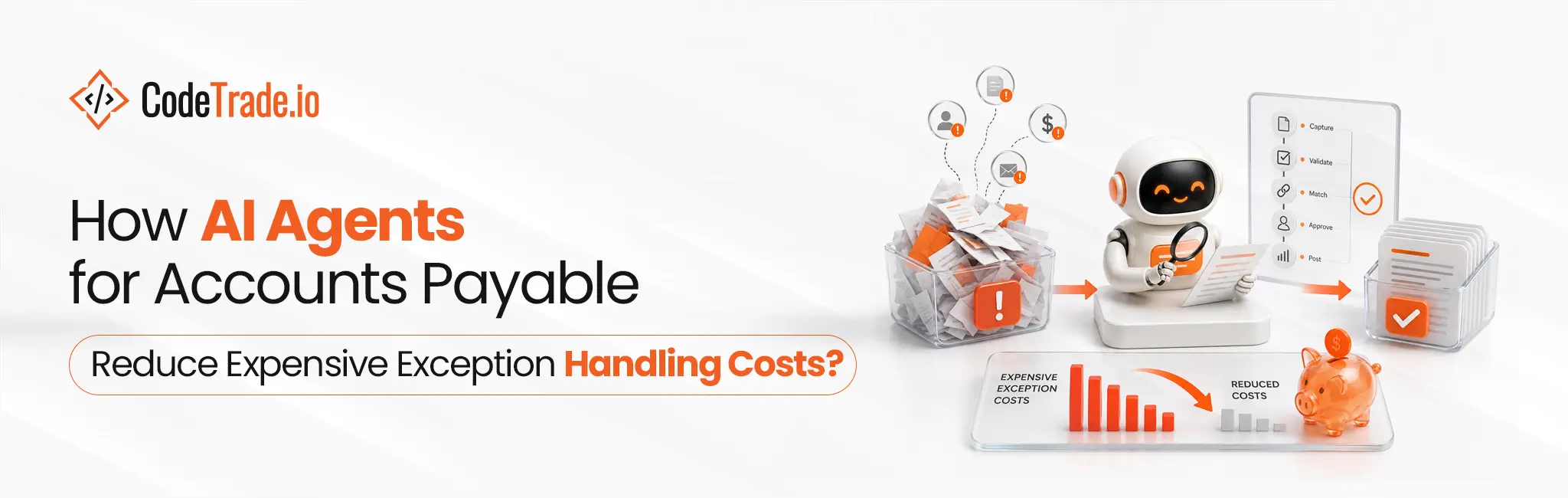
The APQC median cost to process one invoice is $21.40 compared to $10.18 for the top quartile.
This specific financial gap creates the entire business case for AI accounts payable automation. Notice what this metric excludes.
This cost difference has nothing to do with manual typing speed. Faster optical extraction only shortens one minor step. The truly expensive step requires a human resolving a data mismatch.
Deploying extraction alone barely moves your total cost per invoice. This reality makes many finance teams conclude accounts payable automation fails.
This guide explains where AI agents for accounts payable genuinely reduce costs inside an ERP-resident process with scalable AI agents in Odoo capabilities.
You will learn what intelligent invoice processing requires and which decisions must strictly stay with people. For underlying architecture details, the Odoo AI agent architecture guide covers their exact placement relative to your core ERP data model.
A clean invoice that matches a purchase order and falls within tolerance costs very little.
An invoice failing these checks costs a great deal during ERP accounts payable automation. It enters a manual queue requiring constant email follow-ups and supplier contact.
This delay adds several days to the total cycle time. Your financial cost concentrates heavily within a small minority of invoices.
| Stage | Typical share of volume | Cost contribution | Automation leverage |
|---|---|---|---|
| Capture and extraction | 100% | Low | Already solved, 95%+ field accuracy is standard |
| PO and receipt matching | 100% | Low to moderate | High, where tolerance rules are well defined |
| Coding and GL assignment | Non-PO invoices | Moderate | High, using historical coding patterns |
| Exception resolution | Roughly 25 to 40% | Dominant | Moderate, and this is the real target |
| Approval routing | 100% | Low | High, mostly a workflow problem |
| Payment execution | 100% | Low | Deliberately constrained, controls beat speed |
Straight-through processing across all buyers sits near 25% during standard accounts payable workflow automation. Meanwhile, best-in-class organizations reliably reach 35% or more.
Every single percentage point moved out of the exception queue removes a disproportionate amount of cost when Odoo AI Invoice Automation is aligned with finance processes.
Deterministic rules already handle a large share of invoice processing well. Replacing working rules with a complex model remains a common and expensive mistake.
AI agents for accounts payable earn their place in four specific situations where rigid rules structurally struggle.
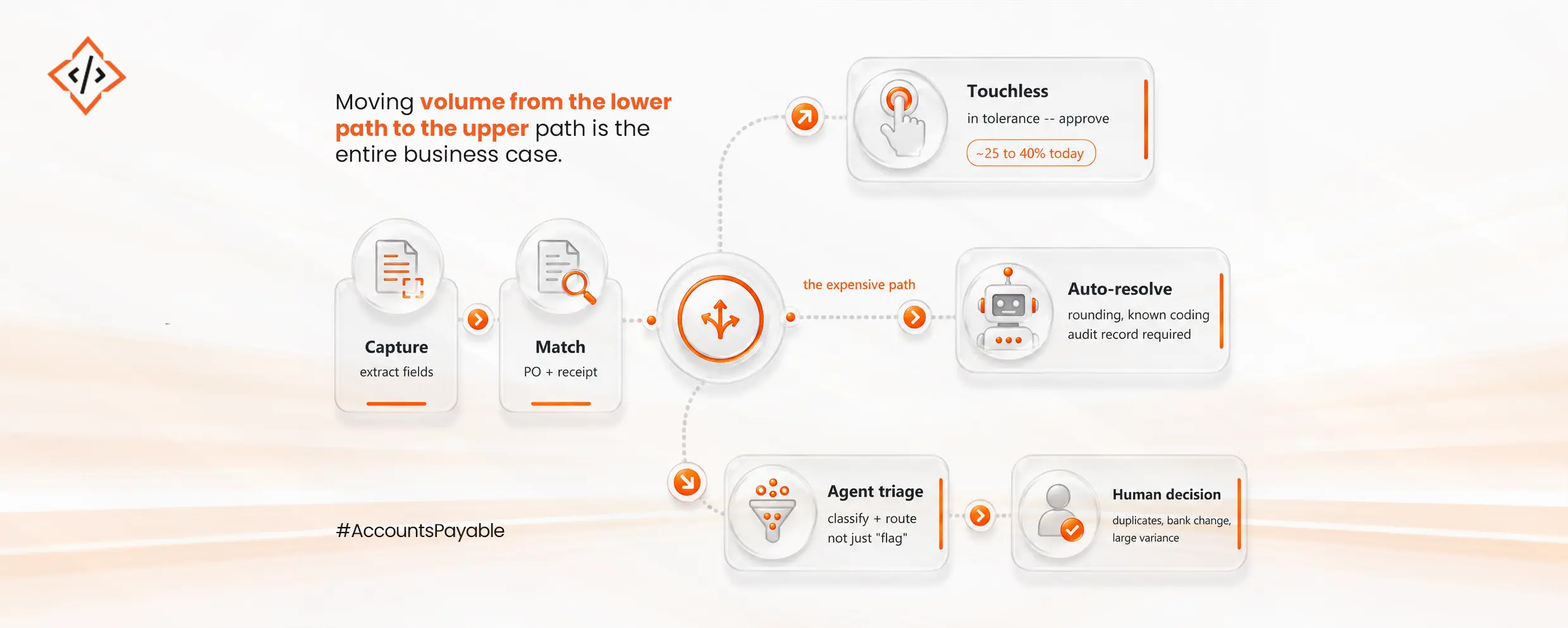
The core job of the agent remains strict triage and routing rather than autonomous posting.
Organizations often work with an AI development company to ensure these exception classes remain properly structured and controlled.
These scenarios must route to a human by design rather than as a simple fallback. The financial downside remains completely asymmetric and irreversible.
There is a fourth structural constraint rather than a categorical one. An agent must never post financial records irreversibly.
Proposing a journal entry and posting one directly represent very different risk positions. Preserving this vital difference costs nothing architecturally during ERP AI automation.
Integrating an AI agent requires careful architectural planning to ensure data integrity and system security remain completely intact.
Successful projects often begin with reliable Odoo implementation services to establish the right foundation. Placement decides both control quality and long-term maintenance costs. Three distinct integration patterns suit different enterprise architectures.
The agent runs as a completely separate service. It reads core data through APIs and writes back only proposals.
These include draft bills, suggested matches, and draft journal entries. All financial posting happens through native ERP workflow with standard approvals supported by structured Odoo integration services.
Default to this specific architectural pattern. Controls, audit trails, and approval routing stay where finance teams already understand them. You can change the agent without touching core ledger logic.
The agent runs as a native module calling models externally.
It executes entirely inside the established transaction boundary. This offers tighter integration but couples the agent lifecycle to ERP release cycles. This approach works well for estates with strong platform engineering. You can explore this further in the Odoo AI 2026 guide.
The agent works upstream of the core system entirely. It resolves what it can before a document becomes a bill.
This remains the simplest pattern to govern but severely limits capabilities. The agent cannot see receipt data or ledger history. Hard exceptions desperately need this exact historical context.
Idempotency on every write remains essential. Network retries are completely normal during intelligent invoice processing. Duplicate draft bills become the real consequence of ignoring this rule.
Provenance is required on every populated field. A human reviewer must clearly see what was inferred versus extracted versus matched.
You need a reversible path for every single action. The system must record this reversal clearly rather than keeping it silent.
Keep tolerance and threshold configuration strictly outside the model. Place this in the ERP configuration where the finance department owns it.
If you process fewer than a few hundred invoices a month, do not automate. The fixed cost of building, evaluating, and monitoring an agent will never yield a return at that low volume.
A part-time accounts payable clerk using a good template remains much cheaper and significantly more reliable.
If your master data remains disorganized, fix that foundational issue first before pursuing integration. This includes duplicate suppliers, inconsistent units of measure, and purchase orders raised after the invoice arrives.
An honest architectural assessment will always reveal this strict prerequisite. Master data quality permanently caps your achievable touchless rate during Odoo accounts payable automation, regardless of whether the organization invests in custom ERP development or other technology improvements.
Engaging an enterprise integration partner makes sense only when invoice volume is substantial. Your master data must be properly organized, and the manual exception queue must be where your finance team actually spends their valuable time.
Honest expectations matter greatly during AI-powered invoice processing. Vendor claims frequently run well ahead of typical operational outcomes.
Field-level extraction accuracy above 95 percent remains highly achievable. This baseline is increasingly standard across the industry. Manual keying carries an estimated one to four percent error rate by comparison. Automated extraction usually improves both accuracy and processing speed.
The touchless rate dictates the true operational variance. Moving from an industry-typical 25 percent toward 35 percent remains realistic.
Best-in-class organizations reach this metric over multiple quarters. Reaching 49 percent requires clean master data and disciplined purchasing behavior. It also demands strict supplier onboarding practices. That requires organizational work; no Odoo invoice automation does that.
Your cost per invoice follows the touchless rate strictly. Fully automated extraction brings the marginal processing cost of a clean invoice below one dollar.
The blended cost per invoice only drops when the overall exception share falls.
A persistent tension exists in accounts payable workflow automation that remains structurally unresolved. Tightening tolerances routes more invoices to human operators.
This raises processing costs but catches more genuine errors. Loosening tolerances makes the touchless rate climb and costs fall. However, some proportion of real pricing errors gets paid unnoticed.
Finance teams constantly seek a definitive number for that second proportion. Measuring this metric remains practically impossible. Auditing those invoices means reviewing the exact documents you deliberately stopped checking.
Observation suggests most mid-market functions run tolerances tighter than the actual error rate justifies.
A structured Business Automation approach can help evaluate these operational decisions. These departments could likely loosen them profitably. This remains a hypothesis rather than a proven finding. A controlled data sample remains necessary before advising a CFO to widen any threshold.
True AI accounts payable automation reduces costs by moving invoices out of manual exception queues. Faster data extraction is already solved with highly accurate modern systems.
The gap between a $21.40 median and a $10.18 top quartile is exception handling. That specific financial gap is exactly where AI agents should point.
Odoo AI agents must handle strict triage and intelligent document routing. They also excel at drafting supplier correspondence and executing non-PO coding. You must keep bank detail changes and suspected duplicates with human operators.
Finance teams must always manage out-of-tolerance variances through strict structural design. Intelligent invoice processing requires automation models to propose rather than post.
Every automated action needs clear field provenance and a completely reversible path. AI consulting services can help teams design these controls effectively. Disorganized master data will always remain your primary operational constraint.
No software model substitutes for fixing foundational data during accounts payable automation.
 Chand Prakash
 Abhishek Karad
 Chand Prakash
 Chand Prakash
 Chand Prakash