






AI
Education & eLearning
 Chand Prakash
22 September 2026
Chand Prakash
22 September 2026
Future of Generative AI in Education: Use Cases and Trends
 Chand Prakash
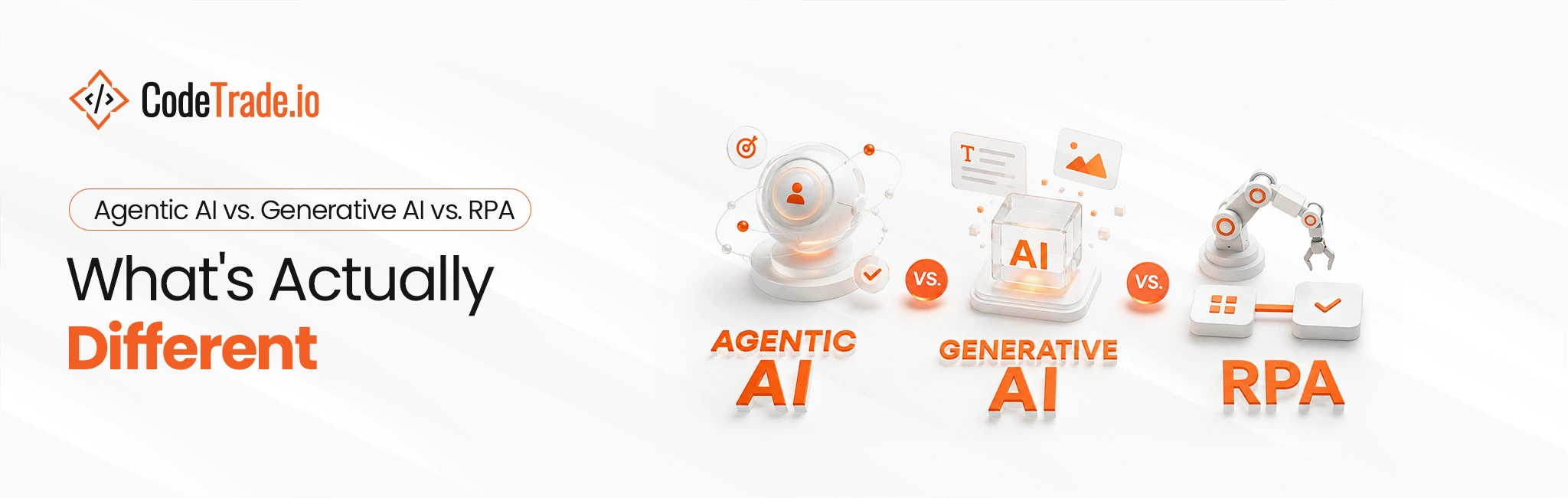
The defining difference between Agentic AI vs Generative AI vs RPA is their exact level of system autonomy. Traditional tools like Robotic Process Automation (RPA) depend entirely on executing strictly coded operational rules. Generative AI systems act differently by requiring direct human prompts to create new digital content.
Agentic AI operates completely independently to reason, execute, and self-correct complex tasks across enterprise platforms. Mixing up these distinct AI automation solutions routinely leads to failed technical deployments and bloated budgets.
While interest in RPA vs AI Agents continues to grow, actual enterprise production scaling remains surprisingly rare across most industries. A 2025 McKinsey report indicates 88% of organizations use AI, yet only 23% are scaling autonomous AI agents.
Understanding this technological split is absolutely mandatory for building reliable intelligent business automation platforms. Proper tool alignment forms the essential foundation for resilient AI workflow automation heading into 2026.
Robotic Process Automation (RPA) functions as the digital hands of a business. It executes repetitive administrative actions based on strictly coded rules. These software bots interact with graphical user interfaces exactly like a human would. This method makes them perfect for older legacy systems lacking modern APIs.
Many IT directors utilize this technology for standard business process automation. A basic bot can copy client data from an email into a legacy database. It processes these structured tasks rapidly and without fatigue. This predictable execution built the early foundation for enterprise AI automation.
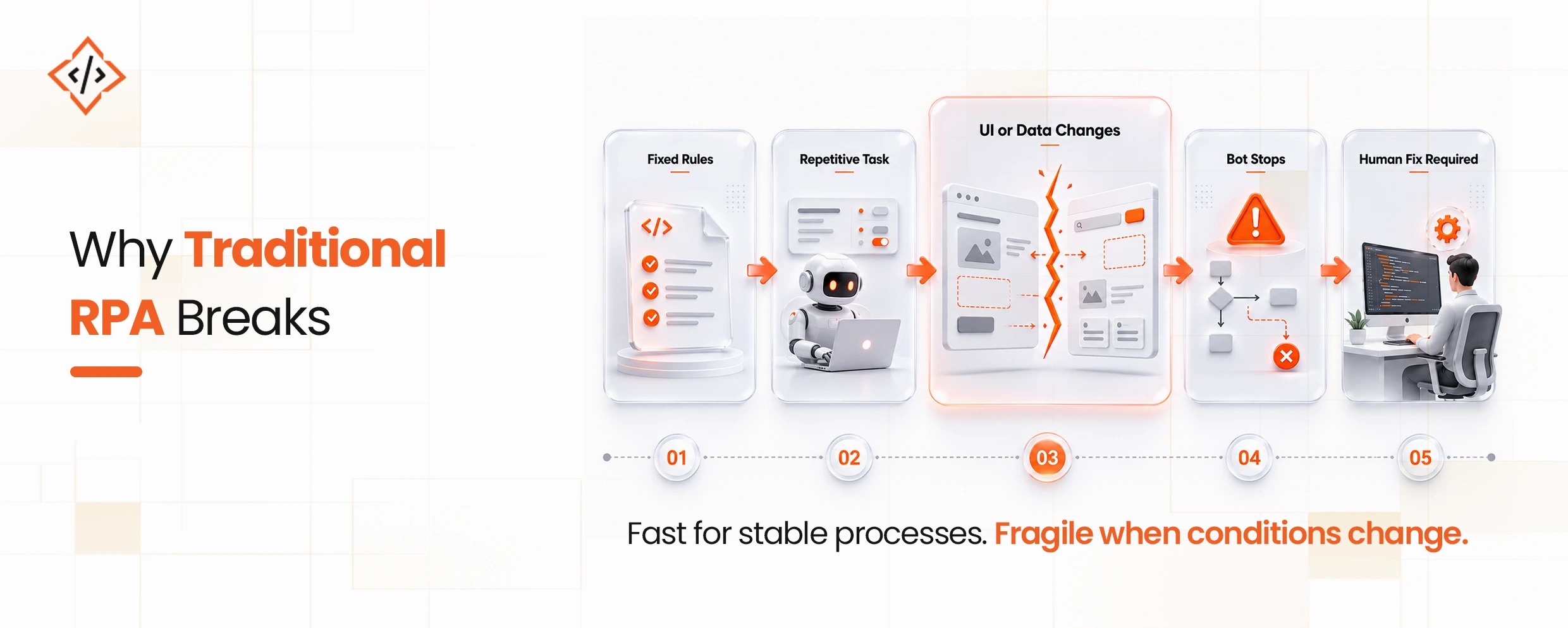
The main operational problem is that RPA possesses absolutely zero cognitive ability. The software cannot think or adapt to unexpected data inputs. Understanding Agentic AI vs RPA means recognizing exactly where traditional bots fail. These rigid systems break down rapidly under very specific conditions.
These systems only follow the exact paths defined during their initial setup. Therefore, they wait for human intervention whenever an unknown variable appears. Without modern AI development services, teams must constantly monitor them to prevent costly operational downtime.
These technical limitations force companies to reconsider their long-term AI automation solutions. IT departments spend far too many hours maintaining brittle scripts. Building a resilient architecture requires moving beyond simple rule execution.
Generative AI acts as the creative brain of digital operations, analyzing vast unstructured datasets to generate content on demand. Through specialized generative AI development services, these models understand context perfectly. They excel at producing high-quality business assets very quickly.
However, Generative AI remains inherently reactive by design. The technology always requires human prompts to initiate any work cycle. Although it successfully determines what to write, it cannot execute multi-step workflows independently. A language model might draft an email, but it still relies entirely on humans to actually send it.
This functional limitation explains current enterprise AI automation trends. According to a 2025 Forrester study, generative AI enterprise spending is projected to surge nearly 75 percent. However, companies want low-risk productivity gains rather than true business process automation. They use these reactive models mostly to summarize meetings or draft initial code snippets.
Generative AI vs RPA presents a clear structural contrast regarding data requirements. Traditional bots need perfectly clean data spreadsheets to function correctly. Generative models easily interpret messy PDFs and conversational inputs instead. Combining these two intelligent business automation systems creates significant immediate value. This hybrid approach sets the stage for fully autonomous AI agents.
Autonomous AI agents represent the next evolution because they answer the question, “What should I do next?” Moreover, they answer this question without waiting for a human prompt. These AI decision-making systems utilize a reasoning loop to continuously navigate complex digital environments.
If an agent encounters a broken API while booking a shipment, it does not crash. Instead, the AI agent analyzes the error, selects an alternative routing tool, and executes the fix immediately. This active problem-solving separates Agentic AI vs Generative AI completely. While the generative model writes the strategy, the agentic system actually executes it across multiple software tools.
This proactive capability explains why AI automation solutions are shifting toward full autonomy. Gartner predicts that 40 percent of enterprise applications will feature integrated task-specific AI agents by the end of 2026, which is an eightfold jump from less than 5 percent in 2025. This massive technological leap demonstrates that AI agents for business are moving far beyond individual productivity aids. They are becoming the primary execution layer for critical operational workflows.
Integrating these systems requires specialized Custom AI development rather than simple off-the-shelf software purchases. Moreover, working with an experienced AI agent development company helps enterprises build robust data governance frameworks before granting these models execution authority over live systems. Consequently, proper architecture ensures these autonomous tools reduce operational friction instead of creating new compliance risks.
By comparison, the differences become stark when you evaluate how each technology handles data structures, autonomy, and unexpected errors in a live environment.
| Feature | RPA | Generative AI | Agentic AI |
|---|---|---|---|
| Core Operational Capability | Executes strictly defined, repetitive administrative rules without deviation. | Analyzes massive unstructured datasets to synthesize new content and insights. | Autonomously formulates plans and executes complex business goals across systems. |
| Level of System Autonomy | Possesses zero independent action capacity; relies entirely on engineered scripts. | Functions reactively; requires specific human prompts to initiate any generation cycle. | Operates proactively; self-directs and continuously executes tasks without human triggers. |
| Enterprise Data Requirements | Demands perfectly formatted, structured data like clean spreadsheets or fixed databases. | Interprets unstructured data effortlessly, including messy PDFs and conversational inputs. | Processes both structured system data and unstructured context to drive independent actions. |
| Error Handling & Resilience | Process breaks and stops entirely if a graphical interface or data format changes. | May hallucinate incorrect information when encountering unexpected knowledge gaps. | Analyzes operational failures, reasons through alternative pathways, and self-corrects dynamically. |
| Workflow Adaptability | Requires an IT engineer to manually rewrite code to bypass newly introduced roadblocks. | Adjusts creative output solely based on how human operators refine their initial instructions. | Alters its own execution strategy in real-time to overcome unexpected system barriers. |
| Execution Depth & Tool Usage | Clicks mapped buttons on legacy screens for basic data entry and transfer. | Drafts detailed strategies or emails but cannot interface with external software tools. | Connects with APIs, updates CRM records, and orchestrates end-to-end task completion. |
| Primary Business Output | Linear data movement between disconnected enterprise software platforms. | High-quality text, visual assets, and code generation for human review. | Fully resolved workflows and autonomous business process automation. |
The defining trend of 2026 is the total eradication of “agentwashing” within the enterprise market. With growing demand for custom AI agent development services, companies are stopping the false claims that basic reactive chatbots are true autonomous systems. Instead, intelligent business automation is rapidly moving toward complex multi-agent ecosystems. These specialized AI decision-making systems collaborate seamlessly to run entire business functions.
This architectural shift changes everything regarding Custom AI development. Engineering teams are actively moving away from isolated tools toward integrated AI agents for business. According to a July 2026 Gartner report, AI agents will outnumber human sellers by a staggering 10 to 1 by 2028. This upcoming reality forces IT leaders to completely overhaul their core data platforms today.
Organizations can no longer rely on simple off-the-shelf software to handle these transitions. Navigating these AI automation trends requires engaging specialized AI consulting services. A professional AI software development company ensures that these powerful new models integrate smoothly without causing fragmented digital sprawl.
Securing AI consulting services now is the only way organizations will successfully navigate the architectural transition from static bots to agentic systems. Investing in custom AI software development ensures your organization utilizes the right tool for specific data types rather than chasing generic trends. This structural understanding fundamentally separates companies that achieve real operational efficiency from those that merely purchase new software licenses.
CodeTrade specializes in comprehensive Custom AI development designed explicitly for enterprise environments. Our expert engineers build and deploy specialized intelligent business automation architectures that seamlessly bridge legacy infrastructure with modern autonomous capabilities. We ensure these high-performance models integrate securely without creating complex digital sprawl across your internal departments.
Looking ahead, integrating autonomous capabilities will move from an experimental strategy to a mandatory operational requirement. By 2028, Gartner estimates that one-third of user experiences will shift from native applications directly to agentic front ends. This massive structural change demands proactive engineering decisions today. Partnering with a dedicated AI software development company guarantees your enterprise remains resilient and adaptable as these AI automation solutions evolve over the coming years.
Yes, Generative AI and RPA work together effectively in a hybrid automation model. Generative models extract data from unstructured documents, while RPA bots enter that clean data into legacy databases.Agentic AI improves business automation by autonomously planning, executing, and self-correcting multi-step workflows without human intervention. Unlike static tools, these intelligent agents adapt to system errors and dynamic data changes in real time.Agentic AI requires higher initial implementation investments than standard RPA due to custom model architecture and API orchestration. However, autonomous agents deliver greater long-term ROI by eliminating continuous script maintenance and manual error recovery costs.Choose based on process rigidity, required output type, and the level of system autonomy your workflow demands. Use RPA for static tasks, Generative AI for content creation, and Agentic AI for end-to-end goal resolution.The primary challenges include securing enterprise data governance, preventing autonomous drift, and orchestrating complex API integrations. Organizations must establish strict access controls and robust verification loops before granting agents execution authority over live systems.
 Chand Prakash
 Chand Prakash
 Chand Prakash
 Chand Prakash
 Chand Prakash