






AI
Enterprise Application
 Chand Prakash
16 October 2026
Chand Prakash
16 October 2026
Enterprise AI Automation Strategy: A Step-by-Step Implementation Guide
 Chand Prakash
Building with AI has become a business decision rather than a standalone technology initiative. Many companies already use AI across individual workflows. The bigger challenge is building systems that solve operational problems at scale and continue creating value over time. This is where custom AI software development becomes important.
It allows businesses to design intelligent systems around their own data, workflows, and decision-making requirements. Generic tools can support simple use cases. Complex operations often need a more tailored approach.
According to McKinsey’s 2025 report, 78% of organizations now use AI in at least one business function. Yet adoption alone does not guarantee measurable outcomes. Businesses are now investing in generative AI consulting services that fit their environment, integrate with existing systems, and support long-term operational growth.
Custom AI software development is the process of building intelligent software around how a business actually works. It is designed to solve specific operational problems with greater precision and long-term usability.
Custom AI software development is built around a company’s own data, workflows, users, and decision-making requirements. It is not created for general use. It is developed to match how teams operate across departments and how decisions happen in real business environments. This makes the software more practical from day one.
The process usually starts with data collection and preparation. That data is then used for model training based on the intended business outcome. Once trained, the system is connected with existing platforms and deployed into daily operations. Over time, performance is reviewed and improved through continuous optimization.
Standard AI tools are built for broad use across many businesses. Custom AI development is built around internal business logic. It fits existing systems better and supports more focused outcomes than most ready-made AI software development services.
Businesses are choosing custom AI development because standard software often cannot solve operational challenges with enough depth or flexibility.
Custom AI performs better when it is trained on business-specific data and real operating context. It understands patterns that generic systems often miss. This improves output quality and makes decisions more reliable across day-to-day operations.
AI works best when it fits the business instead of forcing teams to change how they already operate. It connects with internal systems and supports existing workflows with less disruption across departments. This makes adoption easier and creates stronger day-to-day usability across the organization.
According to IBM’s 2025 CEO Study, 61% of CEOs say competitive advantage depends on who has the most advanced generative AI. As AI becomes more embedded in business operations, companies are prioritizing solutions that align with how work already happens rather than adding another disconnected layer of technology.
With custom AI software development, businesses retain control over data, architecture, and model behavior. That control supports future scaling and gives teams more confidence as enterprise AI development expands across the organization.
The value of custom AI software becomes clearer when it is applied to everyday business operations with measurable impact.
Custom AI software development helps reduce manual effort across repetitive workflows. It can process documents, manage approvals, and handle repetitive operational tasks with greater consistency. This allows teams to spend less time on repetitive work and more time on strategic responsibilities.
Businesses use machine learning development services to identify patterns before problems become visible. It supports forecasting across demand planning, customer behavior, equipment maintenance, and churn analysis. This helps teams make better decisions using operational insights instead of guesswork.
Custom AI development improves customer interactions through AI agents, personalization, and support automation. It creates faster response times and more relevant user experiences across digital touchpoints.
Enterprise AI development helps teams make decisions with stronger context. Real-time insights and recommendations support faster action across operations, planning, and performance management.
Building AI software starts with solving the right business problem before models, tools, or systems enter the picture.
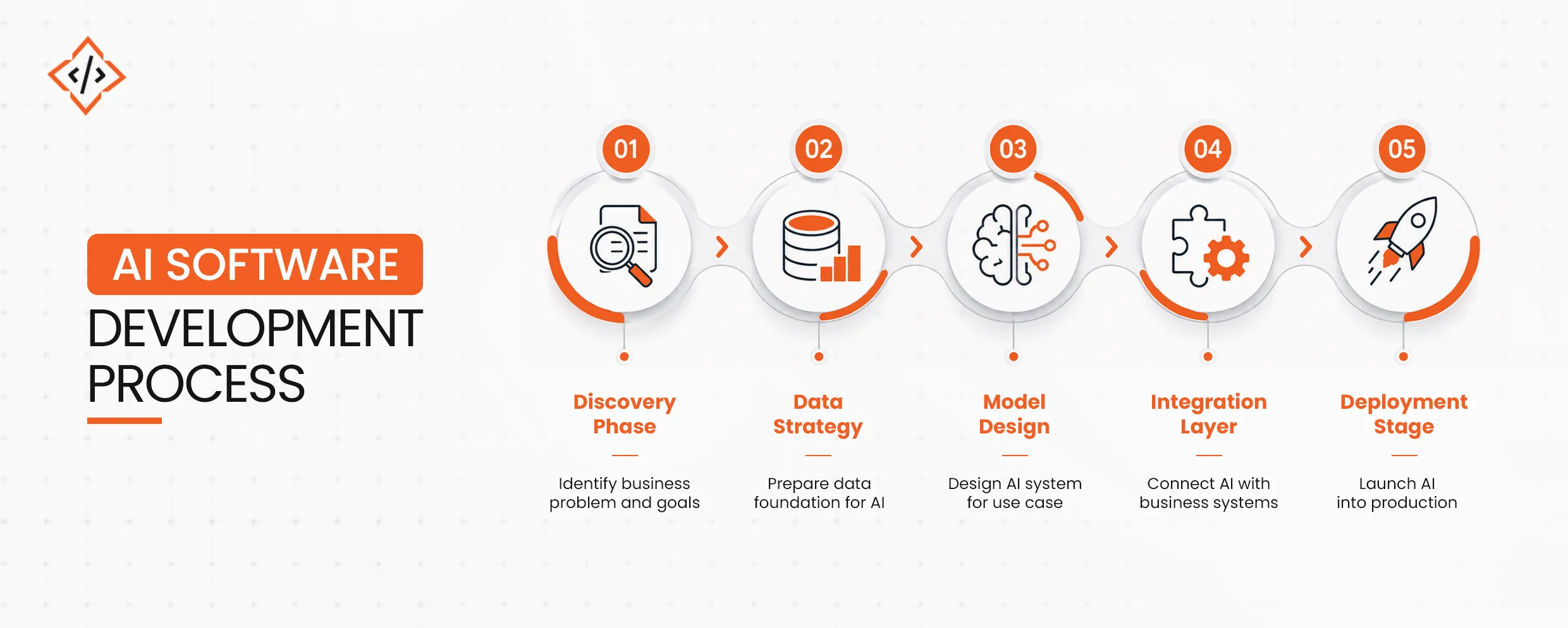
Every custom AI software development project begins with discovery. This stage focuses on understanding the operational problem before development begins. Teams define what needs improvement, where inefficiencies exist, and what success should look like after deployment.
This is also when use-case mapping happens. It separates useful AI applications from ideas that may not create measurable value. Then a feasibility review checks if the business has the data, the systems, and the internal readiness to move ahead. A solid discovery phase reduces wasted development effort later.
Data is the working foundation behind every AI system. Without dependable data, even well-built models struggle to perform consistently.
This stage is about collecting the right datasets and checking their quality. Teams evaluate completeness, accuracy, structure, and relevance. Missing fields, duplicate records, and inconsistent formatting are usually identified during this stage.
The goal is not only to gather data. The goal is to make sure the data is usable for real business outcomes. For many businesses, this is where the biggest preparation work happens.
Once the data is ready, the AI model design begins. This stage defines how the system learns, processes information, and generates outputs.
The model choice depends on the business use case. A customer support assistant requires a different approach than a predictive maintenance engine or fraud detection platform.
This is where AI software development becomes highly strategic. The overall architecture has to match real performance expectations, typical user behavior, and the level of complexity in the business issue at hand. The focus stays on practical performance rather than unnecessary technical complexity.
An AI system becomes valuable when it works within the tools teams already use every day.
This stage links the model with business applications like Odoo ERP development services, CRM systems, APIs, databases, and internal dashboards. The purpose is to make AI part of the workflow instead of keeping it separate from operations.
For example, an AI recommendation engine may need access to customer purchase history inside a CRM. A forecasting model may need inventory data from an ERP.
Strong integration makes AI software development services more practical and easier to adopt across teams.
Deployment is the point where the solution moves from testing into real operations. The AI application is launched into the production environment and made available to end users or internal teams. Performance is observed closely during this stage.
This includes checking output quality, system stability, response time, and workflow usability. Deployment is not treated as the finish line. It is the beginning of how the software performs in real business conditions.
AI systems improve through continuous learning after launch. Once in production, the model is monitored against live performance data. Teams review accuracy, user feedback, changing business conditions, and output quality over time.
When needed, the model is retrained using new data. Rules are refined. Performance gaps are corrected. New use cases are often added in later phases. This ongoing cycle is what makes enterprise AI development scalable over the long term. The strongest AI systems are not static. They improve as the business grows.
Building AI software starts with asking the right business questions before development begins. Early evaluation matters because it helps teams lower risk sooner and choose better long term decisions later on.
AI depends on data quality from the beginning. Businesses should assess whether they have structured or unstructured data that is usable and relevant. Clean and connected data creates a stronger foundation for custom AI software development and improves output over time.
Clear business goals should be defined before any build starts. Teams need to know what outcome the software is expected to support. Strong custom AI development begins with measurable purpose and clear operational direction.
The AI solution should work with existing systems already used across the business. Compatibility with platforms, APIs, and internal workflows makes implementation smoother. This makes AI software development services easier to scale across teams.
Cost should be measured beyond initial development. Businesses should compare build investment with long-term operational value, efficiency gains, and expected return over time.
Security, privacy, and governance should be treated as required steps from the beginning. This becomes even more important as enterprise AI development expands across systems and business functions.
Custom AI software development is moving from experimentation into core business infrastructure. When companies build AI around their own workflows, they create systems with stronger long-term value.
The real advantage comes from solving operational problems with precision and building solutions that improve with use. As AI adoption grows across industries, tailored software will continue to shape how businesses operate, make decisions, and scale.
For leaders thinking about the next phase of digital growth, it’s not just about adoption anymore. It is about building intelligent systems that fit the business from the start and continue delivering measurable value over time.
At CodeTrade, custom AI software development is approached with a strong focus on business outcomes, usability, and long-term scalability. The team works closely with businesses to design intelligent solutions that fit real workflows, integrate with existing systems, and perform reliably in production environments.
 Chand Prakash
 Chand Prakash
 Chand Prakash
 Chand Prakash
 Chand Prakash