






Enterprise Application
.NET Development
 Bhavesh Kachadiya
06 October 2026
Bhavesh Kachadiya
06 October 2026
How Do You Successfully Migrate .NET to Linux Without Breaking Legacy Dependencies?
 Bhavesh Kachadiya
Engineers fluent in minimal APIs and dependency injection often lack experience reading legacy WebForms pages. Conversely, those who understand fifteen-year-old business logic might rewrite it using outdated 2012 patterns. Neither profile is inherently wrong when you hire .NET developers for complex enterprise projects.
These represent entirely different capabilities rather than a single unified skill set. Writing one generic job description for three distinct roles causes major .NET developer hiring failures. Successful .NET application modernization requires both skill sets working together seamlessly.
It also demands a third platform capability that traditional IIS teams frequently lack completely. This guide details these three mandatory capabilities and explains how to test each one accurately before you hire .Net developer talent. It covers which delivery models suit specific project stages when seeking .NET development services. Finally, it outlines the critical contract terms that protect client leverage after development finishes.
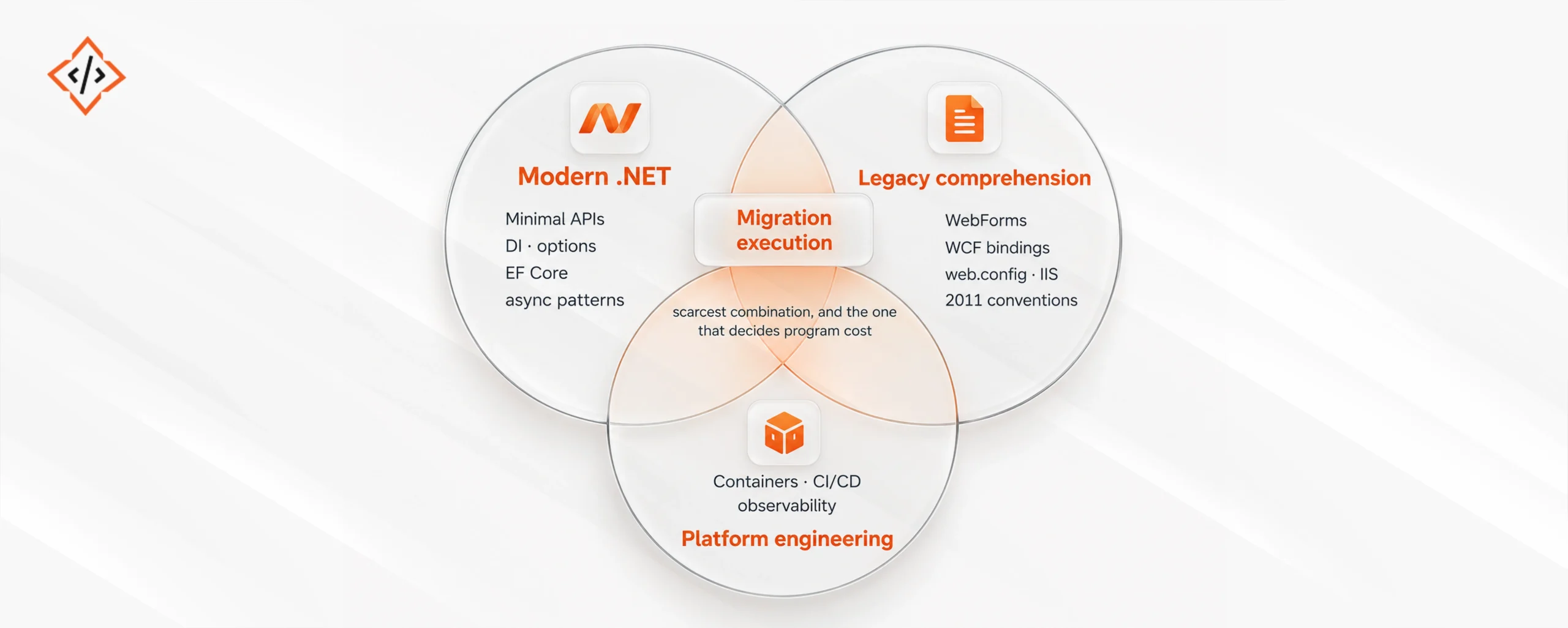
Technical leaders must evaluate three completely distinct engineering capabilities when they decide to hire .NET engineers for modernization.
Building and maintaining current applications involves minimal APIs, MVC, dependency injection, and modern async patterns. Teams utilize Entity Framework Core alongside robust testing protocols. These skills remain widely available today. Conventional interviews test them reasonably well when companies hire dedicated .NET developers.
The true differentiator inside this specific group remains data-access judgment. Most developers can easily write a basic LINQ query. Fewer can explain why a particular query produces an N+1 pattern. Fewer still check the generated SQL before making performance assumptions.
This involves reading older .NET Framework applications accurately. It covers the WebForms page lifecycle, WCF bindings, ASMX services, and web.config transforms. It includes understanding GAC dependencies and undocumented conventions adopted in 2011.
These specific skills remain incredibly scarce and keep shrinking daily. Their absence turns a standard modernization port into a massive archaeology project. The actual value is not writing that old code again. Legacy .NET developers must explain what the existing application does clearly. This ensures the replacement preserves critical business behavior while dropping outdated functions.
This covers containers, continuous integration pipelines, cloud hosting, and robust observability. It includes the entire operational side of running applications on Linux. This remains strictly necessary for anything moving off traditional Windows hosting. These skills are frequently absent from teams who only ever deployed to IIS.
This specific capability matrix helps engineering leaders accurately evaluate required technical proficiency across three completely different architectural domains.
| Skill | Modern .NET | Legacy Comprehension | Platform |
|---|---|---|---|
| Minimal APIs / MVC / DI | Essential | Basic | Working |
| Async and concurrency | Essential | Working | Working |
| EF Core and generated SQL | Essential | Working | Basic |
| WebForms page lifecycle | - | Essential | - |
| WCF bindings and behaviors | Basic | Essential | Basic |
| web.config and IIS behavior | Basic | Essential | Working |
| Upgrade Assistant / analyzers | Working | Essential | Working |
| Characterization testing | Working | Essential | Basic |
| Containers and Linux hosting | Working | Basic | Essential |
| CI/CD and deployment | Working | Basic | Essential |
| Observability and tracing | Working | Basic | Essential |
Effective screening requires evaluating deep architectural reasoning rather than testing basic language syntax when evaluating .NET migration developers.
Conventional interviews test language trivia and framework recall when evaluating .NET developers for hire. The following technical questions predict actual modernization capability far better.
The strongest signal remains carrying applications across major version boundaries. This experience teaches why upgrade-safe code truly matters. Standard greenfield development work never provides this specific technical perspective.
If .NET remains core to your business permanently and local markets supply necessary skills, build your team in-house. External partners simply rent technical capabilities your organization should truly own. Future knowledge handovers cost significantly more than proper .NET developer hiring today.
Organizations needing one bounded integration or single service should hire independent contractors. Dedicated teams provide the wrong structural shape and price for those smaller scopes.
Technical leaders must avoid fixed-bid framework migrations even when they appear safer on paper. Crucial project scope emerges only while actively reading the existing legacy application. Contracts built to resist scope change turn every technical discovery into an expensive argument. Your business ultimately pays for every argument during .NET application modernization.
Selecting the proper delivery model determines whether your enterprise modernization program succeeds or suffers massive budget overruns.
| Model | Suits | Fails When | Why |
|---|---|---|---|
| Fixed-bid | Bounded and well-understood pieces like one service or integration. | Complex framework migrations and first-phase discovery. | Requirements emerge during discovery. The contract strictly punishes finding them. |
| Dedicated team | Multi-phase modernization projects where architectural knowledge compounds. | Genuine one-off work with a strict hard end date. | Legacy comprehension accumulates and cannot be re-acquired cheaply when you hire dedicated .NET developers. |
| In-house | .NET remains core and permanent while local markets supply talent. | Specific skills are needed for a finite program. | Internal hiring lead times frequently exceed the actual program duration. |
| Hybrid | In-house teams own the product while partners supply migration capability. | Structural ownership boundaries remain completely undefined. | It works well when strictly documented but fails when assumed. |
Fixed-bid contracts deserve particular caution during complex framework migrations. This rigid dynamic consistently produces massive project overruns. The Panorama Consulting Group 2026 ERP Report highlights this specific reality. It places inadequate change management and inexperienced teams among top failure causes. These exact factors drive more than 75% of failures when seeking .NET modernization services.
Establishing specific contractual terms guarantees long-term project control when organizations hire dedicated .NET developers for complex modernizations. Four critical terms remain completely free to agree upon before development work actually starts.
A realistic onboarding ramp for an existing enterprise .NET estate runs four to six weeks. The primary output must remain concrete technical artifacts rather than immediate feature velocity.
| Phase | Duration | What Must Exist at the End |
|---|---|---|
| Access and environment | Days 1 to 3 | Local builds succeed, staging deployments are verified, and database restores are fully tested. |
| Codebase discovery | Weeks 1 to 2 | Comprehensive dependency inventory with maintainer status and a complete Windows-only API list. |
| First supervised change | Weeks 2 to 3 | One low-risk change successfully deployed through the full pipeline including strict peer review. |
| Independent delivery | Weeks 4 to 6 | Scoped development work proceeds under normal review with clearly agreed escalation paths. |
The highest-value onboarding artifact remains a comprehensive system behavior map. This details exactly what each significant architectural module does. It maps which specific business process depends on that module. It also clearly identifies who actually owns that operational process. Most legacy .NET estates lack this crucial documentation entirely. Producing this artifact usually reveals hidden functionality that nobody uses anymore when you hire .NET engineers.
Industry discussions frequently highlight that legacy application comprehension remains incredibly scarce. Few technical guides actually provide a genuinely workable solution.
The most obvious move involves dedicated internal technical training. Organizations pair modern engineers with experienced legacy .NET developers. This treats software archaeology as active knowledge transfer. This approach successfully finishes the immediate migration port.
However, it fails to build general legacy comprehension capabilities. The transferred knowledge strictly concerns one specific application. The next enterprise estate introduces entirely different legacy coding conventions.
The second option involves paying premium market rates for scarce talent. This effectively solves the immediate technical problem. Unfortunately, it prices many organizations completely out of critical .NET modernization services.
An uncomfortable third possibility suggests this capability requires no permanent solution. Legacy comprehension actually possesses a natural expiration date. Every successfully ported framework estate reduces the total global backlog. Eventually, remaining legacy systems will simply lack financial justification for modernization. Honest technical advice suggests running them behind strict firewalls indefinitely. This represents a stark reality for specific stranded application estates.
Organizations must carefully evaluate which specific path suits their technical infrastructure. Different business models require entirely different approaches when seeking .NET migration developers. Engineering leaders must assess their unique situation before committing project budgets.
Stop writing single job descriptions for three completely distinct technical roles. Modern code fluency remains common but necessary platform engineering is often lacking. True legacy comprehension strictly dictates if your complex migration succeeds or fails. When you hire .NET developers, screen for architectural reasoning rather than simple syntax recall.
Ask candidates about N+1 database queries or real modernization blockers. Find enterprise .NET developers who check product roadmaps before executing any technical inventories. Organizations must avoid fixed-bid contracts for discovery-heavy migration work entirely.
These rigid contracts for .NET development services strictly punish the exact architectural discoveries your project requires. Protect your technical investment properly before the first code commit occurs. Secure client-owned repositories and strict upgrade-path commitments immediately when securing .NET development services.
Demand detailed system documentation alongside named teams with clear substitution notice. This structured hiring approach ensures your .NET application modernization succeeds seamlessly without unexpected budget overruns.
It depends which of the three capabilities you're hiring. Modern fluency needs minimal APIs, dependency injection, async patterns, and EF Core with generated-SQL awareness. Legacy comprehension needs WebForms, WCF, and web.config. Platform work needs containers, CI/CD, and observability.Asking a candidate to walk through a Framework migration they performed and describe what blocked it. Genuine experience produces specific blockers such as an abandoned package or an authentication model that wouldn't carry over. Secondhand familiarity produces a description of the tooling.Rarely. The scope that matters is discovered while reading the existing application, so a contract structured to resist scope change turns every discovery into a negotiation. Fixed-bid suits bounded, well-understood pieces such as a single integration.Because it isn't career-enhancing work, so the engineers best qualified for it have the most attractive alternatives. Pairing transfers application-specific knowledge rather than a general skill, which means the scarcity persists across engagements rather than being trained away.Client-owned repository from the first commit, an upgrade-path commitment for custom code, documentation as a deliverable in the repository, and a named team with substitution notice. On modernization work the last one matters unusually much, because accumulated legacy understanding is the real asset.
 Bhavesh Kachadiya
 Bhavesh Kachadiya
 Chand Prakash
 Hardik Soni
 Hardik Soni