






Odoo Development
Hire Developers
 Hardik Soni
14 September 2026
Hardik Soni
14 September 2026
How to Hire Odoo Engineers Without Derailing Your ERP Implementation?
 Hardik Soni
Choosing an ERPNext partner requires more scrutiny than selecting a consultant for many commercial ERP systems. Licensed ERP vendors often provide partner programs, certifications, and commercial relationships that create an extra layer of accountability.
ERPNext does not offer the same vendor-led control because the software is open source and does not depend on license sales. That gives buyers more freedom, but it also makes delivery quality harder to judge before a project begins. A provider offering ERPNext implementation services may have deep functional experience or only limited exposure to real business environments.
The same gap appears on the technical side, where strong ERPNext developers must understand Frappe extension patterns and upgrade risks. Good ERPNext consulting services should make those differences clear before scope and pricing are agreed. The real task is to screen capability, evidence, ownership terms, and post-launch responsibility before choosing who will build and support the system.
Choosing the right ERPNext partner starts with understanding that functional consulting and Frappe development solve different parts of the implementation.
Functional consulting covers process discovery, chart of accounts design, item and warehouse structure, workflow configuration, user training, and decisions that shape the data model. The work is mostly configuration rather than code.
The distinguishing skill is knowing what ERPNext already does. One of the costliest ERP mistakes is custom-building something the product already supports. This usually happens when nobody providing ERPNext consulting services knows the product well enough to recognize its native capabilities.
Frappe Framework development covers custom apps, custom fields and DocTypes, server scripts, API integrations, custom reports, and migration tooling. It requires Python knowledge along with an understanding of the framework’s metadata-driven conventions.
The distinguishing skill is extending rather than modifying. The framework provides proper extension points, and code that uses them survives upgrades. Code that changes the core system often does not.
The capability split shows where functional expertise ends, where ERPNext developers take over, and where both roles must overlap.
| Skill | Functional | Framework dev |
|---|---|---|
| Process discovery and mapping | Essential | Basic |
| Chart of accounts design | Essential | – |
| Item, variant, warehouse modeling | Essential | Working |
| Workflow and approval configuration | Essential | Working |
| Data migration and reconciliation | Essential | Essential |
| Python and the Frappe Framework | – | Essential |
| Custom doctypes and server scripts | Basic | Essential |
| API and third-party integration | Basic | Essential |
| Custom report and print format work | Working | Essential |
| Upgrade-safe extension patterns | Working | Essential |
| Hosting, backup, monitoring | Basic | Working |
Small engagements combine these capabilities in one person, and that person is rare and usually expensive. Larger engagements separate them, and the handover between the two is where requirements often get lost.
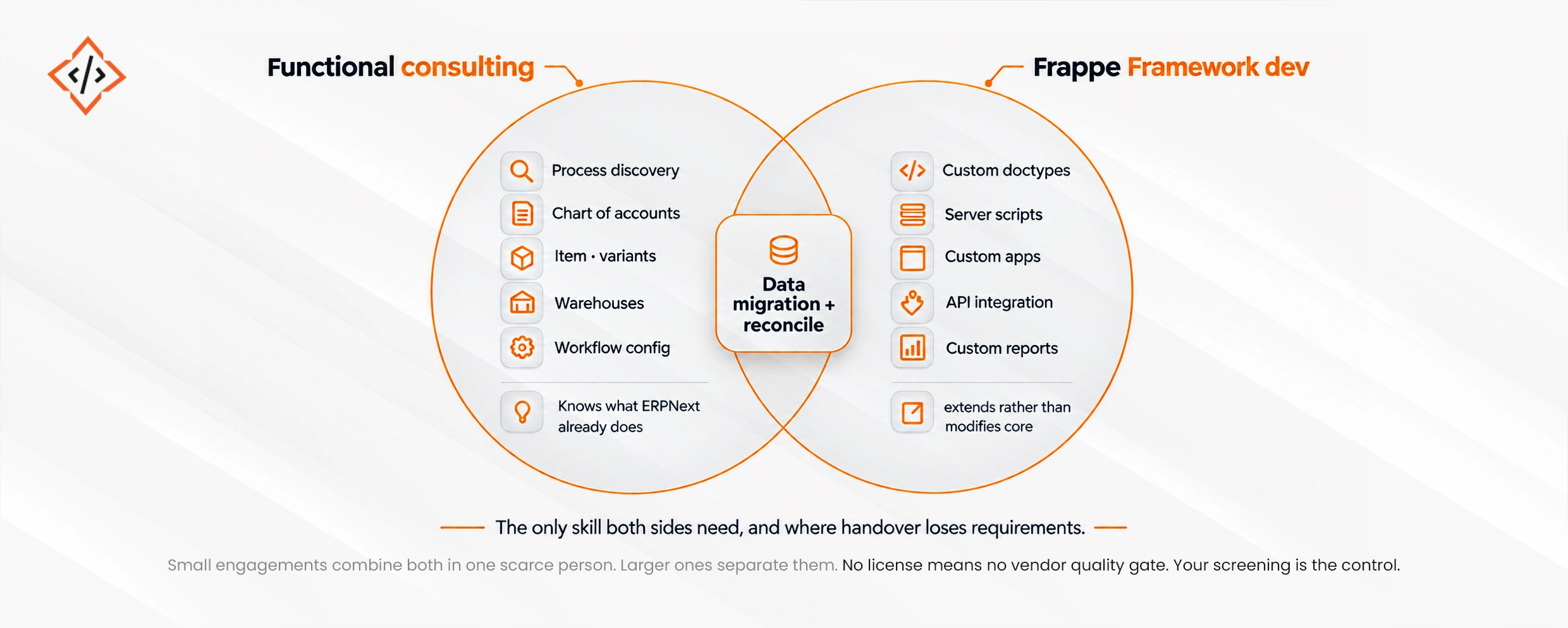
The overlap is narrow, but it is the part that decides whether the opening position can be verified.
These questions help reveal whether an ERPNext partner has practical experience, sound technical judgment, and a clear approach to delivery. Generic ERP sales conversations rarely reveal real competence. These questions are more useful.
Inheriting and stabilizing somebody else’s ERPNext instance. A greenfield implementation teaches configuration. Inheriting a customized instance teaches why extension patterns, documentation, and naming discipline matter. It often means spending weeks reconstructing decisions that were never documented.
Partners with this experience tend to build differently. They document decisions as they work because they have experienced the consequences of missing documentation firsthand.
A negative signal is extensive core modification with no discussion of upgrade consequences. This often leads to an instance that cannot be updated reliably. On a self-hosted system, that can eventually mean missing important security patches.
If your processes stay close to ERPNext defaults and you have technical expertise in-house, you may not need an ERPNext partner. The documentation is clear, the community is active, and your team will understand its own system better than any external partner can explain it back to you.
If you expect a partner to make a chart of accounts or approval decisions for you, that is not something any ERPNext consulting services provider can own well. We can facilitate those decisions and challenge weak assumptions. We cannot make them for you, and a partner who claims otherwise will hand them back during user acceptance testing.
And if the only reason you chose ERPNext is to avoid license fees, but nobody will operate it after go-live, reconsider the
These contract terms protect ownership, continuity, and upgradeability before your ERPNext partner begins implementation work on the system. All are cheap to agree on upfront and expensive to negotiate later.
These terms mirror those in the Odoo engineering hiring guide, and none of them is a rate argument. They decide whether you own the implementation or simply rent access to it.
Partner selection is the primary quality control in ERPNext, and the six questions above provide a useful starting point. However, screening questions are less reliable than they may appear when used on their own.
These questions mainly test candor. Asking what a consultant advised a client not to build, how a migration failed, or what they would refuse to customize can reveal sound judgment. Strong ERPNext partners should be able to explain their limits and show where ERPNext customization would create unnecessary cost or upgrade risk.
The limitation is that good answers can be learned. Once screening questions become public, any provider can prepare convincing responses without having the experience behind them. The same issue applies to technical interview questions, as noted in the Flutter hiring guide.
Checkable evidence is harder to prepare. Ask to review a relevant code repository, speak with a previous client, or see a redacted migration reconciliation document from a real project. For ERPNext migration services, this type of evidence shows whether the partner can manage real data issues rather than simply describe the process.
Use screening questions to start the evaluation, but do not let them complete it. The final decision should depend on evidence that confirms how the ERPNext partner actually works.
Choosing an ERPNext partner is less about polished proposals and more about evidence of how they work under real conditions. The right team should understand native ERPNext capabilities, know when customization is necessary, and protect the upgrade path from the start.
Strong ERPNext developers should extend the Frappe Framework without changing core code or creating avoidable maintenance risks. Functional expertise matters just as much because poor process decisions can weaken even a technically sound implementation. Ask for proof through repositories, client references, migration reconciliation records, and examples of systems they have inherited and stabilized.
Before ERPNext implementation services begin, confirm repository ownership, documentation standards, upgrade responsibility, and the named delivery team in writing. Also decide who will operate the system after go-live. These checks make partner selection more reliable and reduce long-term dependency. Choose an ERPNext partner that can demonstrate disciplined delivery, not simply describe it well.
 Hardik Soni
 Hardik Soni
 Chand Prakash
 Bhavesh Kachadiya
 Bhavesh Kachadiya