






Mobile App Development
FinTech & Banking
 Chand Prakash
01 October 2026
Chand Prakash
01 October 2026
How to Secure a Flutter FinTech App for Regulated Finance?
 Chand Prakash
A developer can build a competent-looking application after just a few months of learning Dart. That reality creates a costly trap for technical leaders overseeing enterprise Flutter app development projects. The hardest parts of Flutter mobile app development remain completely invisible in a traditional portfolio demo.
Platform channel architecture, background execution, release automation, and store compliance rarely show up in early project presentations. Yet these complex technical areas dictate ongoing maintenance expenses down the road. Engineering managers often evaluate basic widget layout instead of assessing core Flutter developer skills. Teams discover this critical gap months later when background services fail under real operational constraints.
Deciding to hire Flutter developers requires evaluating platform integration and release engineering rather than simple UI composition. Technical leaders seeking senior Flutter developers must look past standard demos to verify architectural depth. This guide outlines the three capabilities your program needs, appropriate delivery models, and critical contract terms.
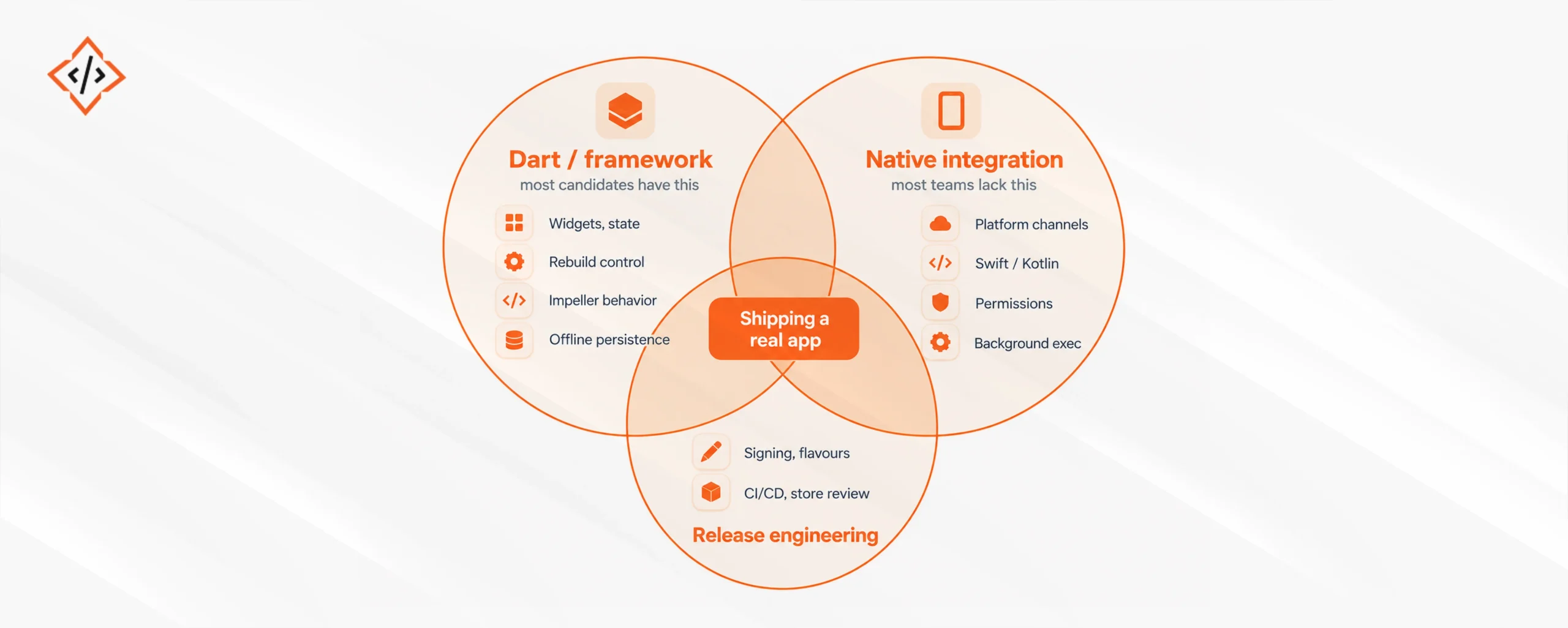
A successful enterprise mobile application requires three distinct technical capabilities to ensure long-term stability and consistent production deployments. Small teams often combine these roles while larger programs separate them logically.
This capability owns widget composition, state management, navigation, and rendering performance characteristics. Most candidates possess this skill, and standard interviews test it heavily. The true marker of senior Flutter developers remains architectural restraint. Strong engineers utilize fewer packages and keep state management completely consistent. They explain exact rebuild triggers instead of wrapping problems in another widget.
This area handles platform channels, Swift and Kotlin interop, and system permissions. It manages background execution, push notifications, deep links, and native SDK integrations. A standard Flutter development team lacks this capability more than any other. Its absence leaves a highly recognizable technical signature during production.
The application works perfectly in happy paths but fails around the operating system. Background location tracking completely stops when users background the iOS application. Push notification behavior differs across platforms in entirely unplanned ways.
This function owns build flavors, code signing, CI/CD, and final store submission. It manages staged rollouts, crash reporting, and over-the-air remote configuration updates. This capability remains strictly mandatory for proper Flutter mobile app development. Release friction directly limits how often your engineering team can actually ship.
App store review represents a genuine engineering constraint rather than administrative overhead. Teams lacking this capability discover strict policy requirements during final submission. Fixing architectural compliance issues at this stage always costs the most money.
This comprehensive skills matrix helps technical leaders evaluate candidates accurately when you decide to hire Flutter engineers today.
| Capability | Dart / Framework | Native Integration | Release Engineering |
|---|---|---|---|
| Dart language depth, async operations, and isolates | Essential | Working | Basic |
| Widget composition and rebuild control | Essential | Working | - |
| State management utilizing one approach deeply | Essential | Basic | - |
| Rendering mechanics and Impeller engine behavior | Essential | Working | Basic |
| Platform channels and Pigeon implementation | Working | Essential | Basic |
| Swift and Kotlin reading and writing | Basic | Essential | Working |
| Device permissions and background execution | Working | Essential | Basic |
| Push notifications configuration per platform | Basic | Essential | Working |
| Build flavors and code signing | - | Working | Essential |
| CI/CD pipelines and store automation | - | Basic | Essential |
| Crash reporting and release monitoring | Working | Working | Essential |
| Offline-first architecture and local persistence | Essential | Working | - |
| Accessibility standards and platform conventions | Essential | Essential | Basic |
| Automated unit, widget, and integration testing | Essential | Working | Essential |
Most interviews test basic widget knowledge. These specific questions evaluate expensive Flutter developer skills instead.
If you need one custom feature added to an existing application, hire a freelance contractor. A dedicated Flutter development team is the wrong shape and price for small, bounded work.
If mobile represents the genuine core of your product, build your engineering team in-house after finalizing your internal Flutter vs React Native debate. We would simply be renting you a capability your organization must own permanently. A complex handover two years later becomes significantly more expensive than hiring today.
Do not start an engagement if nobody on your side can actually approve a release. Every single store submission requires a clear internal decision-maker. Any project where that specific person does not exist stalls exactly when technical execution starts costing you money.
Choosing the correct engagement model ensures your technical investments align perfectly with long-term Flutter app development services requirements.
| Model | Works when | Fails when | Notes |
|---|---|---|---|
| Fixed-bid project | Scope remains genuinely fixed with a defined MVP and an agreed feature list. | Requirements evolve after user feedback, which happens normally on mobile platforms. | Store review cycles make hard deadlines extremely risky. |
| Dedicated team | Ongoing product development exists alongside a clear roadmap and frequent software releases. | Building a one-off application with a hard deadline and zero maintenance plan. | Best fit for most mobile products requiring continuous OS-version maintenance. |
| In-house | Mobile represents the absolute core product for your specific business operations. | Mobile serves merely as one distribution channel among several other platforms. | Hiring all three technical capabilities locally remains quite slow. |
| Hybrid | In-house product ownership combines with contracted release engineering and native depth. | Technical ownership boundaries remain completely undefined between the respective engineering teams. | This approach remains both highly common and extremely effective. |
One crucial consideration remains specific to mobile software engineering. A mobile application is never truly finished. Both iOS and Android ship major operating system versions annually. Both platforms regularly change permission models, notification behaviors, and app store policies.
A delivery model lacking proper maintenance provisions produces applications that silently break within two years. This reality explains why securing a dedicated Flutter development team consistently beats pure fixed-bid contracts.
Properly onboarding senior Flutter developers to achieve genuine productivity on an existing complex codebase requires about four weeks.
| Phase | Duration | Done when |
|---|---|---|
| Environment and access | Days 1 to 2 | Debug builds run successfully on physical iOS and Android devices rather than just software simulators. |
| Signing and store access | Days 2 to 4 | Engineers produce signed builds with store roles granted at the correct administrative permission level. |
| Codebase orientation | Week 1 | State management approaches remain fully documented alongside a clearly understood platform-channel inventory. |
| First supervised release | Week 2 | Teams ship one small code change successfully through CI pipelines for internal distribution. |
| Independent delivery | Weeks 3 to 4 | Engineers take scoped work with normal code reviews while joining active crash-report rotations. |
When integrating external Flutter development services, engineering teams consistently underestimate signing and store access requirements. Provisioning profiles, certificates, and app store permissions routinely take longer than standard technical onboarding. Blocking your new Flutter app developers from producing signed builds directly delays everything downstream.
A complete platform-channel inventory remains the highest-value onboarding artifact. This document lists every channel, its wrapped native capability, and tested platform versions. Most enterprise codebases lack this essential documentation entirely. Producing it immediately surfaces forgotten native code requiring thorough technical review.
Establishing strict vendor contracts with a Flutter development company protects your core intellectual property from future operational disasters. Four critical contractual clauses matter immensely, and one mobile-specific requirement gets missed frequently.
These mirror the terms in the Odoo engineering hiring guide, plus store and signing custody. None of this represents a simple rate-card argument. These specific legal terms dictate whether you truly own your application or merely rent access to it.
The question regarding when Flutter is the wrong choice appeared earlier in this guide, but that specific advice requires slight modification.
It remains a good question that has unfortunately become overly famous. Candidates actively prepare for this exact scenario today. The previously described strong answer appears verbatim inside every single interview preparation article. Fluent delivery no longer clearly indicates genuine engineering judgment versus simple reading comprehension. Assessing true Flutter developer skills requires moving beyond rehearsed theoretical responses.
Engineering managers should ask about actual technical decisions candidates made personally. Ask them to describe choosing a package over writing a custom platform channel and explain the final results. This specific retrospective approach remains significantly harder to prepare for before an interview. The resulting messier answers reveal exactly how dedicated Flutter developers handle real architectural tradeoffs in production.
Publishing effective screening questions publicly inevitably guarantees candidates will eventually memorize them perfectly. This creates a predictable cycle when you hire Flutter engineers for enterprise projects. Every single technical evaluation question listed above possesses a limited effective shelf life before requiring complete replacement.
Hiring dedicated Flutter developers succeeds when organizations evaluate the role across three distinct technical capabilities. Basic Dart and framework engineering remains an abundant skill in the current market. Native platform integration stands as the genuinely scarce capability.
Its absence consistently produces applications that function perfectly until they interact with the underlying operating system. As you prepare to hire Flutter developers, recognize that proper release engineering ultimately decides how often your team can actually ship updates.
Technical leaders must screen for these expensive skills directly. Ask candidates about specific platform channel decisions they made and how those architectural choices performed. Question how background execution differs across mobile platforms. Discuss store submission requirements thoroughly before you hire Flutter developers for complex enterprise projects.
Finally, select a delivery model acknowledging that mobile applications are never truly finished. Budget four full weeks for technical onboarding while ensuring store access occurs immediately. Secure your store accounts and signing-key custody in writing before the first commit. This final contractual term remains genuinely painful to fix after development begins.
 Chand Prakash
 Chand Prakash
 Chand Prakash
 Chand Prakash
 Chand Prakash