






Mobile App Development
 Chand Prakash
01 October 2026
Chand Prakash
01 October 2026
How Does Flutter CI/CD Support Safer Enterprise Releases?
 Chand Prakash
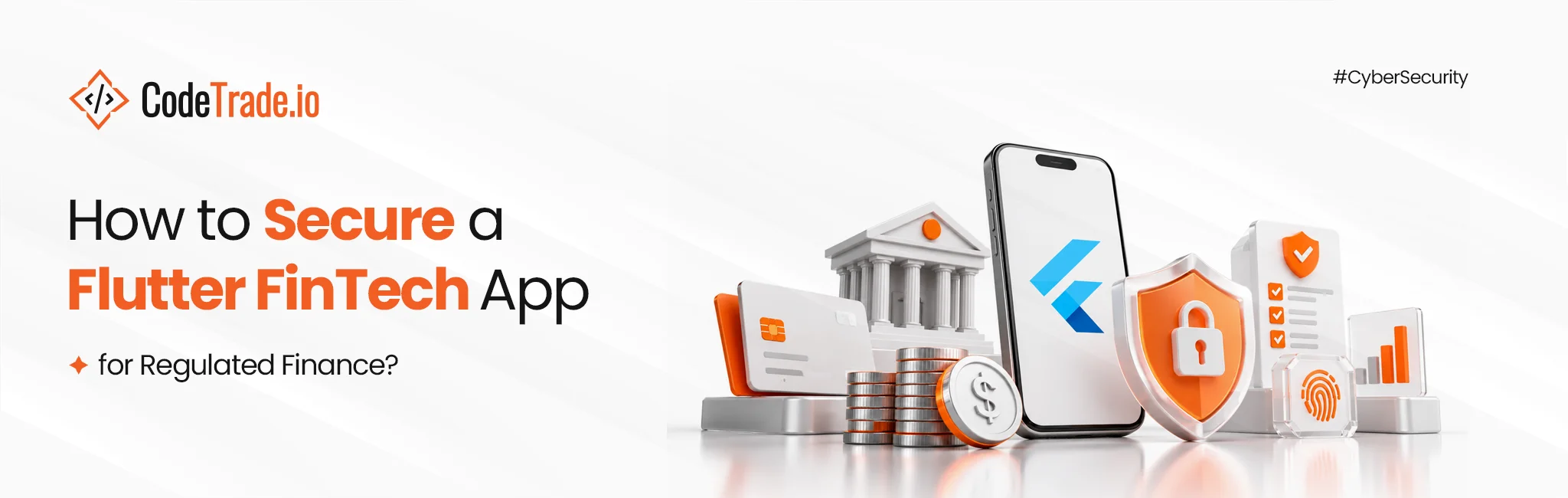
Securing a flutter fintech app starts with understanding what mobile security controls can actually prove. A biometric prompt only confirms that someone passed the device check. It does not prove that the person is the account holder. Strong Flutter biometric authentication should therefore unlock a device-bound key rather than replace identity verification.
Secure Flutter app development services should keep private keys inside the platform keystore and out of Dart code. This is where Flutter fintech app security depends heavily on native iOS and Android controls. A secure design also requires server-side attestation because client-side checks can be altered on a compromised device.
The server should verify trusted platform signals before approving sensitive actions or raising transaction limits. For regulated products, fintech app compliance also depends on evidence that these controls worked as intended.
Flutter fintech development is therefore less about adding security packages and more about designing clear boundaries between Flutter, native security services, and server verification.
For Flutter fintech app security, secrets and authentication tokens should stay outside Dart and remain protected by native platform controls.
One rule: the platform keystore, accessed through a thin channel, and nowhere else.
The specific facilities are the iOS Keychain with Secure Enclave where available, and the Android Keystore backed by hardware where available. Both give you key storage the operating system protects, and both can require user presence to unlock.
What must never hold a secret:
Two implementation points worth stating.
For regulated apps, Flutter biometric authentication should connect user presence to cryptographic proof that the server can verify securely.
Use biometrics to unlock a key, then use that key to prove something to the server.
That gives you three properties a naive implementation lacks. The server receives cryptographic proof rather than a client-reported boolean. The key is bound to that device. And key invalidation on biometric enrollment change becomes available, which matters: if someone adds a fingerprint to the device, the key should be invalidated and re-enrollment required.
The upper path is verifiable. The lower path is the common mistake.
For regulated financial apps, server-side attestation ensures device integrity signals are verified beyond the control of a modified client. Because a modified client reports whatever it’s asked to report.
On-device checks for rooting, jailbreaking, debugger attachment, or tampering are useful signals, and they’re trivially defeated when the client is the only judge. If the app decides locally that the device is safe and sends “safe”: true, that field is under the attacker’s control.
Platform vendors provide attestation services for exactly this. The app obtains a signed token describing app and device state, and the server validates that token directly with the vendor. Trust then rests on the vendor’s signature rather than on the client’s word.
Three design consequences.
Pre-revenue teams building a payments MVP may not need a full compliance program from day one. The immediate priority should be secure key handling, server-side attestation, and other controls that protect sensitive transactions. Broader fintech app compliance work can follow when regulators, enterprise customers, or formal audit requirements make it necessary.
Regulatory requirements also vary by jurisdiction. Teams planning to hire Flutter developer talent should check the frameworks and markets where the partner has direct experience. For regulated Flutter fintech app development, that distinction matters because security controls, documentation, and evidence expectations can differ across regions.
Some teams also need stronger security controls primarily to meet enterprise procurement requirements rather than regulatory obligations. In that case, the scope should focus on mobile banking app security, technical due diligence, and customer assurance instead of a full compliance engineering program. Matching the engagement to the actual requirement helps avoid unnecessary cost and implementation work.
For strong Flutter fintech app security, regulated applications also need controls that protect sessions, screens, transport, and sensitive local data. Beyond keys, biometrics, and attestation, five areas come up in every review.
For healthcare-adjacent financial products, read this alongside SOC 2 and HIPAA readiness, since the evidence expectations are similar in shape.
For fintech app compliance, audit readiness depends on clear records that prove each security control operated as intended in production. Projects lose time here, and designing for it avoids the loss.
| Requirement | Evidence typically requested |
|---|---|
| Strong authentication | Key generation policy, enrollment flow, and server verification logic |
| Key management | Where keys live, invalidation on biometric change, rotation policy |
| Device integrity | Attestation validation performed server-side, with logs |
| Session management | Timeout configuration, server-side invalidation records |
| Sensitive action authorization | Records showing which actions required step-up, and that it occurred |
| Data at rest | What's stored locally, encryption approach, deletion on logout |
| Change control | Release process, code review records, dependency review |
| Vulnerability management | Dependency scanning output, remediation records |
One pattern runs through all eight rows. Auditors want records that something happened, not a description of how it works. A step-up authentication design with no log proving it occurred isn’t evidence.
So design logging as a by-product of the operation rather than something assembled later. And note that these logs are themselves sensitive. No tokens, no keys, no full personal data.
Certificate pinning remains one of the more difficult security decisions in regulated financial apps.
The security argument is straightforward. Pinning can reduce interception risk, and financial app reviewers often expect it as part of mobile banking app security.
The operational risk is just as important. If a pinned certificate expires or changes without a coordinated app release, installed app versions can lose connectivity until users update. Mobile teams also have limited rollback options, which can make recovery dependent on the app store release process.
Backup pins and longer-lived intermediate certificates can reduce this risk, but they do not remove it completely. They make certificate lifecycle management more important, not less.
As a fintech security best practice, certificate pinning is most suitable when the team has a mature release process, certificate expiry monitoring, and clear ownership. Smaller teams with irregular release cycles should assess whether the operational risk justifies the added control before adopting it.
A secure Flutter fintech app depends less on the framework and more on how platform controls are designed and verified. Keys should stay inside the native keystore, while biometric prompts should authorize device-bound keys instead of replacing identity checks. Server-side attestation adds another layer of trust by validating device and app signals beyond the client itself.
Strong Flutter fintech app security also requires disciplined session handling, local data minimization, secure transport, and controlled access to sensitive screens. For fintech app compliance, technical controls must produce clear evidence that auditors can review without reconstructing events after deployment.
Certificate pinning also needs careful operational planning because stronger protection can create serious availability risks when certificate management fails. Teams should treat security architecture, evidence collection, and release operations as connected responsibilities from the start. That approach gives FinTech Solutions a stronger foundation for production use, customer trust, and future audit requirements.
 Chand Prakash
 Chand Prakash
 Chand Prakash
 Chand Prakash
 Chand Prakash