





Mobile App Development
Hire Developers
 Chand Prakash
05 October 2026
How Should You Screen and Hire Flutter Developers for Enterprise Applications?
 Chand Prakash


Development teams often argue for weeks about choosing the perfect state management library. They heavily debate the merits of BLoC versus Riverpod or Provider. The actual failure occurs when they ship a codebase using multiple different approaches simultaneously. A contractor might prefer one method while an internal engineer implements another. This structural inconsistency creates the most common failure mode in custom Flutter app development.
Every mainstream state library works beautifully at scale when applied completely consistently. None of them function well when mixed within the exact same repository. Building a reliable flutter enterprise architecture requires picking one single state management approach early. It also demands defining strict module boundaries and enforcing those exact rules mechanically.
Essential before you hire Flutter developer talent, this comprehensive guide explores proper state selection alongside clear module structure and critical dependency rules. We will examine a specific testing strategy that keeps large-scale codebases highly navigable and secure.
Selecting the right state framework for enterprise Flutter development demands evaluating team dynamics rather than chasing performance metrics alone. Always base your choice on team fit and enforcement cost rather than theoretical benchmark scores.
| Approach | Suits | Cost |
|---|---|---|
| BLoC or Cubit | Larger teams require explicit event modeling and a heavy testing culture. | Verbose syntax requires significantly more files per feature. |
| Riverpod | Teams wanting strict compile-time safety and easy testing without excessive ceremony. | Introduces newer concepts with multiple ways to accomplish the same tasks. |
| Provider | Smaller applications where development teams already possess deep framework familiarity. | Provides less structure which demands high technical discipline directly from the team. |
| Signals and newer options | Small teams remain completely comfortable with constant technical churn. | Lacks ecosystem maturity and significantly reduces the available hiring pool. |
| Mixed | Suits absolutely nothing. | Represents the most common cause of unmaintainable code in Flutter software development. |
Three specific criteria matter significantly more than the actual library design.
The non-negotiable step involves documenting the choice and enforcing it strictly. Place a single architectural document directly in the repository. Add a Flutter CI/CD check rejecting competing library imports. This prevents years of architectural drift.
Establishing a highly logical directory structure early prevents severe technical bottlenecks during complex enterprise mobile app development phases. Always choose feature-first organization over layer-first structures. No other structural decision creates a larger long-term effect on Flutter app development.
Layer-first structures place models and services into top-level directories. This approach fails quickly after building twenty screens. Single feature changes require modifying four distant directories. Multiple teams working simultaneously will constantly collide inside shared files.
Feature-first architecture keeps all related feature components together. It securely places shared code inside a dedicated core module.
lib/
 core/ ← shared, no feature dependencies
 network/ ← http client, interceptors, retry
 storage/ ← local persistence
 auth/ ← session, token refresh
 design_system/ ← tokens, themes, shared components
 platform/ ← platform channel wrappers
 contracts/ ← interfaces features expose to each other
 features/
 orders/
 data/ ← repository impl, DTOs, mappers
 domain/ ← entities, use cases (plain Dart)
 presentation/ ← state, screens, widgets
 catalog/
 account/
 app/ ← routing, DI wiring, bootstrap
Two critical principles govern this specific directory layout.
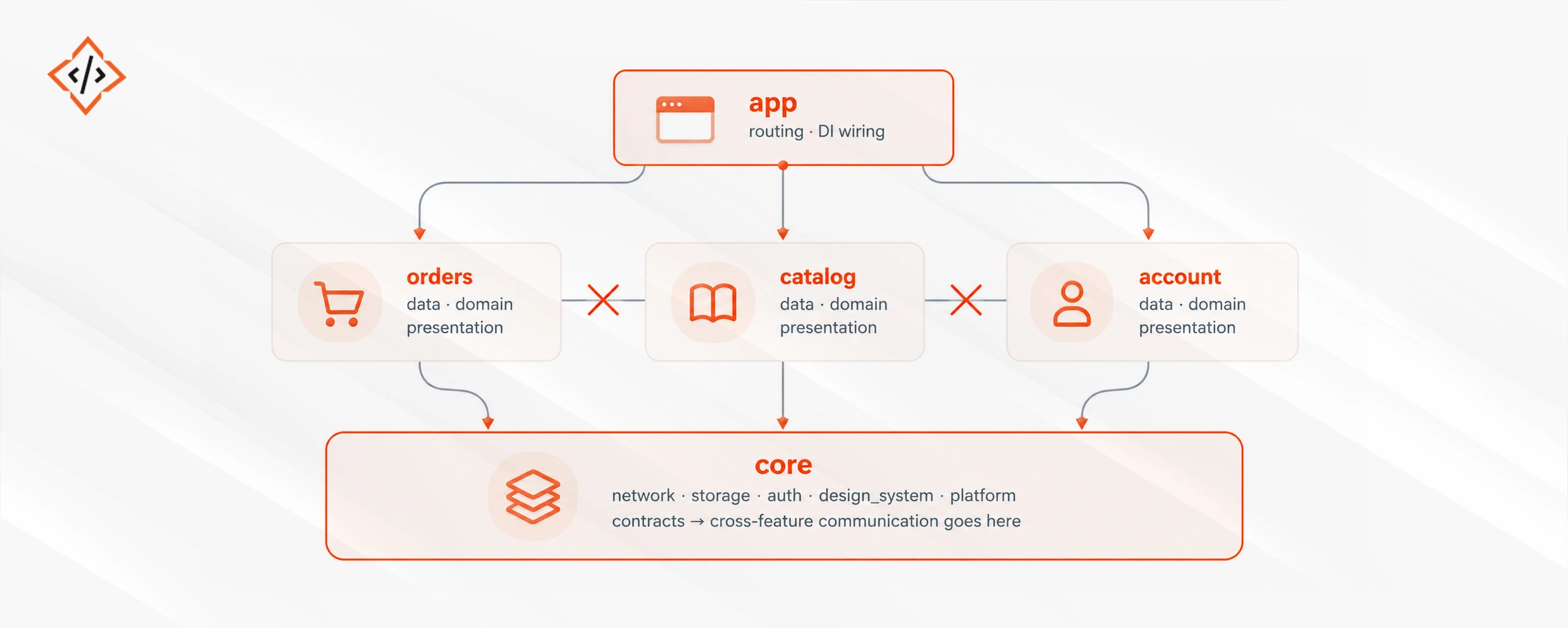
Architectural dependencies must always point downward exclusively. This exact rule remains highly worth enforcing during automated continuous integration checks.
Establishing strict dependency boundaries prevents tight coupling and ensures your flutter enterprise architecture scales flawlessly as teams expand. Implement these four essential rules. Each rule remains mechanically checkable to ensure long-term architectural stability.
Enterprise projects needing separate build units should create Dart packages inside a monorepo instead of simple folders. This strategy turns architectural rules into hard compile-time errors rather than polite conventions. This structural division pays for itself when you hire Flutter developers and scale beyond five engineers.
A robust testing pyramid ensures high reliability and speeds up enterprise Flutter development without slowing down your deployment pipeline. The testing pyramid during Flutter app development differs greatly from standard backend structures. The middle tier remains unusually cheap and incredibly valuable.
| Tier | What it covers | Share of suite | Notes |
|---|---|---|---|
| Unit | Domain logic, application use cases, complex mappers. | ~50% | Fast execution without a widget tree using plain Dart. |
| Widget | Individual screens and distinct UI components in isolation. | ~40% | Represents the absolute highest-value testing tier in Flutter. |
| Golden | Visual regression testing on primary key UI components. | Small | Highly valuable with design systems but brittle if overused. |
| Integration | Full application flows running on a device or emulator. | ~10% | Slow execution requires strict reservation for critical user journeys. |
Widget tests deserve maximum emphasis during Flutter software development. They run in seconds without requiring a physical device. They comprehensively cover the UI layer that changes most often. A codebase featuring good widget coverage allows confident refactoring. This exact practice makes long-lived enterprise mobile app development completely sustainable.
Three specific technical practices matter significantly more than raw coverage percentages.
Two engineers shipping an MVP in ten weeks rarely need this level of strict structural overhead. Implementing complex architecture at this early stage introduces completely unnecessary operational processes. Simply pick one state library and maintain highly sensible folder structures. Organizations should explore enterprise Flutter development practices only after the engineering team expands.
Do not fund a costly migration if an existing codebase works perfectly using Provider. End users never notice or care about internal state management libraries. Upgrading simply to utilize newer technologies wastes valuable technical budget without delivering tangible business value.
Professional Flutter development services become absolutely necessary when multiple teams constantly collide within shared files. Companies must seek external technical intervention when engineers cannot refactor application architecture safely. It is clearly time to hire Flutter developers when accumulated technical debt makes new features excessively expensive.
Documented technical conventions inevitably decay over time. Automated mechanical checks remain completely consistent. Architectural enforcement absolutely belongs inside your automated pipeline. Five specific checks remain highly valuable during custom Flutter app development. All five remain remarkably cheap to implement.
The wider release pipeline encompassing these automated checks is thoroughly detailed in our comprehensive guide to Flutter CI/CD.
Understanding these five common structural bottlenecks early prevents massive technical debt during complex enterprise mobile app development projects. Five recurring problems consistently emerge at scale, requiring specific technical fixes in each individual architectural case.
The preceding guidelines represent strict architectural standards. The following approach remains highly debatable. Making features into real Dart packages creates hard compile errors for boundary violations. This sounds correct in principle but becomes genuinely frustrating during daily execution.
Package splits significantly slow local builds and complicates hot reload functionality. They make dependency version management a massive chore. This structure adds unnecessary friction to routine code refactoring during custom Flutter app development.
The previously suggested threshold of five engineers represents an operational estimate rather than a measured absolute. A disciplined team of eight Flutter developers can work perfectly using simple folders. Conversely, a smaller team might require strict compile-time walls if engineers repeatedly ignore established architectural boundaries.
Team turnover actually predicts this necessity far more accurately than simple headcount. A highly stable engineering team holds architectural conventions naturally. A project constantly cycling external contractors rarely maintains consistency. Treat the suggested team size threshold as a strategic prompt rather than a rigid rule for enterprise Flutter development.
Successful flutter enterprise architecture relies on strict automated consistency rather than loose team agreements. You must select one state management approach carefully and enforce it through rigid Flutter CI/CD pipeline checks. Structuring your codebase feature-first with a shared core prevents dangerous coupling during complex cross-platform app development.
Keep your domain completely free of framework imports to maintain clean testing environments. Whether managing internal teams or engaging Flutter app development services, remember that individual features must never import each other directly under any circumstances. Scaling enterprise Flutter development requires converting these directory boundaries into hard compile errors as your engineering teams grow.
Finally rely heavily on comprehensive widget tests since they provide the highest testing value without requiring physical devices. A thoroughly tested codebase enables confident refactoring which ultimately dictates whether your Flutter mobile app development survives long-term.
 Chand Prakash
 Chand Prakash
 Chand Prakash
 Chand Prakash
 Chand Prakash