






AI
Enterprise Application
 Chand Prakash
16 October 2026
Chand Prakash
16 October 2026
Enterprise AI Automation Strategy: A Step-by-Step Implementation Guide
 Chand Prakash
Businesses have already adopted AI tools, but giving employees copilots is not the same as building an AI workforce. An AI workforce consists of specialized agents that monitor events, work across business systems, and complete defined steps. These intelligent systems also escalate exceptions and coordinate directly with employees. This creates a massive gap between basic adoption and actual AI-powered business automation.
According to the 2025 McKinsey State of AI survey, 62% of organizations are experimenting with AI agents. However, only 23% are scaling an agentic AI system somewhere in the enterprise. In individual business functions, no more than 10% report scaling agents. The core issue is clear.
Deploying enterprise AI automation requires fundamental workflow design, not simply buying more AI software. Organizations must shift focus from equipping individuals with basic chat tools to architecting highly effective AI workforce solutions.
An AI workforce is a coordinated set of specialized AI agents that execute defined responsibilities while employees retain judgment, relationships, and critical approvals. Unlike an assistant that responds to prompts, an autonomous agent monitors operational triggers, retrieves records, and completes permitted actions across business platforms.
The goal is never to replace entire departments, but to divide labor based on where software and people perform best.
The operating model follows a dependable framework where managers set objectives, autonomous AI agents complete defined workflows, and software logs every action. Human specialists step in only to resolve unexpected exceptions or authorize high-stakes decisions.
Furthermore, finance, sales, and operations require dedicated agent roles rather than one general-purpose bot. Each department operates under unique compliance standards, data schemas, and risk thresholds that generic software cannot navigate reliably.
Targeting high-volume reversible tasks first prevents enterprise AI automation from becoming a disorganized list of disconnected departmental experiments.
Ideal candidates for AI workforce automation always feature high transaction volumes and rely on structured business data. Suitable workflows span multiple systems while maintaining predictable rules and low exception frequencies.
Companies must weigh the measurable impact on costs against the consequences of incorrect actions. High-volume tasks consistently make better starting points than rare, high-risk decisions.
Score candidate processes across two dimensions to build a solid AI automation strategy. Assess business value through potential time saved and measurable cost reductions. Measure execution readiness by reviewing data quality, API access, and required approvals. Invoice reconciliation and lead qualification offer high execution readiness and immediate value.
Operational exception triage also serves as a strong early candidate. Conversely, autonomous capital allocation carries extreme risk and remains unsuitable for early deployment. The final output must be a prioritized workflow backlog rather than a random list of AI use cases.
AI agents for finance must focus first on information collection and reconciliation. They also handle forecasting support and exception management. However, human professionals must retain final approval for material financial actions.
AI automation for finance collects data directly from enterprise systems. The agents reconcile accounts and identify unusual variances automatically. They prepare management reporting inputs and draft variance explanations. The key distinction remains clear. Autonomous AI agents prepare and investigate records. Accountable finance professionals approve material adjustments.
Finance agents continuously monitor receivables, payables, and daily cash positions. They track payment trends and forecast assumptions in real time. A 2025 McKinsey survey of 102 CFOs found that 44% use generative AI across five or more use cases.
Furthermore, 65% expect to increase their investments. Finance departments are moving past isolated experiments. These agents flag expected cash gaps and generate scenarios immediately. This replaces slow periodic spreadsheet reviews entirely.
An intelligent automation system identifies duplicate invoices and policy violations instantly. It catches unusual transactions and missing documentation without delay. AI workforce solutions should escalate higher-risk expense exceptions to managers. They must never clear material compliance issues automatically.
AI agents for sales increase seller capacity rather than replacing relationship ownership. They handle research, documentation, and follow-up while salespeople retain negotiation and customer judgment.
An AI-powered workforce combines CRM records with engagement signals to enrich prospect profiles automatically. It qualifies accounts against ICP criteria and routes viable leads. According to McKinsey’s 2025 B2B Pulse research, 19% of organizations use generative AI for B2B sales, while 23% are actively implementing it.
AI automation for sales inspects CRM activity to identify inactive opportunities and missing stakeholders. It flags deal-stage inconsistencies and forecast risks immediately. The system generates an actionable task queue for sellers instead of another static dashboard.
Autonomous AI agents prepare meeting briefs, generate call summaries, and draft contextual follow-up emails. They update CRM systems automatically and set next-action reminders. Human professionals remain fully responsible for pricing commitments, contract negotiations, and sensitive communication.
AI agents for operations create maximum value by continuously monitoring business events. They resolve exceptions much faster than manual queue-based processes.
Intelligent automation detects critical operational deviations instantly. Agents flag delayed orders, inventory shortages, and missed SLA thresholds. They also identify failed transactions and incomplete requests. The system gathers necessary context before identifying permitted responses. It then acts independently or escalates the issue based on predefined thresholds.
These agents orchestrate work across ERP, CRM, and procurement platforms. An operational agent triggers the next logical task automatically while updating records. It notifies the responsible team and tracks the case until resolution. This capability elevates AI workforce automation far beyond simple task execution.
AI automation for operations manages complex work allocation and scheduling. Autonomous AI agents prioritize urgent orders and coordinate vendor service requests. They verify inventory availability across multiple locations in real time. This approach delivers immense value by coordinating several dependent steps instead of isolating actions.
Connecting these departmental agents requires a reliable technical foundation. Enterprise leaders must now focus on building a shared and secure technical architecture.
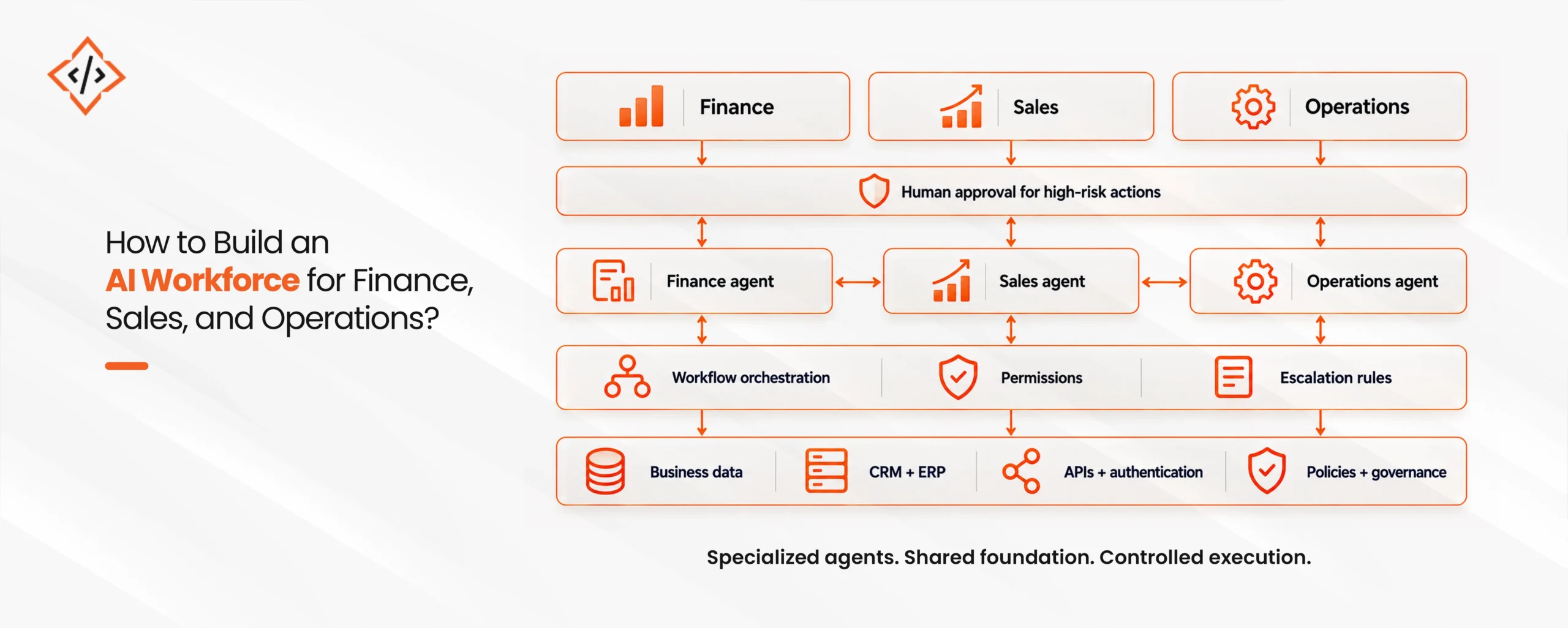
Effective AI workforce solutions require a shared foundation for data, agent responsibilities, permissions, orchestration, and human control.
Autonomous AI agents need reliable access to the exact business context that human employees use daily. This includes CRM records, ERP transactions, operational databases, and corporate policies. Companies must never treat data integration as a secondary technical task. Without accurate data, an AI workforce for business cannot function reliably.
Every agent requires a narrow responsibility, measurable goals, permitted actions, and strict escalation rules. A sales agent manages opportunity context, while an operations agent checks service capacity. Role clarity proves far more effective than building a single generic bot.
An August 2025 Gartner report predicts that 40% of enterprise applications will feature task-specific AI agents by 2026. This marks a massive jump from less than 5% in 2025, proving the need for specialized architectures.
Connecting these systems demands secure APIs, strong authentication, and strict least-privilege access. Different agents should never receive identical system permissions automatically. A sales research agent might simply read CRM records. Conversely, a finance workflow handling payments requires restrictive execution controls.
Establish human checkpoints based on risk levels rather than demanding human approval for every minor task. Human professionals must always handle contractual commitments, pricing changes, and unusual exceptions.
Consider a standard quote-to-cash workflow. Sales agents prepare quotes, operations agents confirm capacity, and finance agents validate credit conditions. Finally, a human manager approves exceptions before agents update the systems, demonstrating true enterprise AI automation.
Scaling enterprise AI automation depends entirely on strict governance and measurable workflow performance. It never relies on the raw number of agents deployed.
Companies must design governance directly into the workflow before deployment. A reliable model requires role-based permissions and strict action limits. It must include clear escalation thresholds and comprehensive audit trails.
Furthermore, sensitive data controls and accurate agent versioning are absolutely critical. Every AI workforce for business must also retain an accountable human owner to manage unexpected risks.
Measure AI workforce solutions against tangible business outcomes rather than vanity metrics. Avoid tracking the sheer volume of agent interactions. Instead, evaluate cycle time reductions, automation rates, and exception resolution speeds.
Track processing costs, forecast accuracy, and overall seller capacity carefully. Monitoring rework rates and direct revenue impact proves the true value of intelligent automation.
A successful rollout requires a very specific operational cadence. Teams must move from baseline measurement into a quiet shadow mode. Next, they transition to controlled execution before attempting any measured expansion. Start with a single limited workflow. Compare the AI performance against existing manual processes closely. Expand agent permissions only when accuracy and business outcomes meet strict agreed thresholds.
Finally, reuse this validated operating model across adjacent workflows. This methodical approach creates a highly repeatable AI automation strategy rather than a disorganized collection of departmental experiments.
Businesses do not need dozens of autonomous AI agents to build an AI-powered workforce. They require a targeted set of high-value workflows. In these processes, responsibilities, data permissions, and human escalation points remain clearly defined. Begin with one measurable workflow in finance, sales, or operations.
Prove the operating model completely before extending the architecture across connected processes. Ultimately, competitive advantage comes from effectively redesigning work around humans and AI. It never comes from simply buying more software.
Transitioning from isolated departmental pilots to scalable enterprise AI automation requires strict architectural planning. The right technical partner for custom AI software development ensures this deployment remains secure and highly effective.
CodeTrade specializes in developing custom AI workforce solutions for complex enterprise environments. The expert team maps operational bottlenecks and architects intelligent systems that integrate securely with existing infrastructure. Reach out to CodeTrade today to design a reliable AI architecture that scales business capacity safely.
 Chand Prakash
 Chand Prakash
 Chand Prakash
 Chand Prakash
 Chand Prakash