






AI
 Chand Prakash
16 October 2026
Chand Prakash
16 October 2026
How to Build an AI Workforce for Finance, Sales, and Operations?
 Chand Prakash
Measurable financial returns from enterprise AI automation require direct connections between reasoning models and live operational databases. An effective enterprise AI automation strategy deploys autonomous pipelines through execution APIs, and production records are validated automatically before any system action occurs. Most corporate budgets are already committed to AI-powered business automation.
Data from a September 2026 Gartner forecast shows that global AI spending will reach $2.7 trillion in 2026, which represents a 49.5% annual increase across infrastructure and software. However, the November 2025 McKinsey State of AI report notes that 88% of organizations use AI in at least one business function, although only one-third have scaled those programs across the enterprise.
This deployment gap occurs because engineering teams attach new models to broken manual workflows, so legacy ERP and CRM systems reject the added transaction load. Technical leaders resolve these architectural bottlenecks when a disciplined AI transformation strategy governs model routing and production reliability.
Most enterprise AI adoption programs stall between initial pilots and production because legacy data silos block dynamic model reasoning. Rigid rule-based scripts are also overwhelmed by multi-step operational logic.
Findings from the November 2025 McKinsey State of AI report show that top companies that generate over 5% of EBIT from AI are 2.8 times more likely to redesign workflows before model deployment, as 55% of those leaders rebuild processes compared to 20% of other firms.
As mentioned earlier, fragmented infrastructure creates severe data bottlenecks across departments. Models fail to execute AI-powered business processes when customer records reside in disconnected SQL databases, and vendor invoices remain trapped inside unindexed PDFs.
A unified retrieval layer is required for accurate context injection into inventory logs. Traditional robotic process automation also obstructs AI workflow automation because static interface scripts use fixed conditional rules. Those brittle sequences are broken whenever an upstream database schema or software layout changes.
Uncontrolled token consumption further threatens enterprise AI implementation when technical teams route minor tickets or basic data extraction tasks to large frontier models. API inference bills are inflated rapidly by this misallocation, so unit economics collapse before the system scales across the organization.
Regulated divisions also face compliance violations and hallucinated records when unverified outputs are written directly to core ledgers during AI business process automation. Deterministic guardrails and human review checkpoints must validate every production payload prior to execution.
A production-ready AI automation framework combines a unified data ingestion pipeline with an intelligent model routing gateway, and a deterministic governance layer completes the architecture. Standardizing these orchestration stacks is a primary budget priority for technical leaders.
Data from a July 2026 Gartner market forecast indicates that end-user spending on AI models and platforms will reach $64 billion in 2026 because enterprise demand drove a 63.4% increase over 2025 levels.
Clean and permission-aware context must reach the model during AI workflow automation. Retrieval-augmented generation pipelines and vector databases index proprietary documents for fast semantic search, while real-time event streams from Apache Kafka supply live operational state.
Unstructured records are converted into standardized embeddings before inference begins. Consequently, the system processes current inventory counts and account statuses with high factual accuracy.
An intelligent gateway evaluates prompt complexity before any model call occurs. Simple classification tasks are directed to compact models so token expenses stay low, whereas high-reasoning models are reserved for multi-step AI-driven process automation.
Through this tiered routing structure, enterprise automation solutions maintain fast response times across heavy workloads.
Strict security controls protect core databases when enterprise AI solutions execute autonomous transactions. Role-based access control restricts model permissions to authorized data tables.
In addition, automated masking filters remove personally identifiable information from prompts prior to external API transmission, although audit logs retain encrypted trace IDs for compliance reviews. Output validation schemas then verify payload structure and data types before any write action reaches an ERP or CRM system.
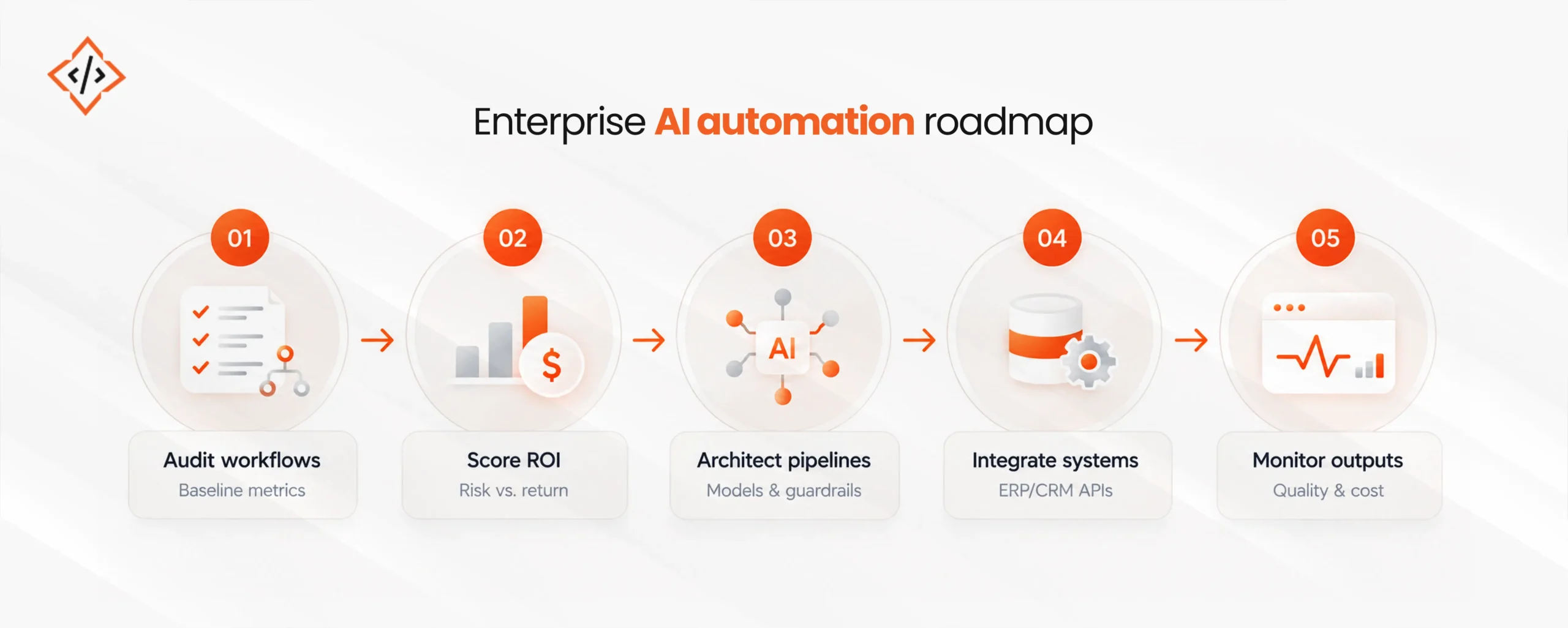
A successful AI automation roadmap follows a sequenced five-stage engineering lifecycle that validates operational bottlenecks and isolates data dependencies before code deployment.
Modular agents are then released in controlled production sprints, so system architects can verify stability at each integration point. Every phase requires strict technical gates because premature scaling introduces severe latency across shared databases.
Engineering teams begin the lifecycle when they map high-volume operational bottlenecks where staff spend hours on data reconciliation across spreadsheets and email threads. Disconnected ERP modules also require manual data entry during daily reconciliation.
Before any code is written, baseline metrics such as transaction cycle time and error rates must be documented by operations leads. The exact labor cost per transaction is recorded alongside those technical logs, although historical audit trails often need manual verification first. This factual baseline governs future enterprise workflow automation benchmarks.
Candidate workflows are filtered next according to data availability and regulatory compliance risk. Finance directors also calculate the expected payback period for each proposed pipeline, so capital flows only to proven bottlenecks.
Technical leaders prioritize business process automation targets that generate measurable cost reductions within a 60 to 90-day pilot window. Scope validation is accelerated when organizations engage AI automation consulting teams to audit database readiness and license expenses. As mentioned earlier, early financial reviews prevent budget waste on low-yield tasks.
System architects select foundational or fine-tuned models and configure vector retrieval indexes to supply accurate domain context. Strict JSON schema constraints are established at this stage because downstream databases require predictable data structures.
Token budgets remain predictable under this design.
Fallback routing logic is also built into the gateway. If a primary model endpoint experiences high latency or triggers a safety classifier, requests are rerouted automatically to a secondary model, so your AI automation strategy maintains continuous execution without pipeline stalls.
The intelligence layer connects to core platforms like Odoo ERP and Salesforce through secure REST or GraphQL APIs. Legacy SAP databases and custom microservices are linked with middleware webhooks to synchronize state changes across departments. Every API call is logged with a unique transaction identifier for security audits.
During initial enterprise AI implementation, engineering leads enforce human approval thresholds on high-value financial transfers and inventory adjustments. An authorized manager reviews flagged payloads before the database commits the record, although low-risk transactions execute autonomously.
Observability tools track model drift and token consumption in real time once the pipeline enters production. Engineering teams also measure p95 and p99 latency alongside first-shot task completion rates to verify system reliability.
Production feedback logs are analyzed weekly, and system prompts are refined to correct recurring extraction errors. Once these accuracy targets hold steady for 30 days, leadership can expand AI automation implementation to adjacent operational divisions.
The highest-yield AI automation use cases target cross-departmental processes that carry high transaction volumes and structured validation rules. Measurable labor overhead is also reduced when these repetitive tasks are automated.
Data from an August 2025 Gartner report predicts that 40% of enterprise applications will include task-specific AI agents for enterprise operations by late 2026, because adoption has accelerated from under 5% in 2025. A separate Gartner hyperautomation forecast projects that the process-agnostic software market will reach $119.2 billion by 2028.
| Enterprise Function | Legacy Bottleneck | AI Business Process Automation Action | Measurable Business Outcome |
|---|---|---|---|
| Finance & AP | Manual three-way invoice matching | Autonomous extraction and contract rate auditing | Faster cycle times and recovered billing overcharges |
| Supply Chain | Static reorder thresholds and delay alerts | Predictive demand slotting and dynamic carrier rerouting | Lower stockout rates and reduced freight costs |
| IT Operations | Manual L1/L2 ticket triage and log parsing | Automated anomaly detection and root-cause remediation | Reduced mean time to resolution (MTTR) |
Accounting departments deploy AI business process automation to compare multi-page vendor invoices with original purchase orders. Extracted line items are then verified against general ERP ledgers, so billing discrepancies are flagged automatically before payment release. Audit cycles shrink significantly, although finance managers still review disputed vendor charges.
Logistics teams use enterprise workflow automation to track live warehouse inventory levels and historical supplier lead times. External weather feeds are analyzed simultaneously because transit delays alter reorder thresholds. When stock quantities reach a calculated minimum, automated purchase orders are sent directly to approved vendors.
System telemetry logs are parsed continuously by autonomous agents, and routine access requests are resolved automatically. Complex security anomalies demand deeper investigation. High-risk alerts are escalated to senior engineers with full diagnostic context, so response teams can isolate affected servers immediately.
Accurate total cost of ownership calculations for enterprise AI solutions measure per-token API inference fees alongside monthly engineering maintenance. Prompt cache discounts and error reduction rates are also factored into the financial model.
Direct expenses cover model licenses and cloud compute, whereas operational budgets are protected when high-reasoning models finish complex tasks on the first pass. Fewer failed runs mean technical teams spend less time on manual output correction.
Repeated input token bills are reduced by up to 90% because static system instructions and repository schemas are stored in a prompt cache. Compliance rules are stored in that same memory layer. In addition, well-designed enterprise automation solutions direct 70% of routine extraction workloads to smaller models, although complex escalations still go to frontier endpoints.
Internal infrastructure builds often suffer from a six to nine-month recruitment delay, so many organizations work with an external engineering firm to deploy enterprise AI automation faster. Dedicated specialists configure the production pipelines through tested templates, and expensive architecture rework is avoided during deployment.
Production growth for enterprise AI automation in 2026 demands strict architectural discipline. Technical leaders must isolate high-friction workflows and enforce data governance rules, while a resilient model gateway is built around foundational models.
Execution starts small. CTOs and operations directors should begin their enterprise AI automation strategy with a 30-day workflow audit, and a single high-return pilot is deployed before multi-agent systems expand across the company.
Internal staff often lack the capacity to build these model gateways while they maintain core software. External AI agent development services accelerate this infrastructure work because tested orchestration templates are applied directly to legacy databases.
CodeTrade develops custom enterprise AI solutions and multi-agent pipelines that convert raw models into dependable production systems. Direct ERP and CRM integrations are configured by dedicated architects, so autonomous workflows execute safely inside current databases. This structured technical approach allows CodeTrade to deliver enterprise AI automation with measurable financial returns.
 Chand Prakash
 Chand Prakash
 Chand Prakash
 Chand Prakash
 Hardik Soni