






AI
Enterprise Application
 Chand Prakash
16 October 2026
Chand Prakash
16 October 2026
Enterprise AI Automation Strategy: A Step-by-Step Implementation Guide
 Chand Prakash
Intelligent workflow automation is permanently transitioning CRM systems from passive data repositories to active operational engines. Integrating Salesforce AI agents eliminates routine administration and fundamentally changes how enterprise teams operate across departments.
This shift moves organizations away from manual data entry and reactive ticket resolution toward a highly resilient back-office infrastructure. Utilizing AI agents for enterprise workflows allows organizations to drive massive operational efficiency and scale their business processes without bloating headcount.
Gartner predicts that 40 percent of enterprise applications will feature integrated task-specific AI agents by 2026, marking a rapid shift from manual oversight to autonomous execution. These advanced cognitive systems drive AI-powered business automation by managing complex internal approvals, triggering outbound communications, and dynamically routing priority tasks based on live business constraints.
By adopting Salesforce automation solutions, Revenue Operations leaders and CRM architects can successfully separate operational complexity from revenue growth and build a genuinely scalable system.
Salesforce AI agents are autonomous, goal-driven cognitive systems operating directly within the CRM to execute multi-step tasks without continuous human supervision. They replace manual intervention with adaptive reasoning across enterprise operations.
Rather than simply recording transactions, these systems evaluate incoming information and complete complex actions to achieve specific business targets. This capability turns the CRM into an active engine that executes work independently.
AI agents in Salesforce differ fundamentally from older logic-based automation tools. Traditional workflow rules follow rigid if-then paths and stall whenever an unexpected exception appears. Modern agentic architectures evaluate ambiguous data inputs and resolve operational anomalies independently.
They adapt to changing variables in real time so critical processes continue without administrative bottlenecks. This flexibility prevents routine pipeline delays across high-volume sales and service cycles.
True agentic systems extend far beyond conversational chatbots that only answer scripted questions. They actively drive Salesforce business process automation across core enterprise functions. These agents update custom fields, generate vendor agreements, and route escalation tickets without human prompts.
They complete operational loops directly within the platform rather than creating backlogs for human coordinators. Every action resolves an operational bottleneck instead of creating another manual task.
These intelligent models reference complete customer histories, account touchpoints, and connected enterprise data clouds. By analyzing unified customer records, they identify underlying patterns across active business accounts.
They understand specific commercial relationships and historical purchasing behavior before taking any action. This deep operational context ensures every autonomous decision aligns with company policies and compliance standards.
Deploying Salesforce AI automation directly transforms your financial margins and operational capabilities. AI-powered Salesforce automation creates a highly resilient, scalable back office that operates continuously without supervision.
It replaces brittle manual processes with adaptive logic to protect your core business from sudden disruptions. This transition guarantees faster execution times while permanently reducing the structural costs associated with managing a massive CRM environment.
Utilizing hybrid AI handling delivers a 71 percent reduction in cost-per-resolution against all-human baselines, per the Salesforce State of Service 2026 report. Automating routine tasks directly translates to recovered revenue and significantly lower overhead across the enterprise.
Furthermore, Gartner predicts that conversational AI deployments will reduce agent labor costs by $80 billion globally by 2026. This massive financial shift allows organizations to manage higher operational volumes without proportionally expanding their administrative headcount.
Agentic AI immediately intercepts tier-1 support queries and frequently solves them in mere seconds. These cognitive systems analyze incoming requests, execute necessary system updates, and close the operational loop entirely independently.
They only route highly complex or sensitive escalated issues to human agents for final review. This intelligent workflow automation ensures your most expensive talent spends their time on high-value problem solving. Your support infrastructure becomes highly resilient and capable of handling sudden volume spikes flawlessly.
Removing manual data entry effectively eliminates duplicate records and costly human errors from your database. Salesforce AI agents maintain strict hygiene across the CRM by continuously monitoring and correcting account information. This automated oversight ensures that sales and service teams always work from perfectly accurate profiles.
Reliable data governance prevents costly miscommunications and forms the absolute foundation of any truly scalable back-office operation. When the CRM self-corrects, business leaders can finally trust their reporting dashboards without requiring tedious manual audits.
Salesforce Agentforce manages enterprise workflow automation by functioning as an active cognitive system component rather than a static rule engine. Its underlying architecture allows it to observe business environments and execute complete operational sequences independently. Instead of relying on human coordinators for every trigger, the model identifies overarching business objectives and drives workflows to completion.
This level of autonomy provided by Salesforce Agentforce for enterprise completely transforms how modern organizations handle high-volume administrative requirements. By embedding AI agents for enterprise workflows directly into the platform, organizations eliminate disjointed middleware integrations. The CRM effectively becomes a self-orchestrating hub that continuously optimizes its own internal operations.
The system operates on an advanced internal logic loop that evaluates each new objective before taking any action. For instance, when processing a complex refund, the agent first reviews the entire customer history and checks internal return policies. It then carefully plans a multi-step sequence of necessary actions to ensure complete operational accuracy.
This structured reasoning process guarantees that the model fully understands the operational context before executing a single step. By actively pausing to reason through potential outcomes, the agent avoids the cascading errors common with older automation software.
Salesforce business process automation allows the agent to independently execute the sequences it plans without waiting for human approval. The system can automatically update custom fields, generate and send outbound client emails, and adjust pipeline stages immediately. It constantly monitors real-time external triggers and adjusts its actions dynamically to keep workflows moving forward.
This independent execution prevents operational bottlenecks and allows revenue teams to focus exclusively on strategic client relationships. Routine administrative friction disappears because the AI handles necessary system maintenance entirely in the background.
Gartner predicts that 40 percent of enterprise applications will feature integrated task-specific AI agents by 2026. This rapid adoption scale makes strict data governance an absolute requirement for modern digital infrastructures. Agentforce addresses this reality through deeply embedded trust layers that protect sensitive information across every automated action.
The system automatically enforces role-based access controls, ensuring agents only utilize data they are explicitly permitted to view. This rigorous security framework guarantees that enterprise workflow automation scales rapidly without compromising internal compliance standards. Organizations maintain total visibility over agent actions while completely protecting private customer records from unauthorized access.
AI agents for enterprise workflows deliver measurable utility across multiple departments. They move beyond simple data entry to actively orchestrate complex business logic. Let us explore how intelligent workflow automation drives practical outcomes for modern sales and support teams.
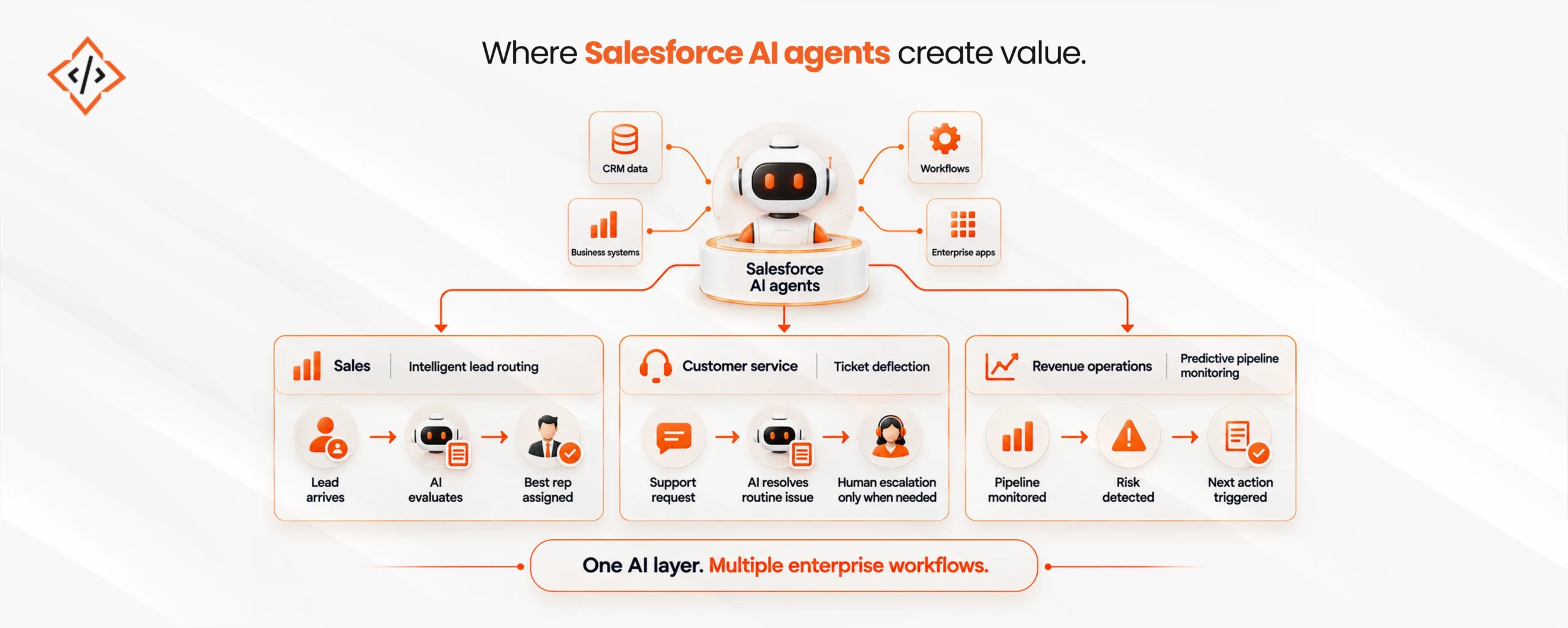
Salesforce AI agents instantly evaluate incoming leads using your historical conversion data. They analyze past successful deals to assign a precise scoring metric. The system then routes the highest-value prospects directly to your top-performing sales representatives.
Gartner reports that sales organizations utilizing AI-enabled actions are 2.6 times more likely to achieve commercial growth. This intelligent distribution ensures capable account executives handle your most lucrative commercial opportunities. The CRM stops acting as a passive list and becomes an active sales dispatcher.
Customer service departments experience significant operational savings through AI-powered Salesforce automation. Virtual service agents process routine product returns and track active orders autonomously. They manage complex subscription changes without requiring human intervention.
This capability deflects a massive volume of standard inquiries away from your primary support desk. It prevents costly SLA breaches during sudden customer traffic spikes. Your human representatives can then focus exclusively on resolving highly complex issues that require critical thinking.
Salesforce Agentforce continuously monitors your active CRM database for stalled commercial opportunities. AI agents in Salesforce analyze deal velocity and historical buying patterns. They quickly identify at-risk contracts and flag them for immediate internal review.
The system automatically prompts account executives with the precise next best action. This proactive guidance prevents valuable deals from slipping through the cracks due to administrative oversight. Sales leaders receive highly accurate revenue forecasts based on actual deal momentum rather than optimistic guessing.
Implementing Salesforce AI workflow automation requires a structured, phased rollout to protect live operational systems. Rushing into full-scale deployment often exposes unresolved edge cases and creates unwanted operational friction. A disciplined approach supported by professional AI agent development services ensures your enterprise transitions smoothly toward autonomous execution.
Start by mapping out existing operational friction points across your core business workflows. Identify exactly where valuable human effort is currently wasted on repetitive field updates and manual follow-ups.
Pinpointing these daily administrative bottlenecks reveals where automated agents will deliver the greatest immediate relief. This initial assessment establishes a clean foundation for subsequent automation steps.
Define specific, quantitative KPIs before initiating any configuration work inside your CRM. Focus on concrete operational metrics such as total hours saved per week, direct cost reductions, and lower SLA breach rates.
Establishing these targets early ensures complete alignment between technical milestones and overarching business goals. It also provides objective criteria to measure long-term financial return.
Launch a tightly controlled pilot program in a secure sandbox environment before going live. Carefully observe how Salesforce AI agents make decisions and handle complex exception workflows under simulated pressure.
Fine-tune your business guardrails based on actual pilot performance to guarantee accuracy. Once the system demonstrates consistent reliability, you can safely proceed with a full-scale organizational rollout.
Transitioning to autonomous systems is now a core competitive necessity for modern enterprises rather than an experimental technology choice. Adopting intelligent workflow automation allows human talent to stop managing software and focus on high-level commercial strategy.
It fundamentally transforms your CRM from a maintenance burden into an active growth driver. The window to capture a first-mover advantage in autonomous customer operations is narrowing quickly.
Organizations that delay this transition risk falling behind competitors who run leaner and far more responsive operations. Auditing your current CRM architecture today is the first step toward building sustainable operational resilience.
Deploying agentic systems into complex enterprise infrastructure requires precise technical planning and strict data governance. Moving from manual processes to autonomous execution demands reliable architecture and specialized Salesforce development services that integrate smoothly with existing enterprise databases.
CodeTrade specializes in architecting and integrating custom Salesforce AI agents tailored to complex enterprise workflows. Our technical specialists ensure your automation scales safely while maintaining rigorous data privacy standards. We help enterprises eliminate routine friction and achieve measurable operational savings across their entire CRM ecosystem.
 Chand Prakash
 Chand Prakash
 Chand Prakash
 Chand Prakash
 Chand Prakash