






AI
ERP
 Chand Prakash
05 October 2026
Chand Prakash
05 October 2026
What Are The Top 10 Agentic AI ERP Systems And Autonomous Solutions?
 Chand Prakash
Businesses today are under constant pressure to innovate faster while managing costs and operational complexity. Generative AI has quickly moved from experimentation to real business application, yet many organizations struggle to translate its potential into measurable outcomes.
This is where Generative AI Consulting Services play a critical role. Instead of approaching AI as a standalone tool, businesses need a structured path that connects strategy, development, and deployment. Without this, even the most promising ideas fail to scale.
From improving operational efficiency to creating entirely new digital products, generative AI is reshaping how enterprises compete. The challenge is not access to technology but knowing how to apply it effectively within existing systems and workflows.
Before starting any engagement, it helps to understand how generative AI works in a business context and where most organizations face challenges. Generative AI refers to models that create new content based on patterns learned from large datasets.
These models can generate a wide range of outputs, including:
Large language models like GPT-4 are widely used to generate responses, summaries, drafts, and code. Alongside these, image generation models, multimodal systems, and code automation tools are being adopted across industries.
While the capabilities are clear, applying them in real business environments is where complexity increases. Most organizations face challenges such as:
This is where Generative AI Consulting Services become critical. A structured approach ensures that AI initiatives are not driven by experimentation alone, but by clearly defined outcomes and implementation plans.
For decision-makers, the focus is on using generative AI to reduce manual effort and improve efficiency at scale. With the right strategy in place, these capabilities translate into measurable business impact instead of isolated pilots.
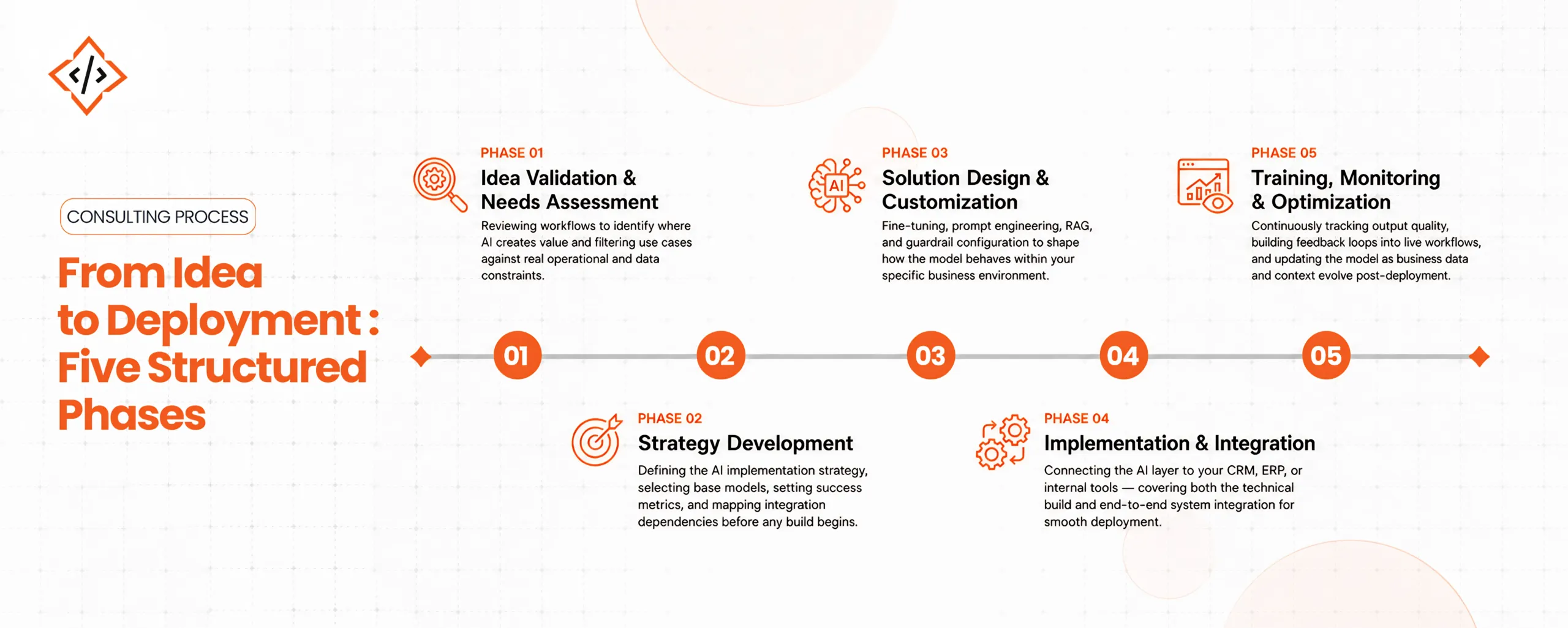
A structured Generative AI Consulting Services engagement moves through clearly defined phases. Skipping phases or compressing them to meet faster timelines is one of the most common reasons enterprise AI projects fail to deliver expected results.
This is where the engagement begins and where the most important decisions are made. This phase involves reviewing your existing workflows and identifying where AI can reduce friction or create measurable value.
It also focuses on filtering use cases through practical constraints, such as:
Many ideas sound promising at a surface level but fail when tested against these conditions. A reliable generative AI consulting company will spend meaningful time in this phase instead of rushing toward model selection.
Strategy development begins once the use cases are validated. This phase defines the overall AI implementation strategy, selects appropriate base models, establishes success metrics, and maps integration dependencies with your existing tech stack.
This step ensures that the solution is aligned with both technical feasibility and business outcomes before any development begins.
This is where the model behavior is tailored to your specific context. Generic outputs are rarely suitable for real-world applications.
Fine-tuning, prompt engineering, retrieval-augmented generation, and guardrail configurations are used to shape how the model behaves within your business environment. These activities form a core part of generative AI development services.
This phase brings the solution into operation by connecting the AI layer with your existing systems. These may include a CRM, ERP, customer support platform, or internal tools.
Our AI development services cover this layer end-to-end, handling both the technical build and system integration to ensure smooth deployment.
This is the phase most organizations underinvest in, even though it directly impacts long-term performance. A generative AI model does not remain static after deployment.
Output quality needs to be monitored continuously, feedback loops must be built into workflows, and the model requires updates as your data and business context evolve.
Across industries, the use cases producing the clearest ROI share a common characteristic. That is, they replace high-volume, repetitive knowledge work rather than complex, judgment-heavy decisions.
| Industry | Use Case | Business Outcome |
|---|---|---|
| Marketing | Automated content generation for campaigns | Faster publishing cycles, reduced agency spend |
| Sales | Personalized outreach and lead qualification | Higher response rates, shorter sales cycles |
| Customer Service | AI-powered support agents and knowledge bases | Reduced ticket volume, faster resolution times |
| Product Development | Code generation and design prototyping | Shorter development sprints, lower iteration cost |
Enterprise AI consulting engagements in these areas typically show measurable results within the first 90 days of deployment. This is why scoping use cases carefully in the validation phase directly affects how quickly the business sees returns.
Any honest conversation about generative AI development services needs to include the risks. These are not reasons to avoid the technology, but they are constraints that must be addressed early in the process.
Data privacy and security require that any model handling sensitive business data operate within clearly defined boundaries. This may involve on-premise deployment, private cloud configurations, or strict API data handling policies. These decisions are most effective when made during the architecture stage rather than after implementation.
Bias and fairness remain important considerations in models trained on large public datasets. When AI outputs influence customer interactions, procurement decisions, or hiring workflows, bias auditing must be included as part of the quality assurance process.
Hallucinations and accuracy are known limitations of generative models. For use cases where factual accuracy is critical, techniques such as retrieval-augmented generation, output validation layers, and human review checkpoints are commonly used to maintain reliability.
Ethical and compliance requirements vary across industries and regions. Sectors such as healthcare, financial services, and legal operations have specific regulatory standards that must be aligned with the intended use case before any AI solution consulting begins.
Cost expectations for AI consulting services in 2026 vary considerably depending on scope, complexity, and the depth of customization required.
Here is a realistic breakdown of the cost categories most businesses encounter.
| Cost Category | Typical Range | What It Covers |
|---|---|---|
| Consulting Fees | Variable by scope | Strategy, architecture, project management |
| Model Licensing | $0 to $50,000+ annually | API access, fine-tuning costs, enterprise tiers |
| Implementation Build | $20,000 to $150,000+ | Custom development, integration, testing |
| Training and Onboarding | $5,000 to $30,000 | Team enablement, documentation, and UAT |
| Ongoing Monitoring | Monthly retainer | Performance tracking, model updates, support |
The widest variable is the implementation build, and it is directly tied to how complex the integration environment is.
A business deploying a standalone content generation tool has a very different cost profile from an enterprise integrating AI across multiple internal systems.
The landscape for AI solution consulting has shifted considerably over the past 18 months. Three trends are reshaping what enterprise AI consulting engagements look like today.
The success of any generative AI initiative depends less on the model itself and more on how it is planned, implemented, and managed over time. Many projects fail not because the technology falls short, but because the strategy behind it is incomplete or rushed.
This is where Generative AI consulting services make a measurable difference. A structured approach ensures that the right use cases are identified early, the AI implementation strategy is aligned with business goals, and the solution is built to perform reliably in real environments.
At CodeTrade, every engagement begins with validation, not development. This ensures that investments are directed toward use cases that can scale and deliver results. With experience in enterprise AI consulting, the focus remains on building solutions that are not only functional at launch but continue to improve with use.
Generative AI is already capable of transforming how businesses operate. The real advantage comes from applying it with clarity, structure, and long-term thinking.
 Chand Prakash
 Chand Prakash
 Chand Prakash
 Chand Prakash
 Chand Prakash