






AI
Odoo Development
 Hardik Soni
29 July 2026
Hardik Soni
29 July 2026
Odoo AI in 2026: The Complete Guide to Native AI in Odoo 19 & 20
 Hardik Soni
Forecasting has become more difficult than it was a few years ago. Demand shifts faster. Customer behavior changes across sales channels. Market conditions can change without much warning. Because of this, traditional spreadsheets and static planning models are becoming harder to rely on.
Many businesses are now investing in AI demand forecasting to improve visibility and make better planning decisions. For SMBs, the focus is often on improving inventory accuracy, reducing operational waste, and using AI-powered automation solutions more effectively. For larger enterprises, the scope is wider and may include forecasting across products, warehouses, and regions.
The growing interest in AI forecasting is also tied to measurable business results. McKinsey reports that AI-driven forecasting can reduce forecast errors by 20% to 50% compared with traditional supply chain planning methods. Better forecasting accuracy helps businesses respond faster to demand changes, improve stock planning, and reduce costly inefficiencies across operations.
Before implementation begins, one question usually comes up early: how much does custom AI demand forecasting cost? The answer depends on several factors, including data readiness, forecasting scope, model complexity, and system integrations.
This guide breaks down the cost of custom AI demand forecasting, the pricing factors behind it, and what businesses can realistically expect before making the investment.
The cost of custom AI demand forecasting depends on how much forecasting depth and operational coverage a business needs.
For SMBs, custom AI demand forecasting projects typically start between $20,000 and $80,000. This range is common for retail brands, distributors, and inventory-driven businesses. These projects usually focus on better planning accuracy, clearer stock visibility, and faster forecasting decisions.
For enterprise businesses, AI demand forecasting projects often start at around $100,000 and increase based on operational complexity. Costs are typically higher when ERP integrations are required, forecasting covers multiple locations, or the business needs advanced forecasting models across large product catalogs. Enterprise deployments usually support planning across multiple teams, warehouses, or regions rather than a single workflow.
Beyond implementation, businesses should also budget for ongoing operating costs. These typically include cloud hosting, model updates, technical support, and regular maintenance. Ongoing investment helps keep forecasting accurate as customer demand, inventory movement, and market conditions continue to change.
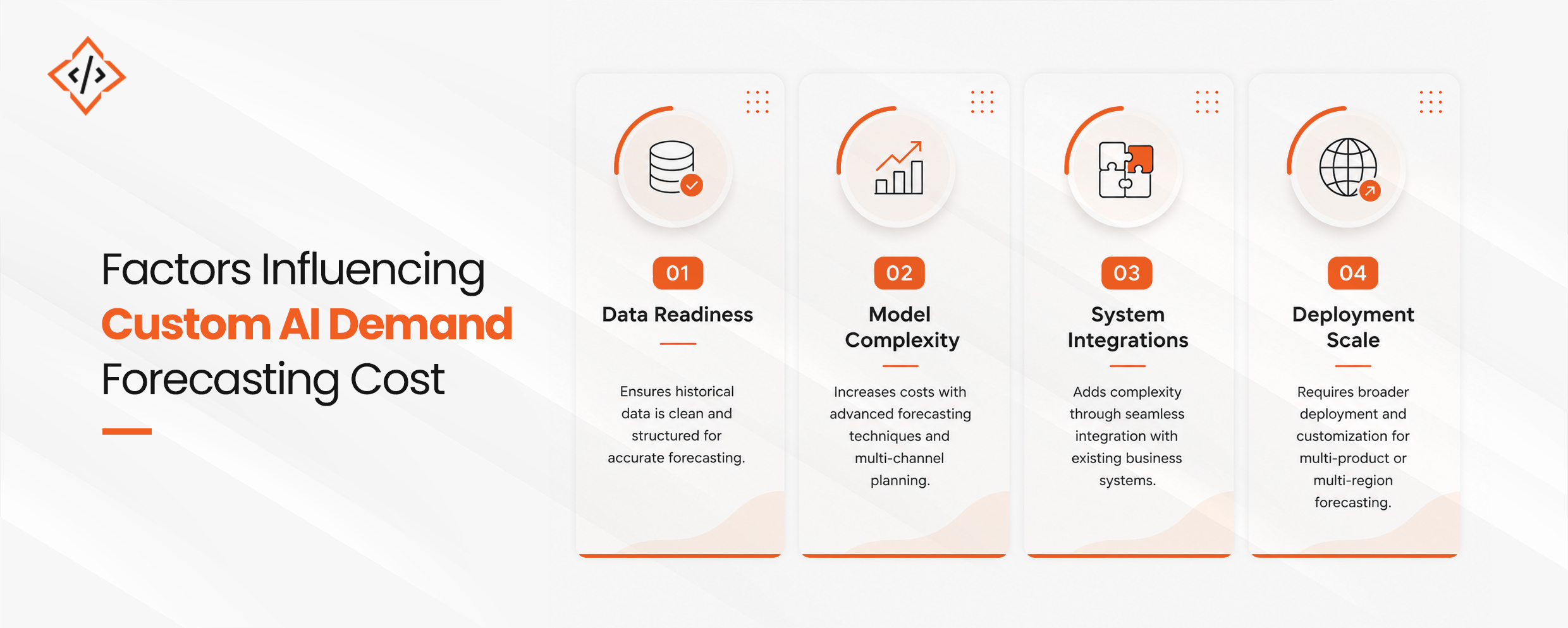
AI demand forecasting costs vary because every business operates with different planning requirements, data maturity, and system complexity.
Data readiness is often the first factor that impacts project cost. Historical demand data needs to be available, consistent, and properly structured. Clean data improves forecast accuracy and reduces development time. Businesses with well-maintained reporting systems usually require less preparation before implementation begins.
Model complexity also has a direct impact on pricing. Forecasting projects may include SKU-level forecasting, multi-variable demand planning, seasonality analysis, or scenario planning across multiple sales channels. The more variables a forecasting model needs to process, the more development, training, and testing it typically requires.
Businesses are also investing more in advanced forecasting systems as planning becomes harder to manage across products, channels, and locations. Gartner predicts that 70% of large organizations will adopt AI-based supply chain forecasting to predict future demand by 2030.
This reflects how quickly forecasting is moving toward AI-led planning. For businesses managing higher operational complexity, more advanced models are increasingly becoming part of long-term planning strategy rather than an optional upgrade.
System integrations also affect implementation cost. Forecasting platforms often need to connect with ERP systems, POS tools, CRM platforms, inventory software, or supply chain planning systems. The more systems involved, the more customization and configuration the deployment usually requires.
Businesses are investing in AI demand forecasting because planning today requires greater accuracy, faster decisions, and stronger operational visibility. This has become more important as demand continues to change quickly.
Forecast accuracy directly impacts purchasing, inventory movement, and daily planning decisions. When forecasts are more accurate, teams can plan with greater confidence and rely less on assumptions. Better forecasting improves visibility across demand cycles and helps reduce planning gaps before they affect operations.
It also helps businesses respond faster when customer demand changes unexpectedly. This creates better coordination across inventory, supply chain, and purchasing teams.
Inventory decisions become more reliable when planning is based on real demand signals instead of fixed assumptions. AI forecasting helps reduce excess stock, lowers the risk of stockouts, and improves inventory turnover across operations. It also gives businesses better control over working capital by helping teams make more informed purchasing and replenishment decisions.
Investment in this area is growing quickly as inventory planning becomes more complex. Reuters reported in 2025 that spending on software that includes generative AI for supply chains could reach $55 billion by 2029, up from $2.7 billion today.
This growth reflects how strongly businesses are prioritizing AI-driven planning across inventory and supply chain operations. Better forecasting not only improves stock accuracy but also helps businesses operate with greater efficiency as demand continues to shift.
Demand can change quickly, and planning teams often need answers faster than traditional forecasting cycles can provide. Predictive demand planning helps businesses respond faster with clearer operational visibility. It supports real-time decision-making across purchasing, supply chain, and inventory teams. Faster access to forecasting insights also helps businesses adjust priorities more confidently across products, sales channels, and markets.
The decision usually comes down to whether a business needs a faster setup or a forecasting solution built around its specific operations.
Traditional demand forecasting software is often the starting point for many businesses. It usually comes with lower upfront cost and quicker deployment. However, flexibility can become limited when forecasting needs grow more complex over time.
Custom AI demand forecasting is built around business-specific demand patterns, machine learning development, and planning workflows. It offers stronger forecasting precision across changing conditions. Many AI demand planning solutions also scale better as operations expand across products or locations.
Software platforms can work well when forecasting needs are straightforward and planning follows a predictable pattern. Custom AI becomes more valuable when forecasting is more complex across products, channels, or locations. The right choice usually depends on operational complexity, business scale, and long-term planning goals.
The value of AI demand forecasting is often measured by the operational results it improves over time.
The return on investment often becomes visible across planning, inventory, and daily operations. Businesses can reduce excess stock, lower inventory carrying costs, and avoid missed sales caused by stock shortages. Better planning also improves coordination between purchasing, inventory, and supply teams.
Over time, this leads to measurable gains in operational efficiency and stronger forecasting confidence. For many businesses, AI demand forecasting becomes a long-term operational investment with measurable business value.
Custom AI becomes especially valuable when forecasting decisions directly affect revenue, inventory movement, and operational planning. It is often a strong fit for fast-growing retailers managing demand across multiple sales channels. Distributors benefit when stock movement becomes harder to predict across products or locations.
Manufacturers also gain better visibility across production and supply planning. Businesses with high inventory volume often see the strongest long-term value from AI demand forecasting.
There is no fixed cost for custom AI demand forecasting because every forecasting environment is different. Some businesses need better inventory visibility, while others need stronger planning across products, warehouses, or regions. That is why project costs can vary from one company to another.
What matters most is not only implementation cost, but the long-term business value. Better forecasting can reduce waste, improve stock planning, and support faster operational decisions across the business. For companies managing changing demand and growing planning complexity, AI demand forecasting is becoming a practical investment with measurable long-term value.
CodeTrade works with businesses that need forecasting systems built around the way their operations actually run. Every solution is shaped around business goals, existing workflows, and the planning challenges teams face every day. The result is a forecasting system designed to support growth while staying practical for daily use.

 Hardik Soni
 Chand Prakash
 Chand Prakash
 Chand Prakash
 Chand Prakash