







AI
Education & eLearning
 Chand Prakash
22 September 2026
Chand Prakash
22 September 2026
Future of Generative AI in Education: Use Cases and Trends
 Chand Prakash
Sales teams do not lose pipeline only because they lack leads. They lose pipeline because too many leads are slow to qualify, poorly scored, or routed too late. When high-intent buyers wait hours for a response, deal velocity stalls and conversion rates plunge.
Relying on manual spreadsheet reviews and delayed data entry creates structural friction that strains human resources. Transitioning to modern business process automation solves this problem by executing instant background research, profile enrichment, and behavioral evaluation.
This smart technology acts as a practical infrastructure layer that brings operational speed, absolute consistency, and elevated pipeline quality to the commercial engine. According to a 2026 Gartner technology adoption study, only 17% of organizations have deployed intelligent agents to date, yet more than 60% expect to do so within two years.
Implementing an AI agent for lead qualification does not replace core sales strategy. Instead, it systematically removes repetitive technical assessment tasks so account executives can focus completely on deep human conversations that close revenue.
This autonomous system optimizes sales pipelines by automating prospect evaluation to save valuable selling hours for account executives.
An AI Lead Qualification Agent is an autonomous sales workflow system that evaluates leads against business rules, buyer intent, CRM data, and conversation inputs. It functions to capture lead details, ask qualification questions, enrich records, and score fit and intent. The software instantly updates CRM fields, routes qualified leads, and triggers follow-ups or immediate meeting booking.
Traditional setups rank pipeline opportunities through fixed rules such as job title, company size, page visits, and form submissions. This rigid infrastructure evaluates historical triggers in isolation, causing severe pipeline friction across departments. Sales operations struggle with slow response times because the static process lacks context.
An AI agent for lead qualification adapts dynamically based on real-time context. It combines deep firmographic, behavioral, and conversational signals before deciding the next action. A 2026 Gartner study confirms its business value. Teams deploying these autonomous workflows achieve a 91% increase in meetings booked within two months.
Deploying intelligent systems streamlines pipeline coordination by managing prospective buyer data across multiple go-to-market channels.
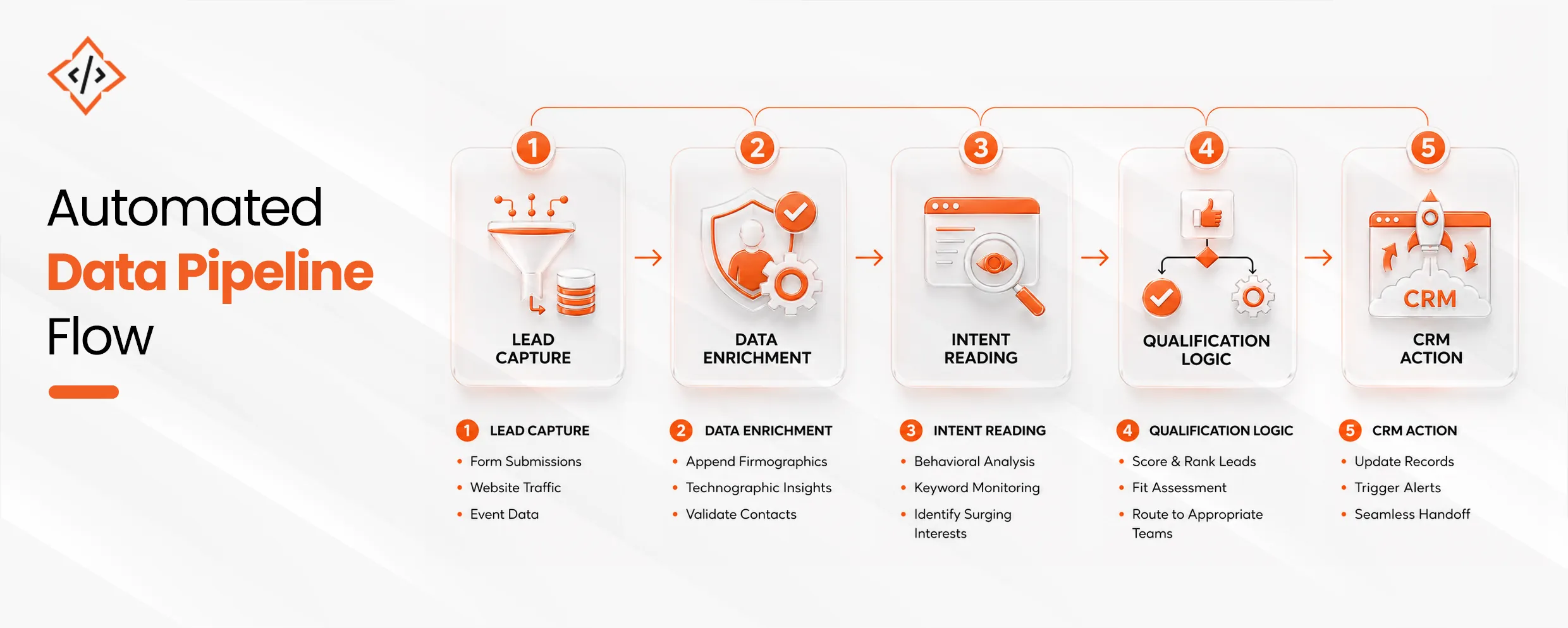
The software collects new records from web forms, landing pages, digital ads, and live chat options. It captures information from incoming email replies, virtual webinars, active LinkedIn campaigns, and outbound lists.
The system evaluates prospect parameters using existing CRM history, company size, core industry categories, and corporate regions. It tracks funding stages, active technology stacks, or past team interactions. This background analysis builds deep prospect intelligence.
The software reads digital interaction signs like pricing-page visits, immediate demo requests, and repeated website sessions. It analyzes specific questions asked in chat boxes, incoming email replies, and downloaded digital assets. These signals prove immediate buying interest.
A specialized AI agent for lead qualification checks each prospect against ideal customer profile rules and deal-size potential. It measures structural urgency, corporate purchasing authority, actual operational need, and overall sales readiness. Flawed prospects drop out immediately.
A high-performing AI agent for CRM updates lead status values, assigns regional ownership, and saves background research notes. The application triggers immediate representative alerts and books meetings directly with the correct sales specialist.
Implementing modern business automation software stabilizes revenue pipelines by standardizing critical qualification data across active go-to-market channels.
Sales teams need lead qualification automation because manual processes are slow, inconsistent, and hard to scale. Sales development representatives spend hours chasing low-fit contacts while premium inbound prospects turn cold due to slow response times. Automated lead qualification routes high-intent inbound prospects immediately when buying interest is highest, triggering instant outreach to maximize conversion opportunities.
Internal records often remain incomplete because manual CRM updates lag behind real-time buyer actions, causing commercial departments to disagree on lead quality. According to a 2026 Forrester report, standard marketing-to-sales qualified lead conversion rates dropped significantly last year. This market compression from 13% down to 9.8% stemmed entirely from high-volume campaigns that completely lacked structural verification layers.
The platform systematically filters out invalid data, duplicate entries, and low-probability opportunities before they reach sales teams to keep tracking metrics completely accurate.
Daily pipeline follow-ups rely too heavily on individual rep discipline without a unified, automated system, causing lead scoring to become outdated quickly. Account executives receive deep behavioral context and enriched corporate background reports before launching their first discovery call.
This seamless data transition removes the need for pre-call manual research, allowing reps to focus entirely on executing high-value conversations that secure revenue.
Deploying intelligent system layers across multiple marketing channels helps companies organize raw prospect data without manual operational bottlenecks.
The software qualifies incoming demo requests, website contact forms, pricing page inquiries, chat interactions, and webinar leads. This structural filtering ensures sales development representatives receive high-intent pipeline opportunities before manual research starts.
An AI outbound sales agent researches cold prospects, checks ideal customer profile parameters, and personalizes initial outreach messages. The system determines exactly whether a profile fits the business criteria before entering an automated sales sequence.
An AI chatbot for lead qualification asks structured questions to identify buying budget constraints or corporate needs. The system answers basic product queries automatically and schedules calendar meetings directly when the buyer is ready. According to a 2026 sales automation report by McKinsey, conversational AI systems optimize pipeline coverage to capture 20% more high-value B2B opportunities without extra staff.
An AI voice agent for sales places outbound calls, confirms buyer interest, and asks specific qualification questions. The platform automatically updates internal corporate data records with detailed notes immediately after finishing the phone interaction.
Strategic AI agents integration in CRM platforms routes complex enterprise accounts to senior executives while directing small business leads to inside sales teams. It sends partner inquiries to channel managers and transfers low-fit profiles directly to passive marketing nurture campaigns
The application tracks historical data records to detect cold opportunities that suddenly show new website activity. It restarts the qualification pipeline using these fresh behavioral signals to capture hidden revenue opportunities.
Transitioning to automated pipelines eliminates administrative friction to maximize executive selling hours across scaling commercial operations.
Sales teams execute more effectively when repetitive database tasks run automatically. Sales development representatives spend far less time researching, manual tagging, and chasing low-fit leads. This system removes technical bottlenecks and shifts focus back to closing deals.
Algorithmic screening ensures complete consistency across the whole funnel. The system applies the same rigorous criteria every time, which reduces subjective human judgment. This continuous tracking helps maintain clean databases across every territory.
Using deep intent signals improves prospect communication. The software tracks existing corporate metrics to shape relevant follow-ups based on real prospect actions. Tailored messaging directly builds deeper buyer engagement and improves pipeline velocity.
High-value revenue opportunities remain secure inside the system. Fresh profiles do not drop out because of manual operational delays or territory ownership confusion. This constant oversight protects incoming lead investments completely.
Deep data validation provides clear pipeline metrics. Automated lead qualification helps managers analyze closing probabilities accurately. Clean data points build reliable revenue projections for executive leaders while reducing overall department friction.
Building an autonomous system layer allows commercial enterprises to stabilize pipeline data validation without increasing ongoing back-office engineering costs.
Companies must establish precise target criteria before writing any code. This tracking guides your active AI Lead Qualification Agent. List your target industries, corporate regions, company sizes, revenue ranges, buyer roles, use cases, urgency, and budget fit.
Operations teams must trace exactly where prospects enter systems and discover where they get stuck. Identify what sales representatives manually check before accepting opportunities. This clarity ensures lead qualification automation aligns with live revenue operations.
Integrating system architectures requires secure data handling protocols. An AI agent for CRM must read and write data safely across platforms. It must not generate duplicate records or overwrite important sales notes saved by account executives.
Revenue leaders must explicitly define automated routing logic and disqualification rules. Setting escalation triggers, follow-up timing, and human approval points prevents pipeline leakage. According to a recent McKinsey global commercial systems study, implementing automated lead management frameworks routinely yields a 10% to 15% improvement in overall operational efficiency.
Engineering teams should run the active architecture on real historical data sets first. Evaluating the code against archived records surfaces scoring mistakes. This validation stage verifies that your AI agent for lead qualification works predictably.
Managing long-term performance requires continuous oversight. Operations specialists must track pipeline conversion rates, representative response times, meeting quality, sales acceptance rates, and disqualification accuracy. Consistent monitoring ensures automated lead qualification constantly adapts to shifting market conditions.
Reviewing system constraints prevents pipeline disruption and ensures automated screening architectures function predictably within production infrastructure.
Flawed inputs lead to weak prospect evaluations. The system requires clean fields, updated records, and transparent lead sources. Fixing data gaps ensures automated lead qualification works effectively.
High-value pipeline opportunities require strategic checkpoints. Revenue teams must establish human review points before major actions occur. Vetting automated outreach strings protects enterprise accounts from mechanical errors.
Maintaining a secure data environment depends on strict platform permission rules. The core infrastructure must follow strict access controls for customer record databases, private buyer information, and call transcripts. Restricting parameters protects the AI Lead Qualification Agent from data leaks.
Commercial leaders must define performance indicators prior to system integration. Crucial evaluation benchmarks include faster prospect response times, higher conversion metrics, and reduced manual workload for sales development representative
Implementing automated lead qualification represents the next practical layer in modern sales automation architecture. The true business value lies in protecting expensive executive selling time.
This smart system ensures human representatives focus exclusively on verified profiles that match the ideal customer profile, demonstrate real-time purchase intent, and maintain high sales readiness. Moving forward, growth-oriented commercial operations must separate pipeline expansion from manual headcount scaling to remain competitive.
CodeTrade specializes in delivering comprehensive AI agent development services to build secure, CRM-connected systems that qualify, route, and support prospects within real business workflows.
The engineering team develops custom architectures tailored to precise corporate datasets and complex system parameters. This technical expertise helps businesses stabilize pipeline data validation while eliminating database friction across multiple go-to-market channels.
 Chand Prakash
 Chand Prakash
 Chand Prakash
 Chand Prakash
 Chand Prakash