







Odoo Development
 Hardik Soni
28 September 2026
Hardik Soni
28 September 2026
Odoo 20 AI features: what the AI agents actually do
 Hardik Soni
Moving a mid-market US enterprise to a new operational backbone through professional Odoo migration services requires exact planning and technical precision. Legacy systems drain IT budgets through disconnected modules and heavy maintenance fees. Handling an Odoo legacy system migration demands a careful strategic approach. According to Gartner, over 70% of recently implemented ERP initiatives will fail to meet their original business goals by 2027.
These failures usually stem from poor data transition strategies. An effective Odoo ERP migration guide prevents these costly errors by mapping out clear technical prerequisites. It helps organizations understand the strict requirements before starting an Odoo database migration. Executing a complete Odoo ERP migration correctly protects your core business data during the transition.
This blog outlines the specific technical steps required to transition smoothly and maintain operational continuity. You will learn the exact Odoo migration process needed to prepare your infrastructure for a modern setup.
Upgrading to Odoo eliminates the need to run five different expensive software silos to manage a single company. US enterprises face severe financial burdens when maintaining disconnected legacy software. Older platforms typically lack modern API connectivity, driving the immediate need for expert Odoo integration services. This forces IT departments to build expensive custom bridges between incompatible databases.
Companies also struggle with excessively high annual renewal costs for outdated systems. These maintenance fees consume budgets that should fund actual growth.
An Odoo legacy system migration solves this data isolation problem entirely. Dropping outdated software immediately improves cross-department data visibility. Sales teams can finally see real-time inventory levels without requesting manual reports.
Accounting departments gain instant access to procurement data. A centralized database ensures every department operates from the exact same accurate information. This single source of truth prevents costly operational miscommunications.
The specific modular architecture of Odoo provides a major financial advantage. Companies only install the specific applications they actively use. You never pay for bloatware or unnecessary system features.
When a new department opens, IT simply activates the required module. This modular approach keeps software expenses aligned with actual operational needs. An Odoo ERP upgrade prevents the typical software licensing waste seen in growing mid-market companies.
An ERP migration to Odoo scales instantly alongside your rapid business growth. US businesses often expand operations across different states and tax jurisdictions. They frequently add new regional warehouses to their complex logistics networks. They also constantly adjust their supply chain logic to meet market demands.
Odoo handles these complex geographical and operational shifts natively within the platform. Handling complicated American regulatory environments requires a flexible software architecture. A proper Odoo migration for US companies simplifies state labor law tracking and federal tax reporting.
You do not need to rebuild your IT infrastructure for every territorial expansion. Professional Odoo ERP migration services ensure these multi-state structures run perfectly from day one.
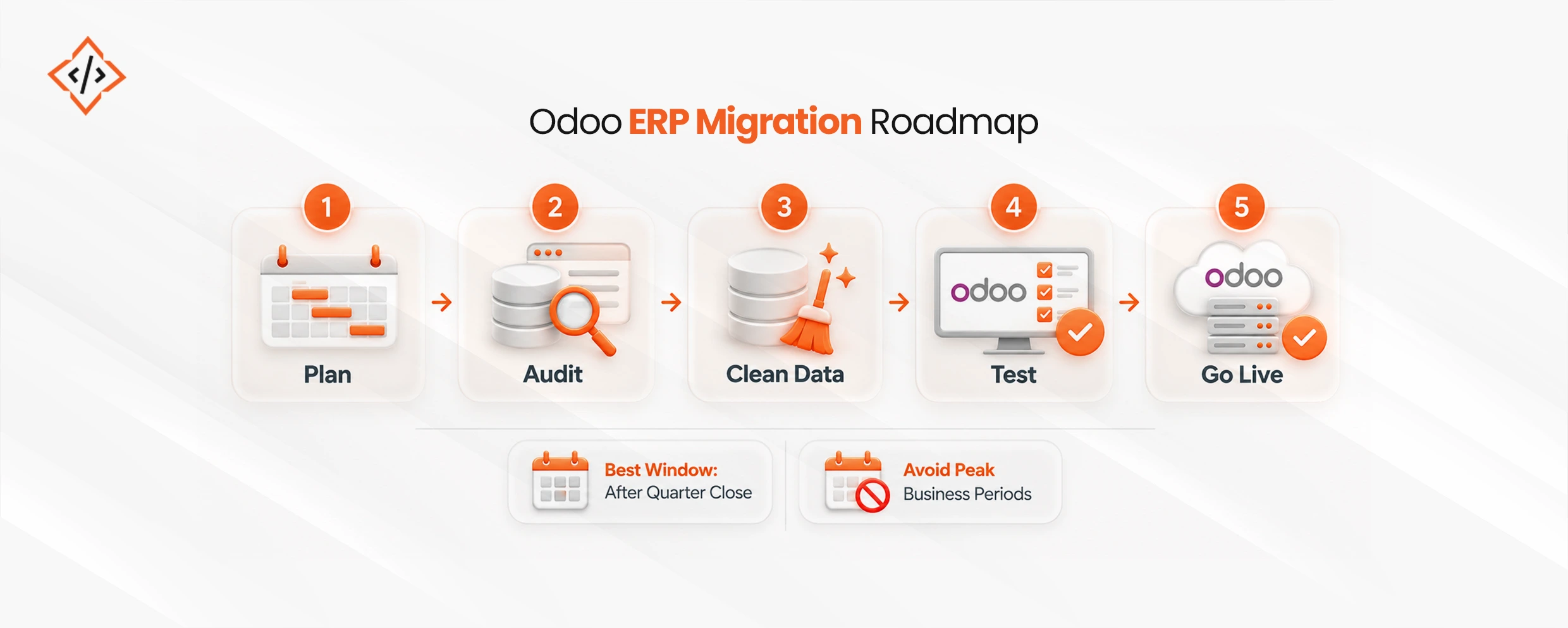
A successful transition follows a strict four-step methodology covering system audits, code mapping, testing, and the final launch. An enterprise Odoo implementation and migration requires restructuring how information flows rather than just moving old files to a new server.
The Odoo migration process protects daily business operations by running comprehensive parallel tests before the final cutover week. This continuous verification ensures system reliability while preventing unexpected operational disruptions for sales and warehouse teams. Preparing your technical infrastructure begins with evaluating your existing software architecture.
The initial audit phase examines every core workflow across your current enterprise software stack. Technical teams must thoroughly review existing accounting rules, inventory reorder triggers, and historical customer relationship records.
Maintaining a detailed Odoo ERP migration checklist helps teams catalog all custom features built into the legacy platform over years. Identifying these custom tools early prevents operational gaps after go-live.
Mapping these established processes directly to native Odoo functionality eliminates unnecessary custom code. This deliberate evaluation keeps implementation costs predictable and protects standard data relationships across all integrated departments.
Structuring the hosting environment correctly ensures low latency for distributed offices across multiple US time zones. Enterprise deployments typically use high-performance regional data centers to guarantee rapid database response times during heavy transaction volumes.
A planned Odoo customization migration allows technical engineers to refactor critical proprietary business logic for the new platform. Through tailored Odoo customization services, developers rebuild unique industry modules so they communicate cleanly with modern REST APIs and updated database schemas.
This careful architectural setup ensures your cloud environment handles high transaction loads without experiencing server bottlenecks. Establishing these clean technical boundaries early simplifies ongoing maintenance and future software releases.
Data extraction and cleansing represent the highest risk factor in any system transition. Moving flawed records into a modern architecture instantly compromises all operational reporting. Dedicated Odoo data migration services strip out corrupted files and duplicate entries before uploading anything. A clean initial dataset ensures the new database functions exactly as designed.
Gartner estimates poor data quality costs organizations an average of $12.9 million every year in wasted resources. Failing to clean this historical data beforehand guarantees inaccurate financial forecasting down the line. Therefore, technical teams must break down data handling into two critical stages. This strict separation protects the integrity of your core business information throughout the project.
The first step involves actively archiving obsolete records that no longer serve a direct business purpose. Five-year-old closed support tickets simply do not need to sit on the active server. Removing this unnecessary historical clutter drastically improves overall system processing speeds.
Next, teams must meet strict formatting requirements for importing clean CSV or Excel files. Every single data column must perfectly match the required target fields within the new system. Misaligned column headers will instantly reject the entire import batch and delay the project timeline. Dedicated formatting tools help technical engineers map these complex spreadsheets accurately before uploading.
The final stage pushes verified records from a secure staging environment into the live production server. A successful Odoo database migration requires exact sequencing to preserve relational data links between departments.
Customer profiles must successfully migrate before engineers import their associated historical sales orders. Breaking this logical sequence creates orphaned records that break internal reporting tools. Engineers utilize script automation to prevent critical human errors during this final data push. These automated transfer scripts run continuously over the weekend to minimize daily system downtime.
This methodical process ensures your company opens on Monday with a completely functional system. A secure Odoo data migration keeps your enterprise running without missing a single financial transaction.
The ideal technology partner holds certified Odoo expertise and a deep understanding of US corporate compliance. Trying to migrate to Odoo ERP in-house usually stalls internal IT departments and severely delays daily operations. Internal teams already manage daily support requests and lack the specialized experience required for complex database restructuring. This lack of specific system knowledge often results in broken software integrations and budget overruns. A specialized vendor prevents these costly internal delays by dedicating full-time expert resources to your transition.
Localized support provides immense value during the critical final software deployment stages. An Odoo migration partner USA ensures real-time troubleshooting in your exact time zone during the go-live phase.
Offshore teams working opposite hours cannot provide immediate fixes if a financial process breaks during standard business hours. Local experts also understand the specific operational rhythm of American corporate environments. This immediate availability keeps your enterprise moving forward without waiting overnight for critical technical answers.
Dedicated Odoo ERP migration services bring pre-built scripts specifically designed for US regulatory environments. These specialized partners provide ready-made Avalara integrations that handle complex state sales tax calculations natively.
They also know exactly how to configure state-specific payroll requirements directly into the new system architecture. Applying these pre-built solutions prevents your company from inadvertently violating strict American tax compliance laws. This targeted financial expertise makes your overall Odoo ERP migration significantly faster and legally secure.
Selecting the correct software vendor requires evaluating specific operational criteria beyond basic consulting rates. First, demand documented evidence of proven past performance with similar mid-market American enterprises. Second, establish clear communication protocols before signing any contract to guarantee daily project transparency.
Finally, require a firm post-launch support policy that guarantees immediate assistance after the new system launches. A reliable technology provider will gladly offer these structural guarantees to fully protect your operational investment.
The best time to begin the transition is immediately following a major fiscal quarter close. This precise timing avoids interrupting critical corporate tax filing periods and financial reporting deadlines.
Leadership teams must establish a clear timeline and a detailed project roadmap before modifying any software. A structured schedule aligns internal departments and sets realistic expectations for the upcoming technical changes.
Planning a successful Odoo migration for US companies requires factoring in specific domestic calendar events. Project managers must actively account for federal holidays and peak retail seasons during the initial scheduling phase.
Executing a major software change during November or December often threatens direct revenue continuity. Scheduling around these high-volume dates prevents catastrophic operational disasters during your busiest sales periods.
Business leaders frequently underestimate the preparatory timeline required for enterprise software projects. Technical planning takes just as much time as the actual software execution phase. Rushing the initial architectural blueprint phase guarantees costly system delays during the final launch week.
Thorough preparation ensures your internal IT teams map every critical integration point carefully. Documenting these requirements early gives your chosen development partner a clear operational path forward. This deliberate scheduling approach keeps your enterprise running efficiently while developers build the new environment. An organized transition timeline ultimately protects your daily revenue streams from unexpected technical downtime.
Completing an Odoo ERP upgrade prepares your enterprise to handle higher transaction volumes without artificially inflating administrative headcount. Careful data planning and professional Odoo migration services eliminate the downtime risks associated with legacy software changes.
As AI and automation become standard in 2026, operating on a unified database is necessary for US market competitiveness. Audit your current software licensing expenses today to identify immediate consolidation opportunities.
Executing this operational shift through comprehensive Odoo development services requires more than just basic technical execution. It demands a strategic software partner who deeply understands American corporate environments.
CodeTrade delivers specialized Odoo ERP migration USA solutions specifically tailored for mid-market enterprises. CodeTrade certified developers manage the entire transition process safely to protect your historical records. The technical team ensures core business data remains completely secure while daily operations continue without interruption.
 Hardik Soni
 Hardik Soni
 Hardik Soni
 Hardik Soni
 Hardik Soni