






Odoo Development
 Hardik Soni
28 September 2026
Hardik Soni
28 September 2026
Odoo 20 AI features: what the AI agents actually do
 Hardik Soni
US SMBs crossing the $10 million revenue mark face a strict operational breaking point. At this stage, basic accounting software fails to handle multi-state tax compliance and advanced inventory needs. Growing companies must replace fragmented spreadsheets with a reliable system to maintain efficiency. This operational strain forces a direct comparison of Odoo vs NetSuite vs SAP for US SMBs.
The market offers three very distinct paths for scaling operations. Odoo acts as the modular open-source disruptor for budget-conscious teams, which surfaces clearly when comparing Odoo AI vs. NetSuite AI capabilities.
NetSuite operates as the native cloud financial heavyweight for complex ledgers. SAP Business One stands as the rigid enterprise-grade standard for heavy manufacturing. The urgency to modernize infrastructure is highly measurable.
According to Fortune Business Insights, the global ERP software market is projected to reach $106.22 billion in 2026. Mid-market companies are driving this massive growth by urgently replacing legacy systems.
Finding the best ERP for small businesses in USA requires analyzing total cost of ownership alongside deployment speed. IT directors need a cloud ERP for small business that completely prevents costly implementation failures.
Evaluating ERP software for small business operations requires mapping total cost of ownership, deployment speed, and core architectural philosophy directly.
| Technical Dimension | Odoo Enterprise | NetSuite (Oracle) | SAP Business One |
|---|---|---|---|
| Target Revenue Size | $5 million to $30 million annual revenue for agile, growing companies. | $10 million to $100 million+ annual revenue preparing for public scale. | $15 million to $75 million annual revenue with asset-heavy operations. |
| Core Architecture | Modular open-source Python framework with full PostgreSQL database visibility. | Multi-tenant proprietary cloud that locks users into a single financial database. | Proprietary client-server or private cloud built on in-memory SAP HANA. |
| Codebase Ownership | Fully open codebase allowing internal teams to inspect and modify business logic. | Closed proprietary architecture with all business logic bound to Oracle infrastructure. | Closed proprietary framework governed strictly by SAP partner development kits. |
| Licensing Model (TCO) | Flat per-user subscription covering access to all standard business applications. | Base subscription platform fee plus named user seats and paid modular add-ons. | Upfront perpetual licenses with annual maintenance contracts or monthly subscription seats. |
| Deployment Timeline | 6 to 14 weeks for standard setups; up to 6 months with custom modules. | 14 to 24 weeks using SuiteSuccess templates and predefined industry workflows. | 16 to 32 weeks due to extensive ledger configuration and compliance testing. |
| Customization Overhead | Low build cost via Odoo Studio, but heavy custom code complicates future upgrades. | Moderate development overhead via SuiteScript, while scheduled cloud updates run automatically. | High overhead requiring specialized certified consultants for every structural system adjustment. |
| Financial Governance | Flexible ledger setup requiring connectors like Avalara for multi-state US sales tax. | Built-in GAAP compliance, native ASC 606 revenue rules, and automated SuiteTax calculations. | Rigid financial controls with mandatory audit trails that strictly prevent manual database tampering. |
| Manufacturing Depth | Visual Kanban shop floor control, multi-level bills of materials, and barcode tracking. | Advanced inventory valuation, multi-subsidiary demand forecasting, and outsourced manufacturing routing. | Industrial-grade material requirements planning engine with strict serial and batch traceability. |
| Ecosystem & Add-Ons | Massive community app store providing thousands of community-built operational extensions. | Curated SuiteApp marketplace with verified enterprise partner integrations. | Vetted third-party add-ons managed and distributed by certified regional SAP implementation partners. |
| Upgrade Maintenance | Annual major version releases that require manual testing for third-party apps. | Bi-annual automated cloud upgrades pushed by Oracle with zero customer server maintenance. | Phased, manual upgrade cycles executed and billed by external certified implementation partners. |
| Best Operational Use Case | US SMBs requiring rapid deployment, deep workflow flexibility, and lower licensing overhead. | Multi-entity businesses needing consolidated financial reporting, parent company rollups, and audit readiness. | Established US manufacturing and distribution firms demanding rigid process enforcement and deep supply chain control. |
Budget forecasting dictates the feasibility of the entire project immediately. Hidden licensing fees frequently derail mid-market budgets before deployment even begins. Evaluating Odoo vs NetSuite directly requires understanding these exact pricing differences. Technical leaders must project future licensing expenses accurately.
Odoo relies on a highly aggressive per-user and per-app pricing model. The free Community edition contrasts heavily with the paid Enterprise version. Growing teams require the Enterprise version for full API access and US localization. Odoo keeps initial capital expenditure remarkably low for operations managers. US SMBs can purchase incremental modules exactly when they need them.
This specific strategy avoids the massive upfront costs found in traditional enterprise software. Consequently, Odoo for small businesses remains highly cost-effective during early growth stages.
NetSuite for small businesses requires a completely different financial commitment. Oracle charges a substantial base platform fee alongside individual named user licenses. This baseline pricing scales exponentially as companies activate advanced modules like Advanced Revenue Management or SuiteBilling.
This financial structure locks companies into a rigid operating expense model. CFOs must execute careful negotiation during annual contract renewals to avoid sudden price spikes. The platform delivers exceptional value, but these recurring subscription costs demand a strictly controlled internal budget.
SAP for small businesses introduces a much more complex pricing environment. The SAP Business One platform contrasts upfront perpetual licensing with standard subscription cloud access. Companies purchasing perpetual licenses face high initial capital expenditures before installation starts.
Furthermore, third-party database hosting like SAP HANA adds substantial hidden infrastructure expenses. Mandatory annual maintenance contracts significantly inflate the true total cost of ownership over a five-year period. IT directors must calculate these backend infrastructure costs accurately to prevent unexpected operational budget failures.
The best ERP for small businesses in USA must natively handle multi-state sales tax, ASC 606 revenue recognition, and GAAP-compliant ledger management. Regulatory exposure multiplies quickly once an organization expands distribution across several states.
Evaluating Odoo vs NetSuite vs SAP for US SMBs shows clear differences in how each vendor manages regulatory risk. A growing firm needs rock-solid transaction histories that external auditors can verify without manual interventions.
Odoo uses a modular Python-based framework that connects directly with modern tax software. Companies integrate tools like Avalara or TaxJar through verified connectors to automate intricate multi-state sales tax calculations. In addition, the global open-source community maintains a vast library of pre-built supply chain tools.
These applications bypass expensive development cycles and speed up daily warehouse operations. Skilled Odoo developers can customize workflows without altering underlying accounting rules. Choosing an Odoo implementation for US businesses gives operations leaders high workflow flexibility without sacrificing core tax reporting standards.
NetSuite leads the cloud ERP for small business sector when organizations require audit-ready financial ledgers. The platform excels at multi-entity consolidation by rolling diverse subsidiary books into a consolidated parent ledger automatically. Native SuiteTax engines track changing tax boundaries across thousands of US jurisdictions in real time.
Automated revenue recognition rules align complex contracts with strict ASC 606 guidelines. Finance teams track deferred revenue accurately without purchasing third-party accounting add-ons. These native capabilities eliminate manual spreadsheet reconciliation and save hundreds of hours for busy accounting teams.
SAP Business One enforces rigid structural governance across all production workflows. This disciplined framework makes SAP the default choice for manufacturers facing strict FDA compliance or defense contract standards. Complete lot tracking and serial number tracing follow raw materials from receiving dock to customer delivery.
Furthermore, material requirements planning connects directly with general ledger accounts. This direct link strictly prevents unauthorized inventory write-offs or unverified shop floor adjustments. In this ERP comparison for small businesses, SAP provides unmatched accountability for physical inventory. Operations managers receive dependable data that holds up under intense regulatory scrutiny.
The Odoo vs NetSuite vs SAP debate often hinges entirely on deployment speed. Extended operational downtime destroys SMB profit margins very quickly. Understanding exact implementation timelines prevents costly business interruptions.
According to a Gartner report, over 70 percent of new ERP initiatives will fail their original business goals by 2027. This high failure rate usually occurs due to rushed deployment schedules and dirty legacy data.
A standard rollout backed by professional Odoo implementation services can take a rapid 4 to 12 weeks. This specific timeframe covers basic accounting and inventory modules perfectly. However, IT directors must proceed carefully when adding custom code. Utilizing heavy Odoo customization services will easily push the timeline into the 6-month range. This extended delay happens frequently if historical data is not sanitized first.
NetSuite handles implementation through its highly structured SuiteSuccess methodology. This framework utilizes pre-configured US industry templates to speed up the go-live phase. Consequently, growing companies achieve an average deployment timeline of just 100 days. This rapid pace requires strict adherence to standardized financial workflows. Internal teams must prevent scope creep strictly to hit this specific deadline.
SAP Business One requires a highly rigid, phased rollout spanning 6 to 9 months. The system explicitly prioritizes strict data compliance and deep system testing over rapid deployment. Consultants must map complex material requirements carefully before migrating historical records. Therefore, US manufacturers must prepare internal teams for a long transition period. This cautious approach ensures the final database meets all audit requirements perfectly.
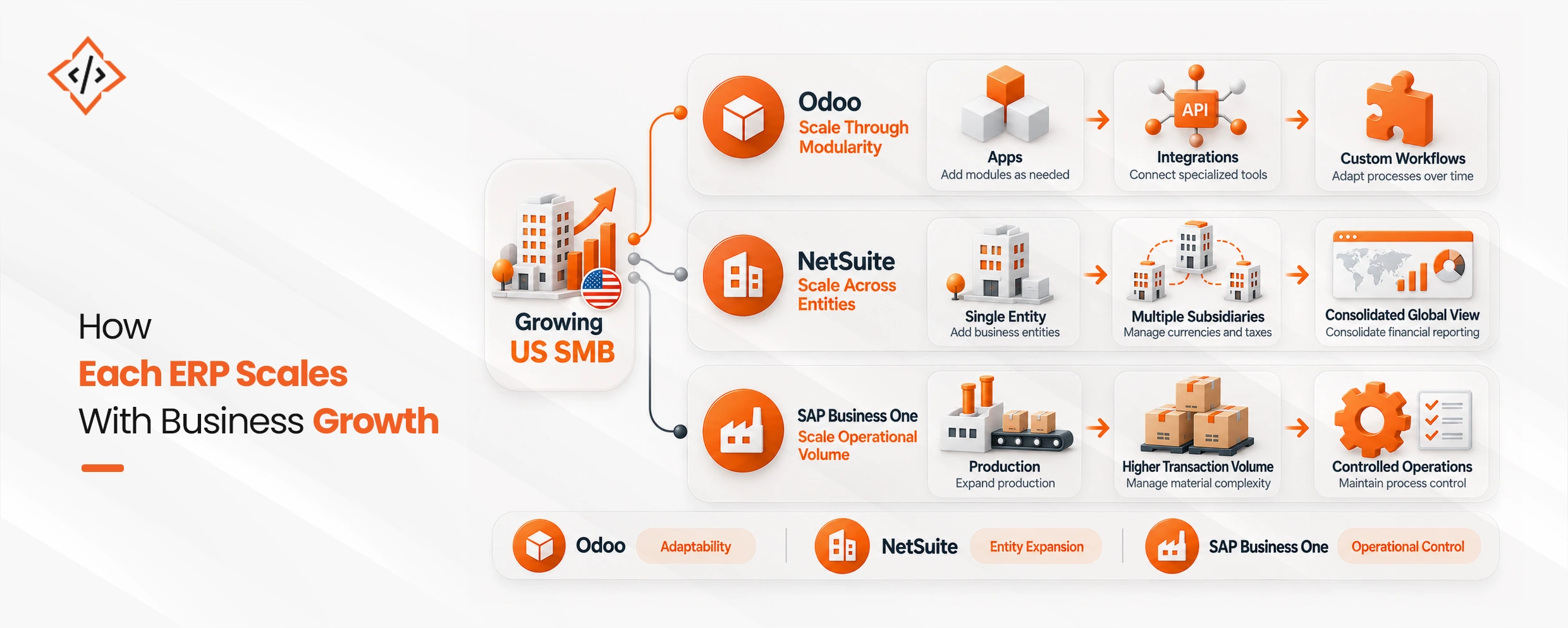
A successful ERP comparison for small businesses must account for transaction volume and employee count five years post-deployment. Software architecture must absorb steady operational expansion without forcing an expensive platform replacement later. Planning for this growth early prevents major infrastructure bottlenecks across sales, inventory, and finance channels.
Odoo handles operational expansion through its modular open API framework and targeted Odoo customization services. Growing US SMBs can easily connect specialized warehouse automation tools or custom e-commerce stores to their central database. These integrations run cleanly without requiring extensive structural database overhauls.
Furthermore, engineering teams retain full control over server resources and data models as order volumes surge. This open architecture makes Odoo ERP for US businesses an adaptable platform that grows alongside changing operational requirements.
NetSuite handles corporate growth by supporting multi-subsidiary management natively within a unified cloud environment. US parent companies can spin up new domestic or international business entities within the exact same database setup. The platform automatically aggregates localized currencies, tax rates, and regulatory reporting into one consolidated general ledger.
Executive leadership gains immediate visibility into regional performance without waiting on manual cross-border reconciliations. This financial engine supports rapid cross-border expansion without demanding new IT infrastructure investments.
SAP Business One scales by processing massive transactional data loads without performance degradation. The system relies on an in-memory SAP HANA database architecture capable of executing millions of ledger entries rapidly. High-volume manufacturing plants track thousands of concurrent assembly lines and raw material shipments without experiencing system latency.
Strict data indexing keeps query speeds reliable during peak operational periods. For heavy industrial operations, this reliable processing power protects business continuity during intense production cycles.
Failing to audit a platform’s limitations before signing a contract leads directly to user adoption failure. IT directors must analyze these operational risks carefully before finalizing any software agreement.
Heavily modifying the core code creates severe, expensive upgrade blockers. When a company attempts to migrate to newer software versions, custom Python scripts frequently break. Consequently, businesses relying on heavy Odoo customization services often face unplanned development sprints and extended downtime.
NetSuite users frequently face aggressive, unexpected subscription price increases upon their initial contract renewal phase. Oracle often relies on steep first-year subscription discounts that expire suddenly. This pricing strategy forces finance teams to negotiate carefully to prevent major operational budget overruns.
SAP Business One utilizes a highly dense user interface that requires extensive, ongoing employee training. This strict structural environment frequently frustrates casual daily users and slows down simple tasks. Consequently, companies must invest heavily in internal change management to ensure successful software adoption.
Every platform in this evaluation serves a fundamentally distinct operational priority. Odoo delivers unmatched modular flexibility and cost control, while NetSuite provides the structural financial controls required for multi-entity reporting. For asset-heavy enterprises, SAP Business One remains the benchmark for rigid manufacturing traceability and supply chain discipline. Before signing a contract, US SMBs must execute a thorough workflow audit and aggressively sanitize legacy records. Preparing clean data early prevents expensive configuration delays during an Odoo implementation for US businesses. Operations leaders should pair software setup with active change management to secure lasting user adoption across every department.
Selecting the right enterprise platform solves only half the operational equation. Modern business infrastructure requires experienced technical execution to turn complex workflows into dependable daily performance.
As an experienced Odoo development company, CodeTrade delivers specialized engineering support for growing enterprises deploying ERP software for small business operations. Technical teams configure custom modules, reliable API connections, and clean database integrations that scale alongside transaction volume. Every migration is engineered to finish on schedule without disrupting active customer operations.
 Hardik Soni
 Hardik Soni
 Hardik Soni
 Hardik Soni
 Hardik Soni