






Salesforce
AI
 Chand Prakash
15 October 2026
Chand Prakash
15 October 2026
How to Automate Enterprise Workflows in Salesforce With AI Agents?
 Chand Prakash
Artificial intelligence is no longer a passive assistant. The AI workforce now functions as an active system component capable of executing long-horizon tasks independently. Traditional enterprise software remains linear and notoriously brittle. When market conditions change rapidly, rigid rules break and force manual human intervention.
Modern organizations solve this by deploying AI-powered automation services that read context, plan steps, and adjust their own logic. This AI workforce automation bridges the gap between static data collection and autonomous business decision-making. Gartner forecasts that 40% of enterprise applications will feature integrated AI agents by 2026. This marks a massive increase from less than 5% in 2025.
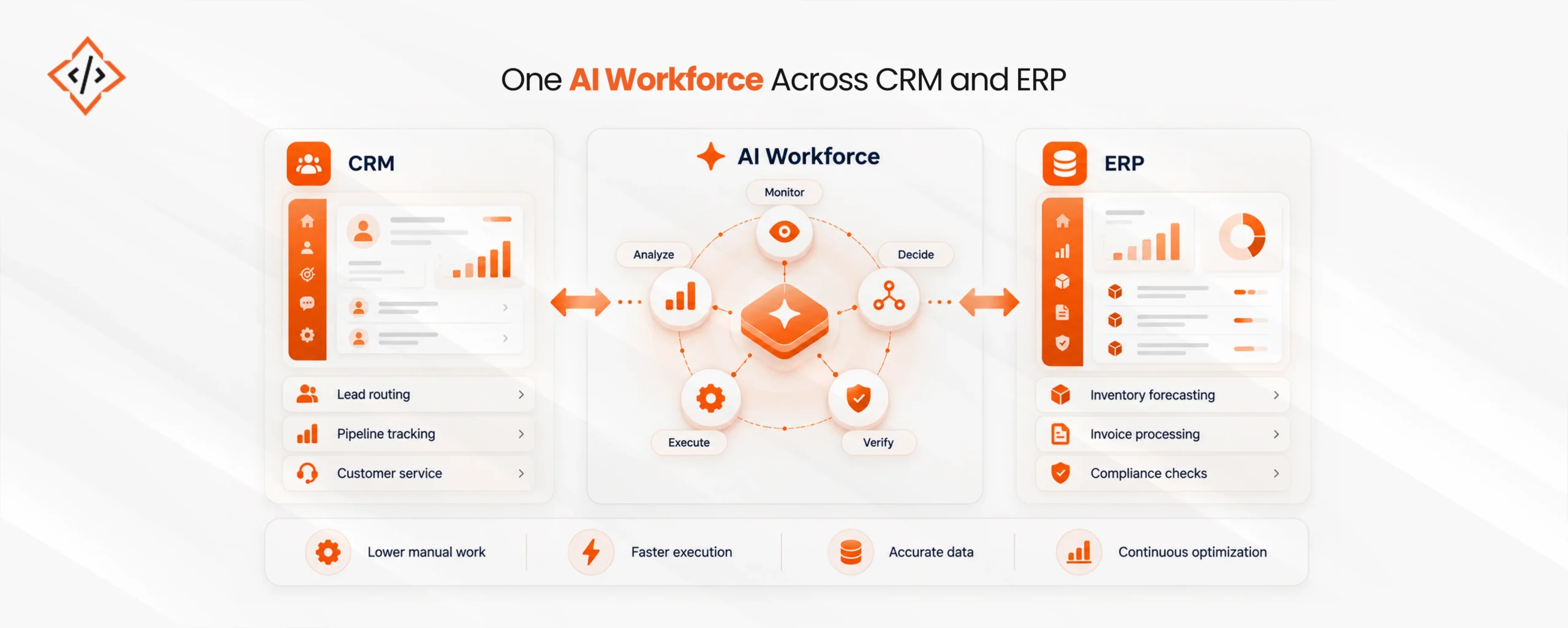
This guide examines exactly how these intelligent modules operate in real corporate environments. CRM automation with AI converts static databases into active revenue engines for sales teams. Simultaneously, ERP automation with AI helps enterprises continuously self-correct their global supply chains. Ultimately, this integration transitions IT infrastructure from basic rules to self-learning systems that yield verifiable financial returns.
The definition of automation has fundamentally changed across enterprise environments. We are no longer discussing software that simply executes pre-programmed commands based on rigid triggers. Two core shifts are driving enterprise adoption and redefining how digital work happens today.
Business leaders must understand these mechanical changes to remain competitive in their respective markets. The focus has moved from basic task completion to complex problem-solving and independent execution. This evolution requires a complete rethinking of how operational software interacts with corporate data structures. Companies must shift their perspective from managing isolated tools to supervising an integrated digital workforce.
The transition from single-prompt chatbots to task-oriented operational software is the first major shift. An AI-powered workforce no longer waits for a human to trigger every specific action. These intelligent agents now pause to reason and verify their outputs before acting. They evaluate multiple potential solutions before committing to a final operational path.
This built-in self-correction capability prevents minor errors from compounding over long project cycles. The McKinsey 2026 State of AI report reveals a clear enterprise performance divide. Only 23% of enterprises are actively scaling AI agents across their departments. Meanwhile, 39% of organizations remain permanently stuck in isolated experimentation phases.
This data highlights the massive gap between deploying AI workforce solutions and merely testing basic concepts. Companies that move past the pilot phase achieve sustainable efficiency gains. They stop treating artificial intelligence as a conversational novelty. Instead, they begin treating it as essential operational infrastructure.
A single agent cannot handle a complex enterprise workflow entirely on its own. Real business processes require multiple operational steps and constant data cross-referencing. The modern approach relies on specialized agent modules collaborating directly across different departments. This distinct strategy drives effective business process automation at a massive enterprise scale.
For example, one dedicated agent extracts incoming financial data from vendor invoices. Another specialized agent validates that specific information against existing internal procurement policies. A third supervisory module then routes any compliance exceptions for immediate human review. This multi-agent structure makes enterprise AI automation fully capable of managing high-stakes daily operations.
Different agents specialize in specific departmental tasks to ensure consistently higher accuracy rates. By distributing the heavy workload, companies create highly resilient internal software networks. These intelligent systems self-correct and adjust constantly without requiring expensive human supervision. Ultimately, this specific orchestration forms the absolute foundation of true intelligent workforce automation.
CRM automation with AI turns a static database into an active revenue engine. It accomplishes this by autonomously qualifying opportunities and maintaining record accuracy. This intelligent approach completely eliminates the need for manual data entry. Sales teams can now focus exclusively on closing complex deals.
AI agents for CRM analyze past deal velocity and current pipeline data continuously. This analysis allows them to route high-value leads to the right sales representatives instantly. The entire process of manual pipeline triage is completely eliminated.
Consequently, sales professionals spend their time engaging prospects rather than organizing spreadsheets. By resolving routine CRM tasks end-to-end, these intelligent systems create immediate value.
They automatically identify and revive stalled deals, driving higher conversion rates from previously ignored opportunities. This AI sales automation capability ensures that valuable leads never fall through the cracks again.
The modern AI workforce handles end-to-end ticket resolution directly. It no longer just suggests helpful articles to human agents for review. These intelligent systems diagnose customer issues and execute the necessary operational steps to solve them. This level of AI customer service automation significantly reduces the overall cost to serve customers.
Companies achieve these financial savings without requiring aggressive headcount increases during peak demand periods. Organizations can scale their support capabilities while keeping operational budgets entirely stable. The focus finally shifts from managing ticket volumes to ensuring consistent customer satisfaction.
Dirty data remains a persistent problem in traditional customer databases. AI-powered CRM systems solve this by keeping records accurate autonomously. AI sales agents proactively prompt sales representatives for missing information.
They also update records automatically based on parsed email threads and call transcripts. This ensures that every forecasting model relies on actual sales activity. Predictions are no longer based on empty fields or permanently delayed close dates. True CRM workflow automation forces accountability and creates a highly reliable financial forecast.
AI agents in ERP systems succeed by continuously monitoring global constraints and adjusting supply chain or financial operations before bottlenecks occur. Traditional ERP software acts as a passive historical ledger that simply records transactions after they happen.
This retrospective approach leaves operations teams constantly reacting to disruptions rather than preventing them. Modern deployments change this dynamic by turning enterprise resource planning into an active operational nervous system.
Modern ERP automation with AI connects enterprise resource software directly to live operational data feeds. Intelligent agents track external variables like port congestion and regional weather disruptions in real time.
Rather than relying on rigid reorder points, the software recalculates purchasing schedules dynamically based on live market conditions. This continuous oversight protects factory floors from unexpected raw material shortages. Furthermore, businesses no longer need to conduct disruptive year-end manual inventory counts.
Instead, the AI workforce runs automated cycle counts quietly in the background every day. Stock levels remain perfectly synchronized across all distribution centers without slowing down warehouse operations.
Manual data entry has drained productivity in accounts payable departments for decades. Deploying specialized accounting agents removes this repetitive data processing burden from human finance professionals. When an invoice arrives, the agent extracts every line item with remarkable precision and zero delay.
The system then cross-references the billed amounts directly against contracted rate cards in the database. Any pricing discrepancies or duplicate charges are flagged instantly before funds leave corporate accounts.
This automated verification stops vendor overcharges that frequently slip past hurried manual reviewers. Consequently, companies safeguard cash flow while advancing their overall business process automation initiatives.
Regulatory compliance demands continuous oversight across procurement contracts and corporate expenditures. Dedicated digital agents perform rigorous audits on all incoming expense reports and vendor agreements. They analyze submission patterns to detect policy violations and suspicious financial anomalies instantly.
Traditional rule-based software often fails when accounting policies change or when exceptions occur. In contrast, advanced models adapt to updated operational guidelines without requiring complex code revisions. Their diagnostic accuracy actually sharpens over time as they process higher transaction volumes. This dependable performance makes enterprise AI automation an essential tool for mitigating corporate financial risk.
Organizations adopting an intelligent workforce are successfully decoupling their operational growth from their back-office headcount. Adding more manual coordinators to handle increased volume is no longer a viable long-term strategy.
True business process automation absorbs heavy coordination work efficiently. Consequently, enterprises scale their capabilities significantly without bloating their internal administrative budgets.
Minimizing system idle time and eliminating repetitive manual coordination directly lowers operational overhead. AI workforce solutions function around the clock without demanding shift changes or accumulating overtime pay. This continuous operation guarantees that core business tasks move forward constantly. By removing manual delays, companies run much leaner supply chains and administrative departments.
According to a 2025 IDC FutureScape report, 70% of G2000 CEOs are now focusing their AI ROI on growth, driving efforts to boost revenue without increasing headcount. This rapid enterprise AI automation adoption proves that direct financial savings justify the necessary integration efforts.
Enterprise AI automation creates a highly reliable self-healing network across the entire organization. When a supply chain bottleneck or data disruption occurs, AI business automation reroutes workflows immediately. The system self-corrects without waiting for human managers to approve new logistical paths.
For example, if a major port shuts down unexpectedly, intelligent agents find alternative shipping routes instantly. They estimate the associated costs and update all relevant stakeholders proactively. This proactive capability stops small delays from escalating into costly operational failures. Ultimately, a self-healing infrastructure marks the difference between a system that bends and one that breaks entirely.
The enterprises that win in the next decade will treat their AI models as core infrastructure, not experimental side projects. Sustainable operational success requires technical leaders to audit their current business workflows immediately. Identifying high-friction administrative tasks allows organizations to deploy a self-learning AI workforce where it delivers immediate financial value.
Connecting these autonomous agents across existing enterprise software requires careful architectural planning and engineering discipline. Transitioning away from manual coordination toward intelligent workforce automation demands reliable integration rather than hasty tool adoption. This deliberate approach ensures data moves cleanly between departments without creating new maintenance liabilities.
CodeTrade delivers production-ready enterprise AI automation tailored to modern CRM and ERP environments. The engineering team designs custom AI workforce automation solutions that eliminate departmental silos without disrupting core business operations. CodeTrade provides the business automation services required to turn complex workflows into scalable systems that yield verifiable financial returns.
 Chand Prakash
 Chand Prakash
 Chand Prakash
 Chand Prakash
 Chand Prakash