






Enterprise Application
.NET Development
 Bhavesh Kachadiya
07 October 2026
Bhavesh Kachadiya
07 October 2026
How Does .NET OpenTelemetry Work in Production?
 Bhavesh Kachadiya
Free software removes the license fee, but it does not remove the cost of running an ERP system. ERPNext is licensed under GPLv3 and does not charge a per-user fee. This becomes an important factor in an Odoo vs ERPNext vs Zoho comparison, especially as user counts and licensing needs grow. However, the real ERPNext cost sits beyond the software itself. Businesses still need to budget for hosting, implementation, customization, and the people responsible for managing the system.
These expenses are rarely visible on an ERPNext pricing page, which can make early budget estimates look lower than the actual requirement. ERPNext implementation and ERPNext customization often account for a larger share of the total spend than hosting.
Ongoing ownership adds another recurring cost through upgrades, patches, backups, and monitoring. A realistic budget therefore needs to look beyond licensing and compare self-hosting with Frappe Cloud based on both cost and operational responsibility.
The real ERPNext cost becomes clearer when each expense is separated by purpose, timing, and the effort required. Four components account for most of the budget, roughly in ascending order of cost and how often businesses underestimate them.
Hosting is usually the lowest-cost part of the budget. ERPNext can run comfortably on modest infrastructure for a mid-market deployment. Businesses can either self-host on a VPS or choose Frappe Cloud.
ERPNext hosting cost often receives the most attention because it has a published price, yet it is usually the smallest expense.
ERPNext implementation covers configuration, data migration, chart of accounts setup, user training, and decisions about how business processes run within the system. The ERPNext implementation cost is comparable to other ERPs of similar scope and is separate from the software license.
The biggest variable is how much your processes differ from the defaults. Standard processes are quicker to configure. Unusual requirements need more discovery and often lead to custom work.
This is where the ERPNext budget can differ most sharply from Odoo, and not always in ERPNext’s favor.
ERPNext has a smaller ecosystem. A requirement covered by a maintained third-party Odoo app may require custom development in ERPNext. The Frappe Framework is straightforward to build on, which can reduce development effort, but more custom work may still be required.
Estimate ERPNext customization cost carefully by listing non-standard requirements before requesting a quote, rather than identifying them during implementation.
Ongoing ownership is the cost line that is most often missed.
ERPNext needs regular upgrades, patches, backups, and monitoring. Someone must handle this work, whether internally, through a partner retainer, or partly through Frappe Cloud. ERPNext maintenance cost remains recurring even when the software itself has no license fee. Leaving it out of the budget does not remove the work. It only delays the cost until maintenance becomes unavoidable.
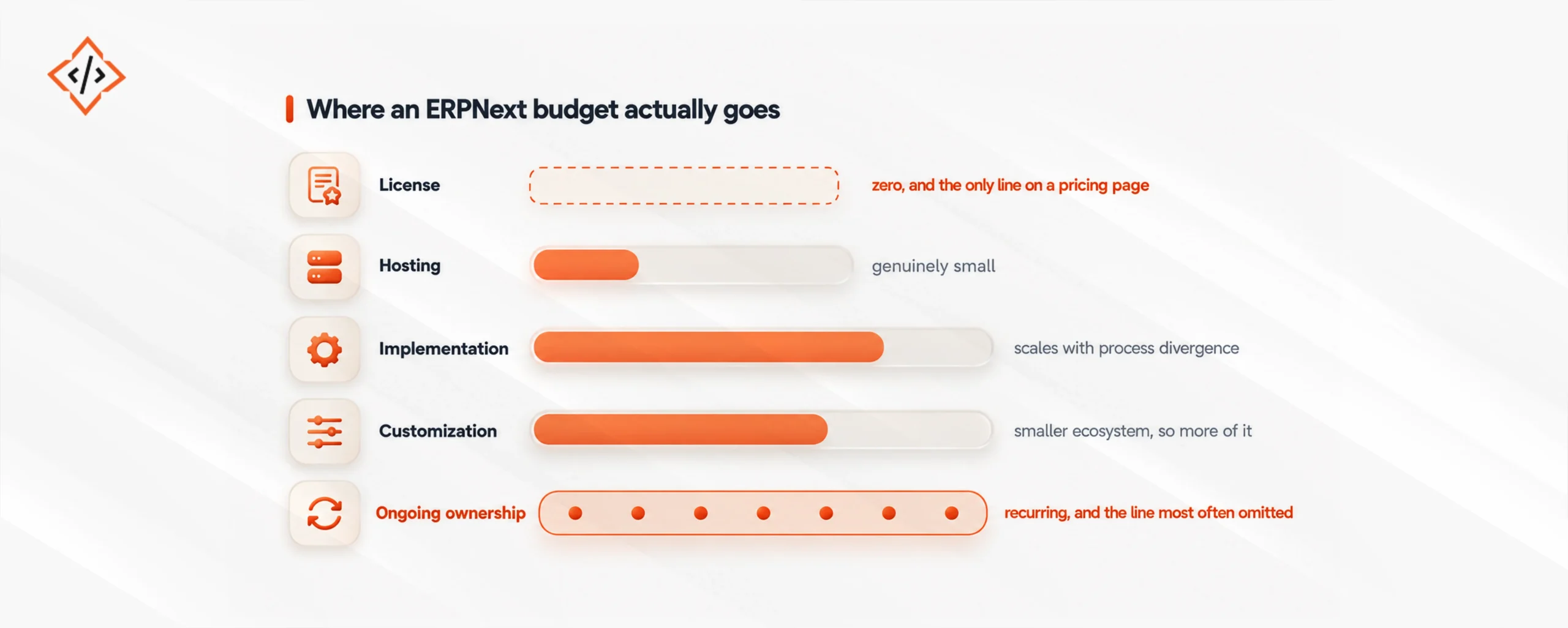
The cost band most often missed in ERPNext budgets is the one that repeats every year.
Choosing between self-hosting and Frappe Cloud depends on your operational capability, control needs, and expected ERPNext hosting cost. It is an operating-model decision more than a simple price comparison.
| Comparison factor | Self-hosted | Frappe Cloud |
|---|---|---|
| Infrastructure cost | Lower | Higher |
| Patching and upgrades | Managed by your team | Largely managed by the platform |
| Backup and restore | Your responsibility | Managed |
| Control over the stack | Full | Limited by platform conventions |
| Custom app deployment | Unrestricted | Supported within platform conventions |
| Operational capability needed | Yes | Much less |
| Predictability of spend | Variable | Predictable |
A practical rule is to choose Frappe Cloud unless someone on your team is responsible for operating the system. Self-hosting reduces infrastructure costs but requires more operational attention. That attention is often limited across mid-market teams.
Organizations with dedicated DevOps capability, or policies requiring data on their own infrastructure, can self-host effectively. Organizations that self-host only to avoid the platform fee may struggle to maintain ERPNext without the required operational capability.
The most useful comparison is with per-seat commercial ERP, because the cost equation changes as your user count grows.
At low headcount, a per-user license is usually manageable and may provide an ecosystem that reduces custom development. In some cases, an Odoo ERP implementation can be cheaper overall when licensing and required custom work are considered together.
At high headcount, especially with many occasional users, per-user pricing continues to rise while ERPNext pricing does not scale the same way. This is where the absence of an ERPNext license cost becomes a more meaningful advantage.
The crossover depends on how much custom work each platform requires for your business needs. Odoo vs ERPNext explains that comparison in more detail.
If your requirements are close to standard ERPNext defaults and you have technical expertise in-house, you may be able to handle the ERPNext implementation yourself. The documentation is detailed, the community is active, and your internal team already understands how the business needs the system to work.
If you are evaluating ERPNext mainly because a commercial license quote came in high, compare the total ERPNext cost before committing to the platform. In some cases, the license may be cheaper than the combined cost of implementation, customization, hosting, and ongoing ownership.
If nobody will take responsibility for operating the system and Frappe Cloud is not in the budget, it is better not to proceed. That setup often leads to maintenance gaps and an ERP that becomes harder to manage over time. It is better to identify that risk early than address it after the system is already in production.
A realistic ERPNext cost estimate should separate one-time implementation expenses from recurring ownership costs before the final budget is approved. Six budget lines matter. Only the first usually appears on a pricing page.
One important planning point is to treat data migration as a separate project with its own timeline. Master data quality is often worse than expected at kickoff. Cleaning that data takes time and can delay the work that follows. The same challenge appears in most ERP migrations, and the Odoo implementation cost breakdown provides figures for comparable implementation phases.
A single ERPNext cost figure would be misleading because the total budget depends heavily on business size, complexity, and implementation needs.
Published ERPNext pricing ranges can vary by more than an order of magnitude. They often combine very different scenarios, such as a ten-user services company and a two-hundred-user manufacturer. Partner rates can also vary significantly by geography, which makes broad ERPNext implementation pricing difficult to apply accurately.
The cost structure is more useful than a generic number. ERPNext hosting cost is usually relatively low. ERPNext implementation cost increases as business processes move further from the standard setup. ERPNext customization cost rises when requirements fall outside the default capabilities. ERPNext maintenance cost is recurring and is often underestimated during initial planning.
A practical approach is to use this structure and collect real quotes against each cost area. Generic ranges can create unrealistic expectations before the actual scope is known. The itemized budget above gives businesses a clearer basis for comparing ERPNext consulting cost, deployment needs, and long-term ownership across different implementation partners.
ERPNext removes the per-user license fee, but that does not make the platform free to implement or operate. The real ERPNext cost shifts into hosting, implementation, customization, and ongoing ownership. ERPNext license cost may be zero, but businesses still need to plan for the work behind the system.
A complete budget should cover all six cost areas, including recurring expenses after go-live. ERPNext maintenance cost should never be treated as an optional line item. Frappe Cloud is usually the better fit when no internal team member is responsible for platform operations. Self-hosting can reduce ERPNext hosting cost, but it requires consistent technical attention and internal capability.
Businesses should also document non-standard requirements before requesting quotes from an ERPNext Partner. Those requirements have the greatest influence on ERPNext customization cost and can create the widest gap between estimates. A realistic budget comes from understanding these costs early, not from focusing only on free software.

 Bhavesh Kachadiya
 Bhavesh Kachadiya
 Bhavesh Kachadiya
 Hardik Soni
 Hardik Soni