






Odoo Development
Enterprise Application
 Hardik Soni
07 October 2026
Hardik Soni
07 October 2026
What ERPNext Actually Costs: Free Software, Real Budget?
 Hardik Soni

Key Takeaways
ERP decisions often feel straightforward in the early research stage. Most platforms promise automation, visibility, and stronger control across teams. The real difference becomes clear once the ERP becomes part of daily operations. That is where Odoo vs ERPNext vs Zoho becomes more than a feature comparison.
Each platform supports core business functions, but the experience can differ in flexibility, usability, and how well Odoo ERP solutions scale over time. This makes an ERP platform comparison a strategic business decision rather than a software purchase.
According to IDC’s 2024 SaaSPath Survey, 46% of companies plan to replace their current ERP system within the next 36 months. That reflects how quickly business requirements are changing across operations, reporting, and system integration. For companies evaluating cloud ERP solutions, the right decision requires more than comparing pricing pages or feature lists.
Businesses are reviewing ERP options more carefully because the software decision now affects operations, visibility, and long-term growth across the organization.
Business operations are becoming more connected across departments. Sales, finance, inventory, and customer service now depend on shared data every day. When systems work separately, teams lose time moving between tools, and reporting becomes less reliable. That is one reason the Odoo vs ERPNext vs Zoho comparison is getting more attention among growing businesses.
More businesses are reducing the number of software tools used across departments. Working across disconnected systems often creates reporting gaps and repeated manual work. This is why many teams prefer cloud ERP solutions that bring core operations into one connected platform with better visibility.
Then growth happens, and suddenly the system that was “fine” for a smaller team starts feeling cramped. More users, more transactions, more workflows, it all adds up, and complexity climbs fast. This is where an ERP platform comparison becomes part of long-term planning instead of a software decision.
ERP buyers expect more from software than they did a few years ago. Usability, flexibility, reporting, and scalability now matter as much as core functionality. Businesses comparing Zoho ERP alternatives are often evaluating which platform can support current operations while remaining reliable as the business grows.
For businesses comparing ERP options, this quick overview highlights where Odoo, ERPNext, and Zoho differ across key decision areas.
| Comparison Area | Odoo | ERPNext | Zoho |
|---|---|---|---|
| Best For | Growing businesses managing complex operations across multiple departments | Small to mid-sized businesses looking for open-source ERP flexibility | Businesses looking for faster cloud deployment with simpler workflows |
| Deployment Options | Cloud and On-Premise | Cloud and Self-Hosted | Cloud-Based |
| Customization Flexibility | High, with strong modular customization | High, with developer-led customization | Moderate, mostly within platform limits |
| Ease of Use | Moderate learning curve | Moderate learning curve | High, beginner-friendly interface |
| Inventory Management | Advanced inventory and warehouse management | Strong inventory with core warehouse capabilities | Suitable for basic to mid-level inventory needs |
| CRM & Sales Management | Strong built-in CRM with sales automation | Functional CRM with standard sales workflows | Strong CRM backed by the Zoho ecosystem |
| Scalability | Highly scalable for growing and multi-location businesses | Scalable for SMBs with internal technical support | Best suited for small to mid-sized scaling businesses |
| Open-Source Availability | Partially open-source | Fully open-source | Proprietary platform |
| Implementation Complexity | Medium to High, depending on customization | Medium, depending on deployment structure | Low to Medium with faster setup |
| Long-Term Flexibility | Strong long-term adaptability across business functions | Flexible with technical ownership | Good for structured workflows with lighter complexity |
What becomes clear after login is that each ERP feels different in the way teams work inside it every day.
The first difference usually appears in the interface. Odoo feels modular and structured from the start. ERPNext feels functional and straightforward. Zoho feels lighter and easier to navigate for first-time users. That first interaction often shapes how quickly teams settle into the platform.
Daily work feels different across all three systems. Odoo supports deeper workflows across departments. ERPNext keeps movement simple and process-focused. Zoho feels faster for routine actions and lighter task management. The difference becomes noticeable after regular use.
Adoption often depends on how easily teams understand the platform, which is why many businesses also invest in Odoo training services during rollout. Zoho usually feels quicker for new users. Odoo takes more time but offers stronger flexibility later. ERPNext often sits between both in terms of the learning curve.
Operational visibility matters once teams begin working across departments. Odoo gives broader visibility across workflows and reporting. ERPNext keeps information accessible with a cleaner structure. Zoho works well for simpler visibility needs across connected teams.
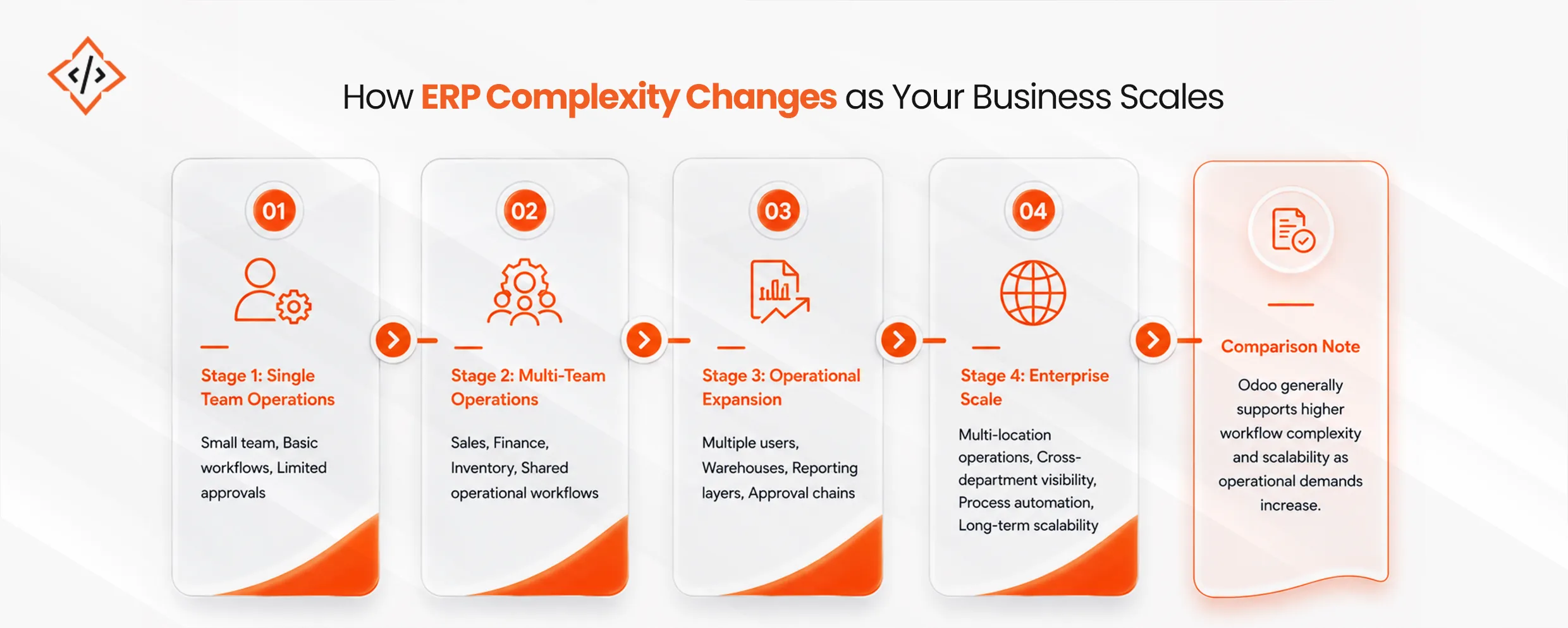
Growth changes how an ERP performs, especially when more teams, workflows, and operational layers begin working inside one system.
An ERP often feels different once multiple teams begin using it together. Sales, finance, inventory, and operations need access to shared information every day. Odoo handles this structure with stronger flexibility across departments. ERPNext and Zoho work well, though larger team coordination can feel more limited over time.
Workflow complexity increases as businesses add approvals, dependencies, and process layers. Odoo supports deeper workflow configuration across business functions. ERPNext manages structured workflows with clarity and consistency, especially for businesses exploring ERPNext development services for deeper customization. Zoho performs well for lighter operational needs but can feel restrictive as workflows become more detailed.
Reporting becomes more important as operations expand across teams or locations. Odoo offers stronger reporting depth across departments and business activity. ERPNext gives practical reporting for daily management. Zoho supports clear reporting, though deeper operational visibility may require additional setup.
Expansion often shows how well an ERP supports growth beyond a single team. More warehouses, users, and business units quickly increase operational demands. In the Odoo vs ERPNext vs Zoho comparison, Odoo often feels stronger for businesses planning long-term operational scale rather than short-term setup.
The strongest ERP decisions usually begin with the right internal questions before any product demos or vendor comparisons begin.
Start by looking at how many people will use the ERP every day. A smaller team may need simplicity and speed. A larger team usually needs stronger coordination across departments. This often shapes the direction of any ERP platform comparison from the beginning.
Every business runs on a different level of process complexity. Some need basic workflows while others rely on approvals, dependencies, and multi-step operations. Understanding this early makes the business management software comparison far more practical and relevant.
ERP decisions should reflect where the business is heading, not only where it stands today. Expansion plans can change software requirements quickly. Businesses evaluating cloud ERP solutions often look closely at flexibility before making a final decision.
Post-launch ownership matters more than many teams expect, especially when Odoo support & maintenance services become part of long-term ERP planning. Some businesses have internal technical support while others depend on external partners. This is often where Odoo implementation services become part of the decision-making process.
Choosing between Odoo vs ERPNext vs Zoho rarely comes down to one platform being the right fit for every business. The better decision depends on how the business operates each day, how teams work together, and how processes are expected to grow over time. Team structure, workflow complexity, reporting needs, and scalability all influence which ERP will perform best in the long run.
Some businesses need deeper flexibility across operations. Others need faster deployment with simpler management. The strongest ERP decision is the one that supports current business needs while remaining practical for future growth.
At CodeTrade, ERP decisions are approached through operational goals, not software comparisons alone, with practical experience across ERP consulting and Odoo implementation services. The team works closely with businesses evaluating Odoo, ERPNext, and Zoho based on workflows, scalability, and long-term usability.
With practical ERP consulting experience and expertise in Odoo implementation services, the focus remains on helping businesses choose a platform that performs well after go-live and continues to support growth over time.
 Hardik Soni
 Chand Prakash
 Hardik Soni
 Hardik Soni
 Hardik Soni