







AI
Education & eLearning
 Chand Prakash
22 September 2026
Chand Prakash
22 September 2026
Future of Generative AI in Education: Use Cases and Trends
 Chand Prakash
The hard part is never the conversation. It is defining what the agent may do, on which records, and under whose authority.
Buyers are not arriving at this question early.
Salesforce reported $800 million in Agentforce annual recurring revenue, up 169% year on year. It also reported more than 29,000 Agentforce deals closed since launch in its FY26 Q4 earnings release, covering the year ended 31 January 2026.
Adoption is real, and it is fast. What comes next is less flattering!
Gartner expects over 40% of agentic AI projects to be canceled by the end of 2027, citing escalating costs, unclear business value, and inadequate risk controls. Agentforce projects are not exempt from that.
Which is why Salesforce Agentforce is better understood as an execution layer over Salesforce data than as a conversational interface bolted onto it. Configuration is easy. Governance is not, and that distinction decides almost everything about whether a deployment works.
This covers what Agentforce provides, where it beats custom AI agent development and where it does not, what readiness the platform demands, and how to think about cost honestly.
If you are weighing a custom alternative, read this alongside the custom AI agent development guide.
Salesforce Agentforce is a platform-native agent runtime inside Salesforce.
It combines a reasoning engine, explicitly registered actions, grounding in Salesforce and Data Cloud records, and topic-level guardrails.
Agentforce AI agents can only perform actions that have been declared, which is the platform’s primary safety property.
Four components sit underneath that, and understanding them separately prevents most disappointment.
The architectural consequence matters.
Because permissions flow from the platform, Agentforce inherits an access-control model that custom AI agent development would have to reimplement.
If your customer data already lives in Salesforce, that is a substantial head start on any Salesforce agent development effort.
When work lives inside Salesforce, Agentforce usually wins because it inherits data proximity and the sharing model.
A custom agent is generally a better fit for reasoning that spans several systems Salesforce does not own. Many enterprises need both.
| Dimension | Salesforce Agentforce | Custom AI agent |
|---|---|---|
| Access control | Inherited from Salesforce sharing | Must be built and audited |
| Data proximity | Native to CRM records | Requires integration layer |
| Time to first useful agent | Short | Longer |
| Cost model | Per-conversation or per-user license | Infrastructure plus model tokens |
| Reasoning model choice | Constrained to supported models | Free choice |
| Cross-system orchestration | Salesforce-centric | System-agnostic |
| Behavior customization | Within platform limits | Unbounded |
| Portability | Locked to platform | Portable |
Agentforce wins clearly when the work lives inside Salesforce. Service case deflection, sales research and summarization, and guided record updates.
The data is present, the permissions are correct, and the integration cost is near zero. This is the sweet spot for Salesforce agent automation.
A custom agent wins when the work spans systems Salesforce does not own.
An agent reasoning across an ERP, a warehouse system, and a contract repository is doing work. Agentforce would have to reach out at every step, which erodes the native data advantage that justified it in the first place. Agentforce ERP integration is possible through external services and API-backed actions. The question is whether it should carry the load.
Three signals that it should not.
Where those hold, AI agent development services building outside the platform will cost less and behave better.
The commonest architectural mistake is choosing one runtime for everything.
Organizations frequently need Agentforce inside the CRM and a separate agent elsewhere, and connecting them is a smaller problem than forcing either to cover both.
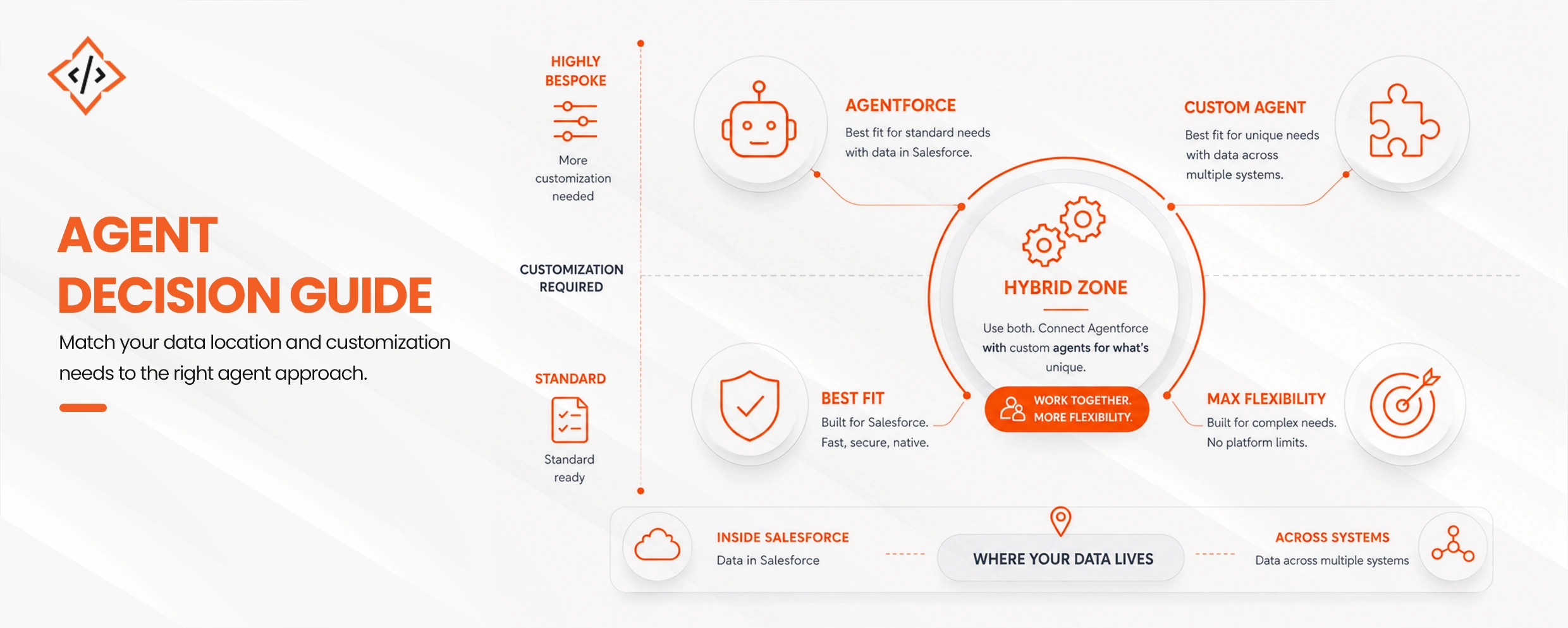
Most enterprises land in that middle zone and treat it as a failure of decisiveness. It is not.
Agents make bad data visible in a way dashboards never did.
A dashboard reporting duplicate accounts is a nuisance somebody gets to next quarter. An agent that reads the wrong duplicate and tells a customer something false is an incident with a timestamp on it.
That difference is why readiness work comes before configuration work. Four areas decide the outcome of a Salesforce Agentforce implementation.
Reaching Agentforce after years of unmanaged customization usually means a cleanup project first.
Deduplication rules, field descriptions, and retiring unclaimed automation are all part of ordinary Salesforce development services. None of this work is wasted, because reporting and integrations improve alongside the agent.
The mistake is finding that work mid-project. Scope it before the license renews.
License pricing is published, and it is the smaller half of the story. Reported figures cluster well above implementation-only quotes, because those quotes exclude the work that decides whether the agent is usable.
Five cost areas sit outside the license and drive real Agentforce implementation costs.
Note that the last three are recurring.
They belong on a retainer alongside your other AI development services spend, not in a one-time build budget.
The pattern mirrors custom AI generally, covered in what mid-market buyers underestimate about custom AI cost. Consumption-based pricing adds a second dimension, because cost scales with conversations.
A successful deflection program increases spend even as it reduces headcount pressure. Model that relationship before launch.
Start with one narrow, high-volume, low-risk use case.
Case deflection for a well-understood request type is the standard opening move, because volume produces evaluation data quickly and the downside of an imperfect answer is bounded.
From there, there are four steps in order.
Gartner’s expectation that over 40% of agentic AI projects will be canceled by the end of 2027 is a warning about exactly this phase. Projects fail after launch, quietly, when nobody owns quality.
Any partner who says an org needs cleaning before Agentforce will work is saying something true and something that sounds self-serving, both at the same time. Two things stop the argument landing.
The workaround that holds up is to build the first agent on a deliberately narrow, clean slice of data and let the contrast do the arguing.
It works on that slice. It then degrades visibly as scope widens to messier objects, and the readiness case makes itself.
That sequence costs more than cleaning up first, and it persuades better, which says something uncomfortable about how technical arguments actually get won.
Not a good state of affairs. It is the one the market is in.
Salesforce Agentforce is strong where work is CRM-resident because it inherits Salesforce’s data proximity and permission model instead of reimplementing them.
It is weaker where reasoning has to span systems Salesforce does not own, and pretending otherwise produces an agent making constant external calls with none of the native advantage.
Readiness decides the outcome more than configuration does.
Duplicate records, undocumented fields, unmapped Salesforce agent automation, and over-permissive sharing all convert directly into unreliable agent behavior, and all four need budgeting instead of discovery.
Then start narrow, keep the first agents read-only, instrument from day one, and give transcript quality a named owner.
Salesforce AI automation 2026 buyers rarely see a failure at launch. They see it six months later, quietly, in transcripts nobody read.
 Chand Prakash
 Chand Prakash
 Chand Prakash
 Hardik Soni
 Hardik Soni