







Odoo Development
Mobile App Development
 Abhishek Karad
28 August 2026
Abhishek Karad
28 August 2026
Connecting a Flutter App to an Odoo or ERP Backend
 Abhishek Karad
Teams expecting to halve their mobile spend often face severe financial disappointment. Flutter lowers the cost of building a user interface once instead of twice. However, that remains a surprisingly small share of any technical budget. The actual financial saving is real but much narrower than the standard sales pitch assumes.
Your chosen UI framework barely touches deep backend integration or complex store compliance. These expensive structural elements determine your true Flutter app development cost. Technical factors like required Flutter platform channels dictate the final budget heavily.
Planning for strict Flutter offline app development requirements also adds significant engineering complexity. This guide covers what genuinely drives an accurate enterprise Flutter app development cost today.
You will discover indicative budget ranges and the hidden expenses that routine estimates omit. Evaluating Flutter versus React Native comparison based on actual team skill remains better than deciding strictly on price.
Evaluating specific technical requirements helps business leaders accurately project their final Flutter mobile app development cost before starting. Four factors determine this budget in order of weight. UI complexity is surprisingly absent from this list.
Every capability without a maintained package needs a custom connection. Dart sits on one side while Swift and Kotlin sit opposite. This setup requires two native implementations to test thoroughly. Bluetooth peripherals and specialized hardware demand native bridges. Background location and native payment SDKs require custom handling.
Unusual permission flows also land strictly in this category. Nothing else shakes the total so far. An app needing four Flutter platform channels costs meaningfully more. This remains true even against projects with identical screen counts.
Consuming three clean REST endpoints remains highly cost-effective in Flutter app development. Integrating with an ERP lacking a mobile-shaped API is expensive. A substantial budget share goes into the integration layer rather than the application itself. This happens frequently with Odoo or legacy line-of-business systems. The backend frequently needs a dedicated API first. This foundational step must happen before building the application economically.
No three-word requirement in mobile costs more than working offline. Genuine Flutter offline app development demands extensive local persistence. It requires a robust sync engine and strict conflict resolution.
Teams must define exactly what happens when two devices edit identical records. Field-service and logistics apps almost always need this precise architecture. Many teams mistakenly price this complex synchronization as simple caching.
Code signing and managing build flavors requires structured continuous integration. Staged rollouts and privacy manifests demand rigorous administrative preparation. Data-safety declarations and store review responses represent fixed technical work. This required compliance effort never scales down for smaller projects. Therefore very small apps carry a higher cost per screen. Mid-sized applications absorb these fixed release costs far better.
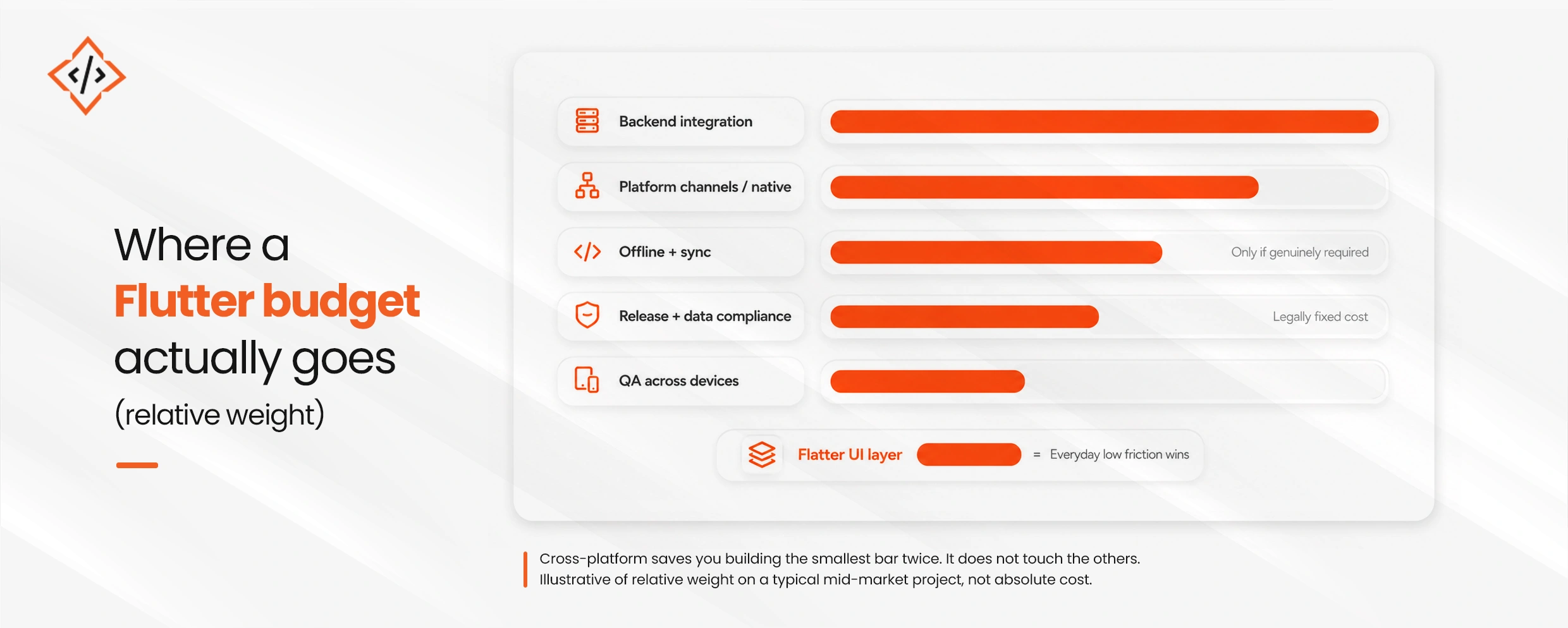
The framework decision affects only one specific budget bar. The final financial estimate is completely decided by these other operational factors.
Review these indicative engineering ranges as practical scoping anchors rather than final quotes. They assume you have a competent technical team alongside a straightforward backend. This baseline helps determine your overall Flutter development cost accurately.
| Project type | Typical scope | Relative cost | Dominant driver |
|---|---|---|---|
| Proof of concept | 3 to 5 screens, mock or single API, no store release | Lowest | Speed of decision, not engineering |
| MVP, content or catalog | 8 to 15 screens, REST backend, auth, push, store release | Low-moderate | Release engineering is a large fixed share |
| Transactional consumer app | Payments, accounts, notifications, analytics | Moderate | Payment SDK integration and compliance |
| Field service / logistics | Offline-first, sync, maps, camera, background location | High | Offline sync and background execution |
| ERP or line-of-business front end | Deep backend integration, roles, approvals, reporting | High | Backend API readiness |
| Regulated app (health, finance) | Above plus audit, encryption, compliance evidence | Highest | Compliance and security engineering |
Two distinct patterns remain worth naming regarding your overall budget. Very small apps become disproportionately expensive per screen quickly. Release engineering and store setup represent large fixed technical costs. A five-screen app never costs exactly one-third of a fifteen-screen build.
Field service and ERP front ends naturally cluster at the top pricing tier. Neither category is driven primarily by user interface complexity. Both depend entirely on what happens securely behind the application itself. Evaluating these critical backend requirements clarifies your true enterprise Flutter app development cost.
Shared work dominates the entire engineering process. This reality is exactly where cross-platform economics genuinely reduces your overall Flutter development cost.
When you hire Flutter developers, teams write business logic, state management, and API integrations only once. Most user interfaces and testing protocols share this exact efficiency. Platform-specific work represents a strict minority of overall effort. This includes distinct store submissions alongside native permission and background behavior handling. Device testing across both operating systems also requires dedicated separate attention.
Adding a second platform creates a modest increment rather than doubling your Flutter mobile app development cost. This financial increment grows strictly based on the required number of Flutter platform channels.
An application without native integration adds very little extra expense. Applications requiring multiple custom channels add considerably more engineering hours. Each custom channel demands a secondary native implementation and dedicated testing cycles.
Single-platform builds rarely represent the cheapest architectural option for this exact reason. Native development becomes a legitimate comparison if no cross-platform future is planned. Building for one platform leaves the primary economic advantage of the framework sitting completely unused.
Do not start a project with CodeTrade if your backend cannot serve a mobile client yet. You must be willing to fix those infrastructure limitations first. Building an integration layer that simply covers gaps forces you to pay twice. The application will also perform slowly in completely untraceable ways.
CodeTrade represents the wrong price point if you want a five-screen application on the cheapest possible terms. Fixed release engineering costs dominate completely at that specific size. A smaller development shop absorbs these fixed expenses much better. This dynamic directly impacts your baseline Flutter MVP development cost.
Never buy an estimate if your brief demands offline functionality without defining strict conflict resolution rules. You must dictate exactly what happens when two devices edit the same record. This single answer changes your enterprise Flutter app development cost more than anything else. Do not purchase technical estimates from anyone until this is fully resolved.
Exactly six items are omitted consistently enough to be predictable when teams calculate their Flutter app development cost.
Building a broader business case spanning AI and mobile technology? The analysis of what mid market buyers underestimate shows the exact same omission pattern. Complex system integration and Flutter offline app development remain common culprits.
Many development teams consistently miscalculate specific testing requirements rather than solving estimation completely. Device quality assurance gets underpriced constantly across the industry by significant margins.
The initial reasoning sounds perfectly fine since a shared codebase implies shared testing. However Android fragmentation ignores identical Dart code across different devices completely. Failures surfacing on older mid-range handsets involve renderer and memory limits. Shared logic never prevents these specific hardware limitations. This oversight heavily impacts the final Flutter mobile app development cost.
The subsequent review cycle complicates things further during deployment. Finding defects late requires a complete store round trip that consumes valuable days.
Quoting device QA as a separate line item with an attached device list solves this transparency issue. Clients see exactly what they purchase and can cut it explicitly. This approach remains far better than burying testing expenses within the overall Flutter development cost. This explicit separation establishes highly reliable Flutter app development services.
Applying specific constraints controls your Flutter app development cost using five levers that work and two that reliably backfire.
Levers that work:
Levers that backfire:
Flutter strictly lowers user interface expenses, which represent the smallest portion of your overall Flutter app development cost. Your final financial estimate depends entirely on complex backend integration, strict release compliance, and required Flutter platform channels. You must estimate these structural dependencies accurately before initiating professional Flutter app development services.
Interrogate mandatory Flutter offline app development requirements carefully, as true synchronization costs significantly more than simple caching. Treat release engineering as a fixed expense, which explains why small custom mobile app development projects carry disproportionate baseline budgets.
Finally, treat your annual Flutter app maintenance cost as a predictable schedule rather than a random technical contingency.
Abhishek Karad Abhishek Karad
 Abhishek Karad
 Abhishek Karad
 Abhishek Karad