






Open edX Development
Education & eLearning
 Chand Prakash
07 September 2026
Chand Prakash
07 September 2026
Open edX vs Moodle vs Canvas for Corporate Training
 Chand Prakash
Organizations often hire a very good Django engineer who ultimately becomes useless during an Open edX platform upgrade. Technical leaders typically discover this expensive reality eleven months too late. This common structural problem stems directly from treating one job description as covering three genuinely different technical capabilities.
A strong Python engineer building custom features might never execute a complex Tutor release upgrade. An experienced Open edX DevOps professional might not understand why specific stored grade recalculations remain dangerous. Meanwhile, a highly capable instructional engineer building excellent courses may not read Python code at all.
When organizations look to hire Open edX engineers, they must recognize that all three roles represent essential work. When looking to hire Open edX developers, organizations discover that very few professionals execute all three capabilities perfectly, and the market rarely prices these skills accurately.
This comprehensive guide explains what each distinct capability actually involves. It outlines how to test specific Open edX Tutor skills and size a technical team against the strict named-release cadence. If you’re still choosing a platform, read the Open edX, Moodle, and Canvas comparison first, because the hiring commitment is the main argument against Open edX.
Organizations seeking to hire dedicated Open edX developers must recognize that this ecosystem demands three entirely distinct technical capabilities.
Platform DevOps engineering owns Tutor, container topology, environment parity, secure backups, and the critical named-release upgrade path. This Open edX DevOps capability is frequently outsourced. Lacking this specific operational expertise becomes incredibly painful because downtime stops all learning activity completely.
Core knowledge requires mastering the official Tutor plugin configuration model. Engineers must possess strict discipline to express every system customization exclusively as standard plugins. Manual container modifications must remain strictly prohibited. Operating environments featuring manually edited running containers typically suffer through grueling upgrade projects requiring several months.
Backend engineering handles custom features, native Open edX XBlock development, deep LTI integrations, event pipelines, and standard APIs. This requires deep Python and Django fluency alongside strict adherence to specific platform conventions. These internal architectural conventions differ significantly from standard generic Django frameworks.
The distinguishing professional skill involves knowing exactly what code you should never fork. The system represents a massive codebase. Modifying core files rather than extending through supported extension points makes future platform upgrades extraordinarily expensive. Organizations providing professional Open edX development services heavily emphasize this strict architectural boundary.
Course engineering completely owns OLX authoring, advanced Studio configuration, integrating Open edX AI tutors, complex grading policies, cohort management, and SCORM content imports. This specific capability frequently sits directly within the corporate learning and development department rather than engineering.
These instructional professionals frequently identify missing platform requirements first before technical teams notice them. Successful Open edX implementation depends heavily on this unique intersection between deep technical configuration and practical instructional design.
This technical skills matrix clearly outlines the varying proficiencies required across all three primary capabilities for successful platform operations.
| Capability | Platform DevOps | Backend / XBlock | Course engineering |
|---|---|---|---|
| Tutor plugin and config model | Essential | Working | Basic |
| Docker and container orchestration | Essential | Working | – |
| Named-release upgrade execution | Essential | Essential | Basic |
| Python and Django | Working | Essential | – |
| XBlock development | Basic | Essential | Basic |
| Open edX REST APIs | Working | Essential | Basic |
| MFE / React front end | Working | Essential | – |
| MySQL and MongoDB operations | Essential | Working | – |
| Event pipeline and xAPI | Working | Essential | Basic |
| OLX authoring and Studio | Basic | Working | Essential |
| Grading policy and certificates | – | Working | Essential |
| LTI and SCORM integration | Basic | Essential | Working |
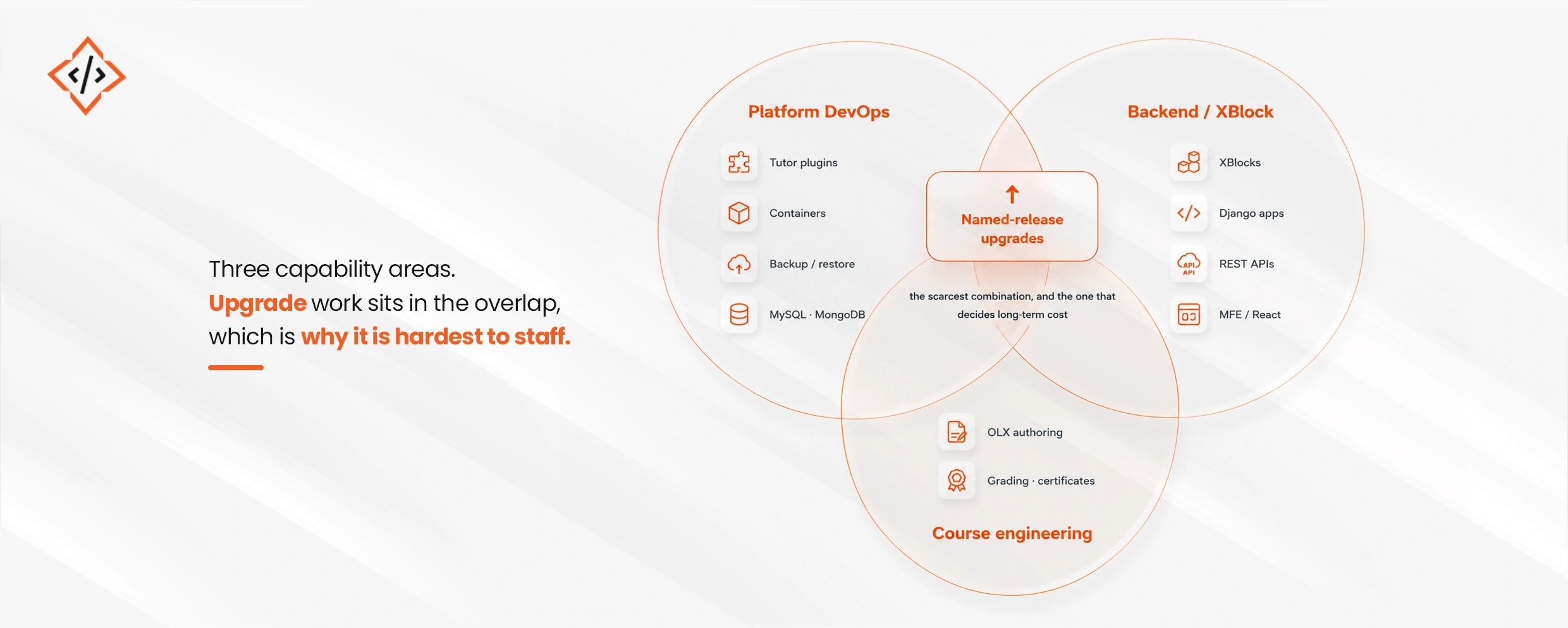
These three distinct capability areas rarely exist within one individual. Critical upgrade work sits perfectly in the technical overlap. This specific operational overlap explicitly explains why staffing these specialized educational platforms remains incredibly difficult today.
Technical leaders looking to hire Open edX developers require highly specific questions to accurately evaluate genuine platform capability. Standard Django interview processes simply will not surface true platform competence. These specific questions will.
Two specific signals deserve heavier weighting than simple years of experience. Active contribution to the platform ecosystem implies real technical depth. The core developer community remains relatively small. Operating a self-hosted production instance also holds immense practical value. Purely managed-host experience leaves critical knowledge gaps that appear exactly when infrastructure misbehaves.
Watch closely for one specific negative technical interview signal. Candidates might describe extensive Open edX customization without discussing future upgrade consequences. That destructive pattern reliably predicts a technical estate that cannot undergo future upgrades safely.
This represents a massive planning error specific to Open edX LMS development. The platform ships named releases on a strict regular cadence. Each release demands a scheduled technical project rather than a simple background task.
A technical team sized purely for feature delivery naturally accumulates serious version debt by default. Every skipped release directly raises the financial cost of the next technical upgrade. The technical estate eventually drifts toward needing a dedicated recovery program.
Practical implications:
If you’re building the business case, the Open edX implementation cost breakdown puts figures against ongoing platform effort.
Organizations utilizing a managed host successfully should never engage an Open edX development company for basic configuration changes. This approach forces companies to pay twice for platform ownership they already outsourced successfully.
When projects require exactly one custom feature, simply hire an independent contractor experienced in Open edX XBlock development. This specific requirement represents a strictly bounded technical task. A dedicated engineering team offers the completely wrong operational structure and an unjustified financial price for isolated components.
Do not begin any platform project without an internal technical contact, a clear roadmap, and a dedicated decision-maker. Agency engagements lacking internal technical ownership consistently fail across both participating organizations. Without dedicated internal leadership, every minor technical decision escalates endlessly and business stakeholders ultimately accept nothing.
Organizations must carefully evaluate their technical capacity before selecting an operating model for their enterprise digital learning infrastructure. Professional Open edX developers remain genuinely scarce, which fundamentally changes staffing calculations compared to mainstream software stacks.
| Model | Works when | Risk |
|---|---|---|
| Fully in-house | The platform is a core product with a permanent roadmap, and your local market can supply Tutor and XBlock skills | Single-person dependency on upgrade knowledge, slow to hire |
| Managed partner | Platform reliability matters more than customization velocity, no internal DevOps appetite | Customization turnaround depends on the partner’s queue |
| Hybrid | Course engineering in-house, platform DevOps and upgrades with a specialist partner | Needs explicit ownership boundaries in writing |
The hybrid model suits most corporate learning estates perfectly, especially when utilizing specialized Open edX development services for the heavy technical lifting. Course engineering benefits greatly from sitting close to the business units. Meanwhile, technical Open edX upgrade services benefit from teams possessing repeated execution experience.
This specific split works only when organizations document everything meticulously. Define exactly who owns the Tutor configuration repository. Clarify who approves plugin changes and who remains accountable when upgrades slip.
Whichever model applies, identical contract terms matter exactly as they do on any standard platform engagement. Organizations must secure client-owned repositories from the very first commit. Demand comprehensive documentation as a primary deliverable. Secure a named engineering team requiring formal substitution notices. The standard Odoo engineering hiring guide covers these specific contractual terms in greater detail, and those principles transfer directly.
When organizations hire dedicated Open edX developers, knowledge concentration represents a significantly bigger risk than on common software stacks.
Acknowledging this ongoing industry failure remains much more productive than pretending the underlying staffing issue is completely solved. When organizations hire Open edX developers for hybrid models, they consistently underestimate required instructional engineering knowledge across platform teams.
Companies frequently place strong DevOps professionals who cannot determine whether a specific grading policy change remains technically safe. Consequently, every course-adjacent decision routes directly back to the corporate client and drastically slows overall project delivery.
The obvious fix of hiring professionals possessing both distinct skill sets simply fails because that specific combination barely exists. The most effective current strategy requires implementing a structured handover document between the course team and the platform engineers.
Technical leaders must produce this vital documentation during initial onboarding rather than assembling it during critical platform incidents. Long-term operational data will eventually reveal whether this specific management strategy truly resolves the underlying technical handover friction.
The platform strictly demands three distinct technical capabilities. The most consequential skill sits directly between DevOps and backend engineering. Executing named-release upgrades correctly prevents massive technical debt. When organizations hire Open edX engineers purely for backend work, systems inevitably fail during upgrades. Technical leaders must screen directly for genuine Open edX upgrade services experience.
Ask exactly what broke previously and listen closely for highly specific technical details. Verify candidates extend through supported points rather than dangerously forking the core codebase. Confirm they have actively operated self-hosted instances rather than simply consuming managed environments. To accurately manage your long-term Open edX implementation cost, organizations must absolutely reserve explicit engineering capacity for the strict release cadence.
Keep critical upgrade knowledge shared across at least two technical professionals. Enforce strict Open edX Tutor usage during every code review. Maintain a detailed platform upgrade log continually. Within this specialized talent pool, comprehensive documentation never represents simple administrative overhead. It remains your primary defense against one sudden departure becoming a complete platform crisis.
 Chand Prakash
 Chand Prakash
 Chand Prakash
 Chand Prakash
 Chand Prakash