






AI
Education & eLearning
 Chand Prakash
22 September 2026
Chand Prakash
22 September 2026
Future of Generative AI in Education: Use Cases and Trends
 Chand Prakash
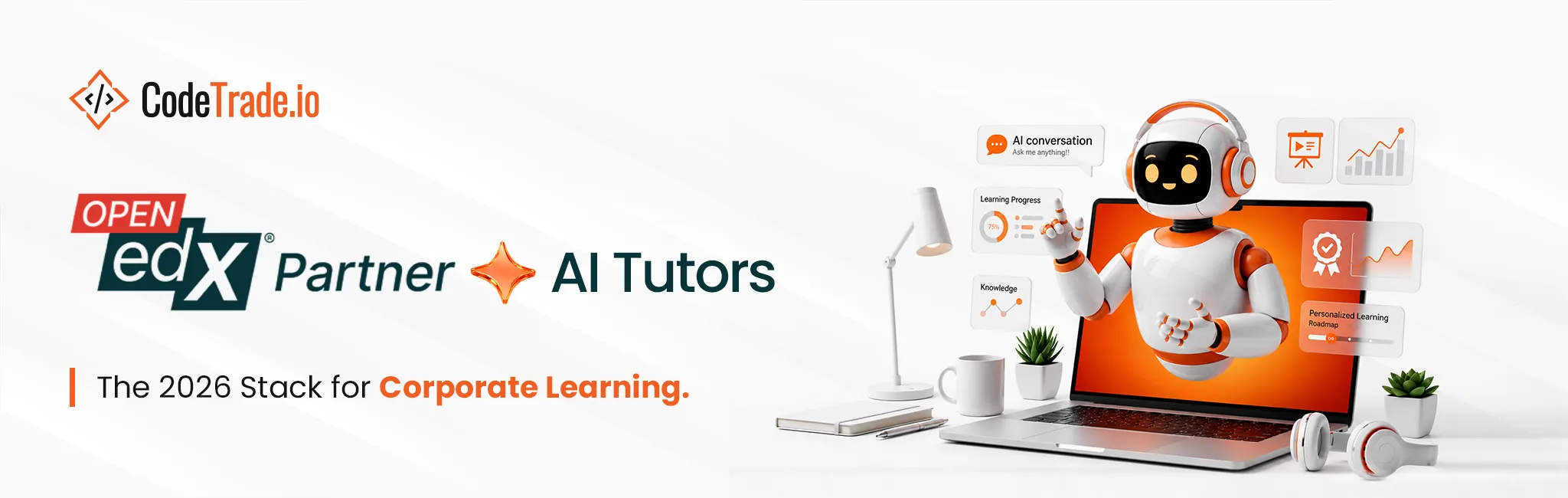
Corporate learning is entering a new phase where course delivery alone is no longer enough. Employees expect immediate answers, personalized guidance, and learning experiences that fit their daily work. Many traditional LMS platforms were designed to manage content, not support continuous learning. This gap is pushing enterprises to rethink how training systems are built.
The combination of an Open edX AI tutor and a modern learning infrastructure is emerging as a practical solution. Open edX corporate learning environments give organizations greater control over customization, while an AI tutoring system provides contextual support throughout the learning journey.
The result is an AI-powered learning platform that extends beyond content delivery. According to the World Economic Forum’s Future of Jobs Report 2025, 85% of employers plan to prioritize workforce upskilling over the next five years. This growing focus on skill development is increasing demand for AI-driven employee training and more personalized learning experiences.
As these expectations increase, the discussion shifts from LMS features to the learning stack that can support long-term workforce development.
Modern LMS decisions are increasingly shaped by flexibility, AI adaptability, and long-term control rather than feature lists.
| Evaluation Area | Traditional SaaS LMS (Docebo) | Enterprise Learning Suite (Cornerstone) | Fully Custom LMS | Open edX |
|---|---|---|---|---|
| Customization | Limited vendor-supported customization | Moderate customization | Complete flexibility | High customization with source-code access |
| AI Integration | Depends on vendor roadmap | Built-in AI with limitations | Fully customizable AI stack | Supports custom AI tutors and private AI models |
| Ownership | Vendor-owned platform | Vendor-owned platform | Full ownership | Full ownership of deployment and data |
| Scalability | Easy scaling with increasing costs | Enterprise-grade scalability | Depends on infrastructure design | Highly scalable with cloud deployment |
| Vendor Lock-In | High | High | None | Minimal |
| Best Fit | Quick deployment needs | Large enterprises with standard processes | Highly specialized requirements | Organizations seeking flexibility, AI readiness, and long-term control |
Organizations with complex training environments often need learning platforms that can adapt to their business rather than the opposite.
Open-source platforms give enterprises direct access to the codebase and greater control over platform decisions. This flexibility supports long-term planning without depending on a vendor’s product roadmap and creates a stronger foundation for Open edX development initiatives.
An Open edX LMS can also evolve alongside changing training requirements, making it a stronger foundation for Open edX corporate learning initiatives.
Many enterprises rely on connected systems across departments. A corporate learning management system must integrate with HRMS platforms, ERP systems, and internal knowledge repositories. Open edX customization makes these connections easier to support. This creates a more unified corporate training platform and reduces operational friction across teams.
AI adoption often requires more control than packaged LMS platforms can provide. Organizations can choose their preferred AI models, deploy private environments, and build an Open edX AI tutor around internal knowledge. This approach supports personalized learning with AI while protecting sensitive business information.
AI tutors deliver the greatest value when learning support is available before, during, and after every training interaction.
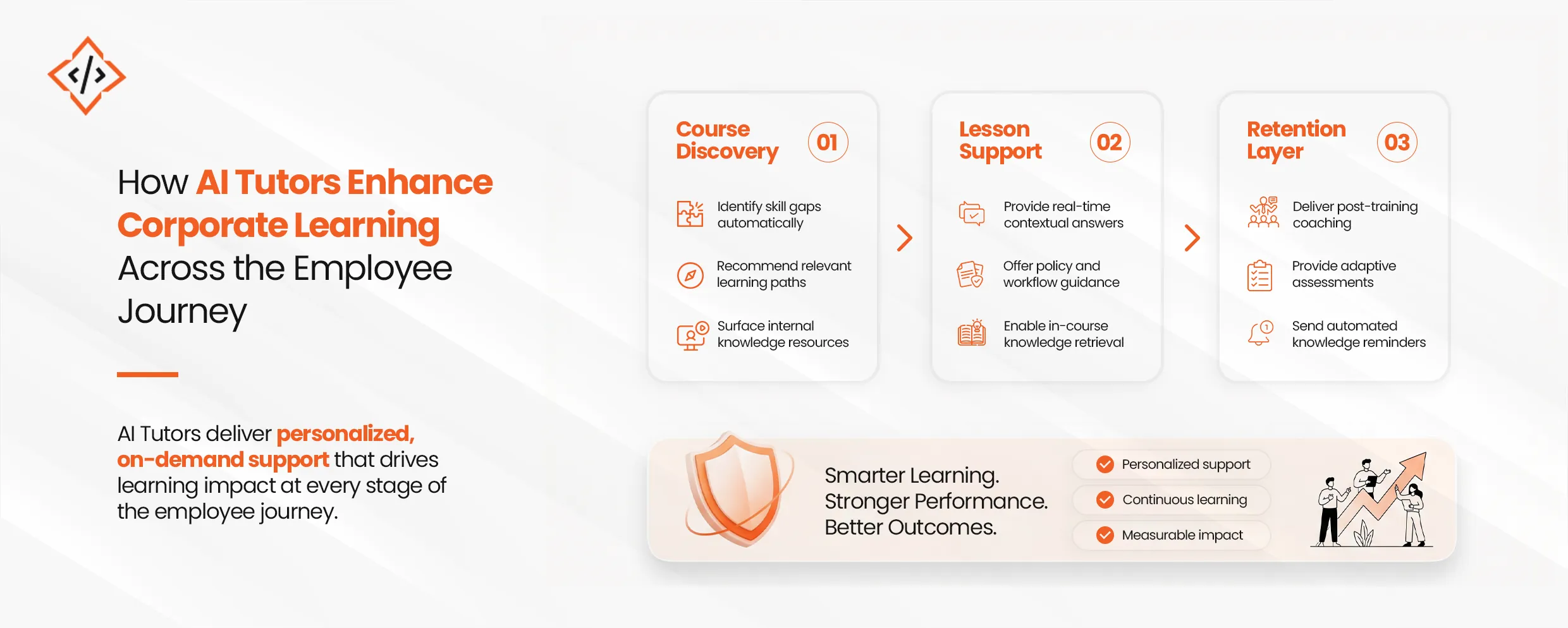
Many employees struggle to find the right training path within large learning libraries. An Open edX AI tutor can identify skill gaps and recommend relevant content based on role requirements. It can also surface internal resources that employees may not discover on their own. This makes Open edX corporate learning more targeted and relevant from the start.
Learning momentum often breaks when employees cannot get answers at the right moment. Organizations investing in AI development services can extend learning support through contextual explanations, policy guidance, and knowledge retrieval directly within the course environment. This creates a more responsive corporate learning management system and improves the overall learning experience.
Training outcomes depend on what employees retain after course completion. An AI learning assistant can deliver follow-up coaching, adaptive assessments, and timely reminders that reinforce key concepts. These capabilities support personalized learning with AI and help employees apply knowledge long after formal training ends. This approach transforms an AI-powered learning platform into a continuous learning environment rather than a one-time training event.
Deploying an adaptable corporate learning framework allows large enterprises to escape the engineering restrictions of conventional software ecosystems.
At a smaller scale, the cost gap between SaaS platforms and an Open edX LMS is often modest. SaaS licensing can appear cost-effective because infrastructure and maintenance are managed by the vendor. For organizations with straightforward requirements, the convenience may outweigh the ownership benefits during the early stages of deployment.
Cost dynamics begin to shift as learner volumes increase. Additional user licenses, premium integrations, and AI-related features can raise overall spending. Open edX corporate learning environments typically scale through infrastructure investments rather than recurring seat-based charges, which creates greater cost predictability.
At enterprise scale, recurring licensing costs become a significant budget consideration. Organizations also face growing expenses for advanced reporting, integrations, and AI capabilities. A corporate learning management system built on Open edX provides greater ownership and flexibility, making it a stronger long-term option for large enterprise training solutions.
| Cost Factor | 1K Seats | 5K Seats | 20K Seats |
|---|---|---|---|
| Annual LMS Cost (SaaS) | Lower initial licensing costs | Licensing costs increase significantly | Large recurring subscription expenses |
| Annual LMS Cost (Open edX) | Infrastructure investment required | Moderate infrastructure scaling | Cost growth remains relatively predictable |
| AI Cost | Vendor AI add-ons or usage fees | Higher AI licensing costs | Substantial AI platform expenses |
| Estimated TCO | Comparable across both models | Ownership model becomes more competitive | Ownership model often delivers lower long-term costs |
As AI becomes part of workplace learning, protecting sensitive business knowledge is no longer an optional consideration.
Corporate learning environments often contain information that extends far beyond training materials. Internal SOPs, product documentation, customer records, and operational processes frequently become part of an AI tutoring system. Without proper controls, this information can be exposed in ways organizations never intended. This is especially important when deploying an Open edX AI tutor that interacts with internal knowledge repositories.
Strong governance helps organizations maintain control over how training data is accessed and used. Private deployments, role-based permissions, retention policies, and audit trails create a secure foundation for an AI-powered learning platform. These controls also support Open edX corporate learning initiatives that require strict oversight of sensitive information.
Compliance requirements continue to evolve as Generative AI in education enters enterprise environments. Organizations must align learning systems with internal governance standards and industry regulations.
According to the World Economic Forum’s Global Cybersecurity Outlook 2025, 66% of organizations expect AI to have the most significant impact on cybersecurity in the year ahead. This growing focus on AI-related risks highlights the need for stronger governance and controlled access to enterprise knowledge.
For organizations investing in AI-driven employee training, protecting proprietary information is just as important as improving learning outcomes.
A structured rollout reduces implementation risks and helps enterprises move from planning to production with greater confidence.
The first month focuses on planning and alignment. Teams conduct discovery workshops to identify learning objectives, business requirements, and technical dependencies. This phase also includes learning architecture design, infrastructure planning, and mapping the knowledge sources that will support the Open edX AI tutor after deployment.
The second phase moves into platform implementation. Organizations deploy the Open edX LMS, configure the learning environment, and establish the technical requirements for openEdx customization while connecting approved knowledge repositories and learning workflows. Security controls are established during this stage, while existing training content is migrated into the new corporate learning management system.
The final phase focuses on validation and readiness. Pilot groups begin using the platform while teams monitor performance and collect feedback. Adjustments are made to improve learning experiences before the broader launch. This approach helps establish a reliable AI-powered learning platform that supports long-term enterprise training solutions.
Corporate learning is no longer defined by content libraries alone. Enterprises now need platforms that can support personalized learning, protect business knowledge, and remain cost-effective as learner volumes grow.
An Open edX LMS combined with an AI tutoring system addresses these requirements through greater flexibility, stronger governance, and long-term ownership. This combination allows organizations to build learning environments that adapt to changing workforce needs without becoming dependent on restrictive licensing models.
CodeTrade helps enterprises design and deploy Open edX corporate learning environments tailored to their operational requirements. From Open edX customization and secure AI integrations to enterprise-scale deployments, the focus remains on building practical learning ecosystems that support measurable business outcomes.
With experience in Open edX development services, CodeTrade helps organizations implement an Open edX AI tutor that aligns with internal knowledge systems while maintaining compliance and control.
 Chand Prakash
 Chand Prakash
 Chand Prakash
 Chand Prakash
 Chand Prakash