




Open edX Development
Hire Developers
 Chand Prakash
08 September 2026
Chand Prakash
08 September 2026
Hire Open edX Engineers: Tutor, DevOps & Platform Skills
 Chand Prakash
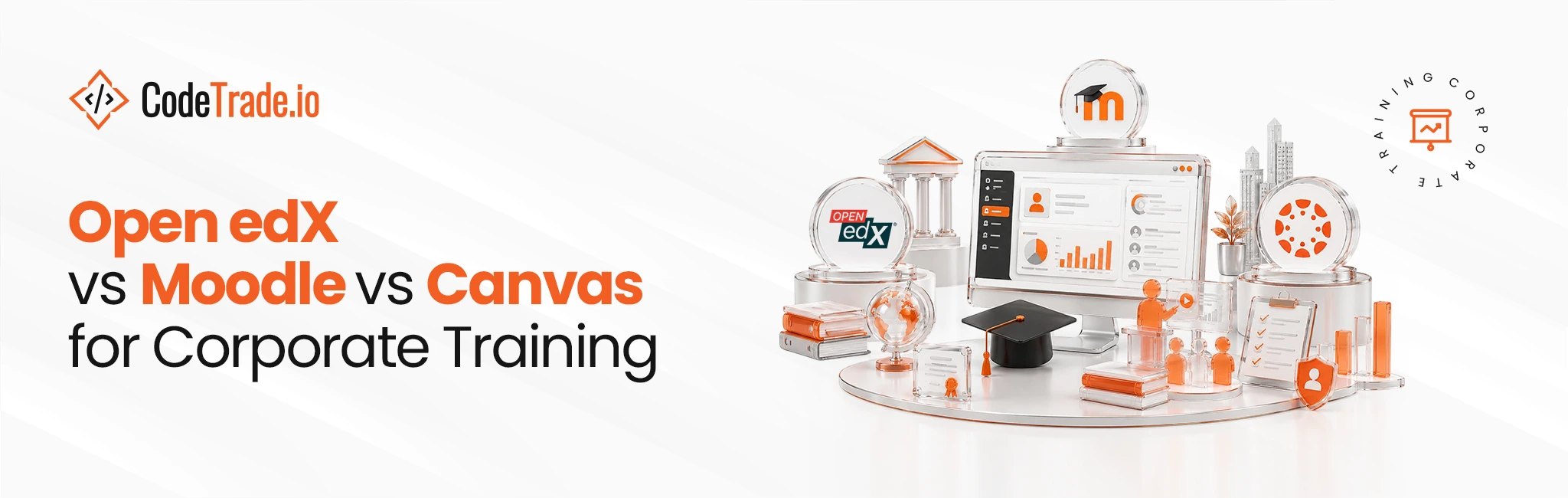
Most LMS evaluations begin by comparing learner counts and program types to determine the best LMS for corporate training. Organizations typically ask which platform handles three thousand compliance learners better. This represents the completely wrong approach because raw learner numbers barely influence the final answer.
The actual deciding factor for a corporate learning management system centers entirely on who will operate the platform in two years. Open edX development services work best when organizations are prepared to run the system. Moodle expects teams to administer it. Canvas expects businesses to simply buy it. Every other architectural difference directly follows from that single operating model decision.
Standard feature comparison tables miss this operational reality completely. Consequently, enterprise selections often fail in year two when actual LMS implementation cost and maintenance realities surface. This Open edX vs Moodle vs Canvas evaluation focuses strictly on long-term operating divergence. Technical leaders must align their Open edX vs Moodle decision with actual engineering capacity rather than a feature checklist.
Each platform was built to solve a specific problem. Their underlying architecture still clearly reflects those original design intentions. The Open edX LMS emerged from MIT and Harvard to deliver massive open online courses. It successfully handles hundreds of thousands of simultaneous learners. The platform remains service-oriented, horizontally scalable, and deliberately structured. Courses are strictly composed of sections, subsections, units, and XBlocks that can support AI in Open edX.
The Moodle LMS grew in the exact opposite direction. It started as a flexible teaching tool for individual educators. The system accumulated an enormous plugin ecosystem over two decades. Developers have already built almost any pedagogical pattern imaginable.
The Canvas LMS operated as a commercial cloud product from day one. It currently holds roughly 39% of the North American higher education market. Its primary design priority ensures a low-friction experience for non-technical instructors.
This detailed enterprise LMS comparison directly evaluates core technical requirements alongside long-term operating costs across all three major platforms.
| Dimension | Open edX | Moodle | Canvas |
|---|---|---|---|
| License | Open source (AGPL) | Open source (GPL) | Open source core, commercial cloud |
| Operating model | Self-hosted via Tutor, or managed vendor | Self-hosted or Moodle Partner | Predominantly vendor-hosted SaaS |
| Team required | DevOps plus platform engineer | LMS administrator | Administrator only |
| Scale profile | Very high, built for MOOC-scale cohorts | Moderate, scales with tuning | High, and it’s the vendor’s problem |
| Extensibility model | XBlocks, plugins, Open edX APIs, Tutor plugins | Plugin directory, thousands of modules | LTI integrations, limited core modification |
| Content standards | SCORM via plugin, xAPI, LTI, OLX native | SCORM, xAPI, LTI, IMS CC | SCORM, xAPI, LTI |
| Structured curriculum | Strongest, programs and pathways are native | Possible, needs configuration | Course-centric, not program-centric |
| Upgrade burden | Named releases, real upgrade projects | Frequent releases, plugin compatibility risk | Vendor handles it |
| Dominant cost | Engineering and infrastructure | Administration and plugin maintenance | Per-user licensing |
| Best fit | Certification programs, product academies | Compliance training, internal academies | Minimizing internal burden |
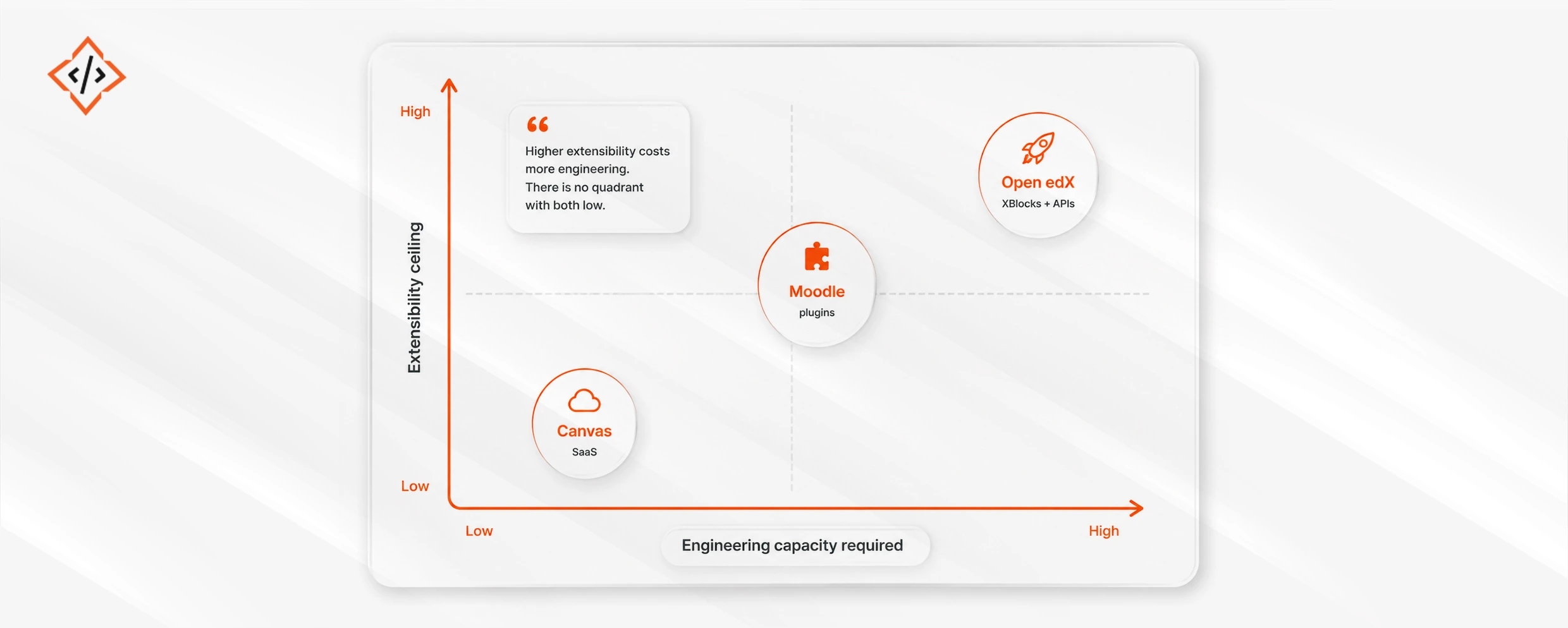
System extensibility and internal operating burden always move together. Making a final selection simply requires choosing which tradeoff to accept.
The right LMS depends on the training model, learner scale, reporting needs, and how much platform ownership your team wants. Corporate L&D isn’t one workload. It’s at least three, and each points in a different direction.
High learner counts, low content complexity, strict reporting requirements, and audit exposure define this workload. Plugin breadth and mature reporting matter more than architecture here.
Moodle handles this well and at a lower cost. Completion tracking and certification plugins are battle-tested, while the admin burden stays within what an L&D team can manage without engineering help.
This is where Open edX pulls ahead, which is why Microsoft Learn, MongoDB University, and AWS Training all run structured, versioned, publicly facing curricula on it.
Three properties drive that advantage. Program and pathway structures are native rather than added later. The XBlock model supports genuinely custom interactive content, including graders that execute learner-submitted code. It also holds up under cohort sizes that would require significant tuning elsewhere.
Teams running this workload are usually the ones asking about AI tutoring too, which the Open edX AI tutors stack guide covers.
Mixed workloads with instructor-led components and moderate scale tend toward Moodle or Canvas. The deciding question is whether you want to own and manage the platform at all.
Industry mix supports this pattern. According to the TalentLMS 2026 L&D Report, technology companies account for 30% of LMS users, followed by education at 21%, manufacturing at 9%, and healthcare at 7%. That concentration in technology closely matches the product-academy use case where Open edX clusters.
There’s a recurring failure pattern in Open edX selection that I’ve seen more than once, and the warning sign is always the same.
The organization has a developer. The roadmap includes custom assessment and scaling to partners. On paper, it fits, and the recommendation is defensible on the day it’s made.
Then the developer leaves. Nobody replaces them because the platform was never anyone’s actual responsibility. The estate falls two named releases behind, a custom XBlock breaks during the next upgrade attempt, and getting current costs more than the original build did.
What I’ve changed is the question. Not “do you have engineering capacity,” which almost everyone answers yes to. Instead: “will you still have it in eighteen months, and who specifically?” Naming a person is much harder than naming a capability, and that difficulty is the signal.
If you have no engineering capacity and none planned, don’t choose Open edX and don’t hire us to build it. You’ll pay for capability you never use, then fall behind on upgrades.
The same applies if you have fewer than a few hundred learners with simple content. The architecture is built for scale you’ll never reach, and the operating burden isn’t proportional to what you get back.
The same applies if instructor-led training is your main mode. Scheduling, rostering, and classroom management aren’t Open edX strengths, and no amount of custom work changes that.
In those cases, Moodle is usually the better answer, and we’d rather say so before you spend anything.
Moodle deserves the same treatment, incidentally. It’s the wrong choice when curriculum structure must be versioned and programmatic, when custom interactive assessment is central, or when cohort sizes reach tens of thousands concurrently.
License cost is the least useful number here. Two of the three are free to license, and the one that charges is often the cheapest to operate.
Four cost buckets matter.
If you’re building an Open edX business case, the Open edX implementation cost breakdown puts figures against these.
One area still does not have a clear answer.
Open edX is midway through a front-end transition to micro-frontends. Architecturally, it is the right direction. However, it also makes the upgrade cost of any given named release less predictable than it was three years ago because MFE rework does not track Python changes.
For teams deciding on Open edX today, that uncertainty is real and difficult to price precisely. It may settle within a year, or it may take longer. Teams with strong front-end capability are less affected. Teams without it should treat Open edX upgrade estimates as broader than they may initially appear.
Selection failures usually come from evaluating features rather than long-term requirements. Use this order instead.
The Open edX vs Moodle decision comes down to operating fit, not which platform has the longest feature list. Open edX suits large cohorts, product-style learning, and teams with engineering capacity to manage and extend the platform. Moodle works better when broad teaching options, lower administration effort, and simpler operations matter more than extreme scale.
Canvas fits organisations that value a managed experience and predictable operations, even if the platform offers less technical flexibility. In this corporate LMS comparison, the biggest risk is choosing capability without funding the team required to support it. That gap can quickly turn a sound platform choice into an expensive long-term problem for teams.
For any corporate learning management system, start with the operating model, then assess content complexity, scale, and LMS implementation cost. The best LMS for corporate training is the one your team can support consistently over time, without creating avoidable operational risk.
 Chand Prakash
 Chand Prakash
 Chand Prakash
 Chand Prakash
 Chand Prakash