







FinTech & Banking
Python
 Hardik Soni
09 September 2026
Hardik Soni
09 September 2026
Why Python Is a Smart Choice for Fintech App Development?
 Hardik Soni

Financial institutions are moving beyond rule-based automation because traditional systems cannot process growing volumes of unstructured financial data with enough speed or contextual understanding. As operational complexity increases across banking ecosystems, legacy infrastructure is becoming less effective in handling modern financial workflows.
Generative AI in Fintech is being deployed to analyze customer interactions, summarize compliance records, strengthen fraud monitoring, and support real-time operational decision-making across banking environments. This shift is changing how financial institutions approach risk management, customer servicing, and fintech automation with AI at scale.
According to a 2026 Research and Markets industry forecast, the global AI in fintech market is expected to reach $23.05 billion as financial institutions scale their operations.
To execute these transitions safely, enterprises engage professional AI consulting services to implement intelligent automation, predictive risk systems, and AI-powered financial solutions. The strongest generative AI use cases in finance are no longer experimental projects
They are becoming operational systems embedded directly into AI applications in financial services and AI in digital banking workflows.
Legacy fraud engines fail against modern financial threats because static rules cannot interpret behavioral patterns across multiple digital channels. Traditional systems often block legitimate transactions while missing coordinated attacks involving synthetic identities, automated bot activity, and manipulated account behavior.
Generative AI for fraud detection improves this by analyzing transaction intent, device activity, customer communication patterns, and behavioral anomalies in real time.
Modern fraud monitoring systems now focus on:
Financial institutions are increasingly deploying AI-powered financial solutions to improve fraud monitoring accuracy while reducing operational inefficiencies tied to manual investigation workflows. This is why Generative AI in Fintech is becoming critical for modern financial risk infrastructure across digital banking and enterprise financial operations.
Institutions are prioritizing Generative AI in Fintech in areas where operational complexity involves large volumes of unstructured information, increasing regulatory pressure, and time-sensitive decision-making requirements.
The strongest generative AI use cases in finance are focused on improving accuracy while reducing manual processing overhead across risk, compliance, and investment operations.
Financial firms are deploying custom generative AI development services to assess thin-file applicants through alternative data sources such as cash flow records, invoice histories, and B2B contract language. This analytical approach directly improves lending decisions for customers who lack traditional credit histories.
Large Language Models help compliance teams monitor changing regulations, generate audit-ready documentation, and reduce legal review delays. Shifting to these intelligent automation layers directly removes back-office processing friction and protects institutions from substantial regulatory penalties.
According to a 2026 Research and Markets strategic business report, the global market size for generative AI in fintech is projected to reach $20 billion by 2032 as financial groups increase their baseline AI budgets by 20% to 35% annually.
This rapid institutional funding shift confirms that deploying advanced cognitive architecture is crucial for maintaining real-time compliance oversight while optimizing internal corporate workflows.
Financial institutions use GAN-based models to create privacy-safe transaction datasets for stress testing, fraud simulations, and internal risk modeling without exposing sensitive customer records.
AI-powered financial solutions help wealth managers process earnings calls, market reports, and corporate filings to generate faster investment summaries aligned with portfolio risk preferences.
Banks are adopting Generative AI in Fintech to improve operational efficiency, reduce infrastructure costs, and increase decision-making speed across both customer-facing and internal systems. The strongest benefits of generative AI in banking are tied directly to measurable business performance rather than experimental automation initiatives.
Financial institutions are reducing dependency on manual document review by automating onboarding records, compliance files, loan documentation, and reconciliation workflows. This improves cost-to-income ratios while lowering operational friction across large back-office environments where repetitive processing traditionally consumes significant institutional resources.
Banks are integrating AI coding assistants into engineering workflows to shorten software release cycles and improve delivery consistency across financial platforms. Specialized AI development services help enterprise engineering teams reduce repetitive coding workloads, improve testing efficiency, and streamline deployment processes for customer-facing banking applications and internal operational systems.
According to GitHub’s 2025 developer productivity research, developers using AI coding assistants completed tasks up to 55% faster compared to traditional development workflows. This is why Generative AI in Fintech is becoming increasingly important for institutions modernizing digital banking infrastructure and accelerating software delivery operations.
AI in digital banking is evolving beyond scripted chat systems into context-aware virtual agents capable of handling disputes, transaction analysis, and personalized financial support requests. These AI-powered financial solutions improve response accuracy while reducing pressure on customer operations teams managing high service volumes.
Enterprise adoption of Generative AI in Fintech is increasingly tied to measurable operational outcomes rather than experimental innovation projects. The strongest AI in fintech examples show how financial institutions are embedding AI directly into investment research, compliance monitoring, and market intelligence systems to improve institutional decision-making speed.
JPMorgan Chase introduced IndexGPT to analyze market signals, investment themes, and sector-level trends for building customized index strategies. The system processes large volumes of financial intelligence to generate thematic investment options that align more closely with changing investor demand and market sentiment patterns.
AlphaSense implemented financial Large Language Models capable of reviewing millions of earnings reports, filings, and analyst documents simultaneously. This reduced research processing time by nearly 75% while improving how investment teams identify market shifts, competitive signals, and sector-specific financial developments across global corporate datasets.
HSBC integrated machine learning systems with automated transaction summaries to improve anti-money laundering investigations across international banking operations. The platform analyzes multi-border transaction flows, customer behavior patterns, and hidden network relationships to identify suspicious financial activity with stronger contextual accuracy than traditional monitoring systems.
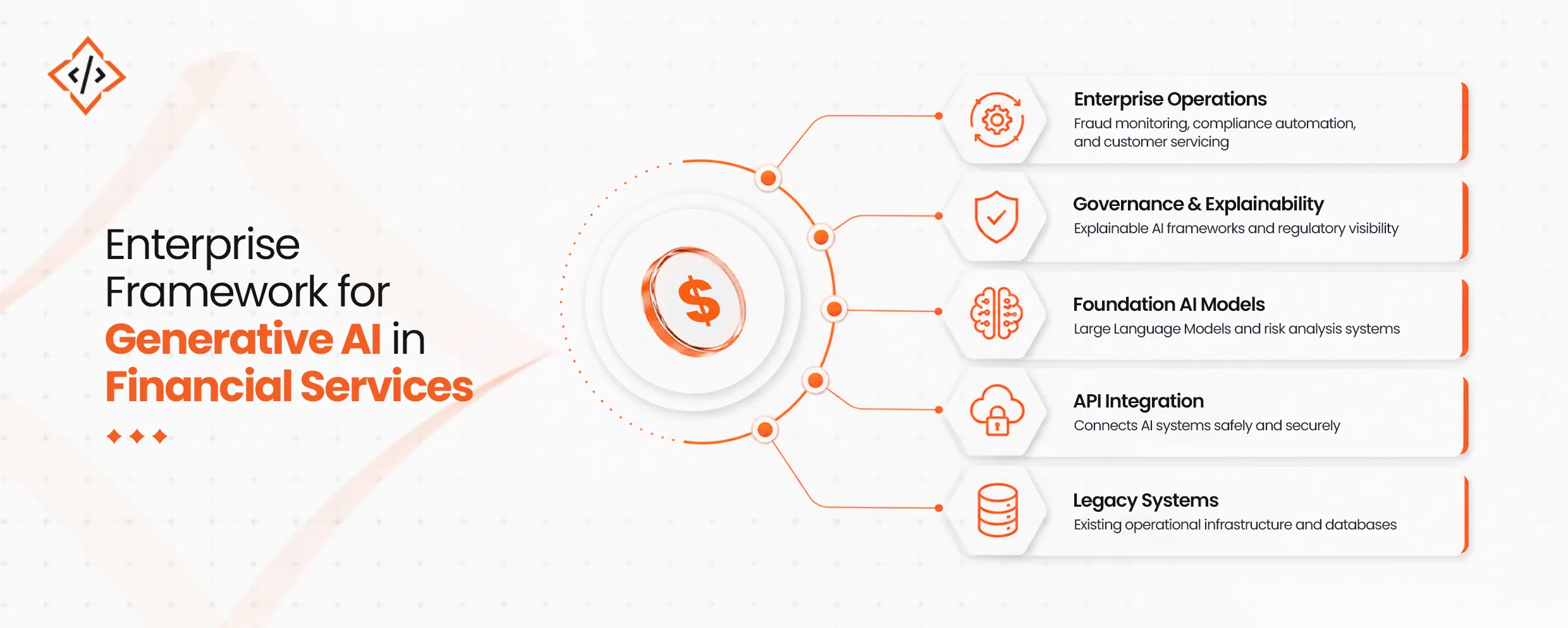
Financial institutions deploying AI applications in financial services are prioritizing secure integration layers instead of replacing entire banking infrastructures. Most organizations now connect foundation models to legacy systems through controlled API architectures that allow real-time data access without disrupting core operational environments. This approach lowers migration risk while improving deployment flexibility across compliance, underwriting, and customer operations.
Key infrastructure priorities now include:
Institutions are also implementing Explainable AI governance frameworks to maintain mathematical traceability behind automated decisions, particularly in regulated financial workflows where audit visibility is mandatory. As Generative AI in Fintech expands into high-risk operational areas, explainability, infrastructure security, and compliance alignment are becoming as important as model performance itself.
Financial institutions that treat Generative AI in Fintech as long-term operational infrastructure rather than isolated experimentation will build stronger cost efficiency, faster decision systems, and more resilient compliance operations over time.
Firms still operating in extended pilot cycles may face increasing operational pressure as customer expectations, fraud complexity, and regulatory scrutiny continue rising across global financial ecosystems.
The next phase of AI applications in financial services will depend less on model access and more on scalable data architecture, explainable governance frameworks, and secure deployment environments that support sustainable institutional growth.
CodeTrade helps fintech organizations build production-ready AI-powered financial solutions designed for regulated enterprise environments. From intelligent automation workflows to secure AI integration layers, the focus remains on creating scalable systems aligned with compliance requirements, operational performance, and long-term business stability.

 Hardik Soni
 Chand Prakash
 Chand Prakash
 Chand Prakash
 Chand Prakash