







AI
 Chand Prakash
11 September 2026
Chand Prakash
11 September 2026
Generative AI in Software Testing: Transforming QA and Test Automation
 Chand Prakash
Global supply chains have become harder to manage than ever before. Operations leaders must actively monitor inventory, coordinate global suppliers, and resolve logistics disruptions instantly. This massive operational complexity creates a strict demand for complete real-time network visibility.
A proactive supply chain digital transformation is now a mandatory requirement for long-term market survival. Relying on disconnected legacy tools creates severe data silos and limits executive decision speed. Organizations require unified operational platforms to maintain absolute control over their complex inventory networks. This is why leading executives prioritize custom supply chain software development over rigid commercial alternatives.
According to a 2026 Gartner report, spending on Supply Chain Management Software with AI will reach $53 billion by 2030. A tailored application directly links vendor tracking and distribution into one highly cohesive architecture.
For enterprise leaders evaluating these powerful platforms, the financial blueprint requires deep evaluation. This comprehensive guide directly details the breakdown of the Supply Chain Management Software Development Cost in 2026.
Custom supply chain software development costs range from $40,000 to $800,000 based on core operational features and integrations.
| Platform Tier / Factor | Cost Range (2026) | Operational Complexity & Key Features |
|---|---|---|
| Basic SCM Platform | $40,000–$80,000 | Designed for small businesses needing core inventory tracking and basic vendor management software. |
| Mid-Market SCM Solution | $80,000–$200,000 | Fits expanding logistics and supply chain software needs with multi-location warehousing and standard CRM integrations. |
| Enterprise Supply Chain Software | $200,000–$500,000+ | Supports multinational operations requiring advanced distribution network management and complex legacy system connections. |
| AI-Powered SCM Platform | $250,000–$800,000+ | Features sophisticated AI in supply chain management for automated decision-making and automated demand forecasting software. |
| Workflow Complexity | Varies by Tier | Intricate operational workflows require custom supply chain management application development, driving engineering hours upward. |
| Integration Requirements | Varies by Tier | Connecting multiple third-party logistics APIs eliminates a universal pricing model and increases development costs. |
| Automation Depth | Varies by Tier | Implementation of autonomous supply chain automation software shifts costs based on required rule depth. |
Four major operational drivers dictate the total financial investment required to build custom logistics and supply chain software.
Feature complexity directly impacts the Supply Chain Management Software Development Cost more than sheer development hours. Deploying basic inventory tracking and automated order management costs far less than configuring complex warehouse operations.
Advanced platforms require sophisticated vendor management software to handle external supplier communication smoothly. Scaling the architecture to oversee distribution network management requires intricate software logic that expands the engineering timeline. Incorporating demand forecasting software also increases feature depth.
Operational scale shifts the pricing structure significantly when moving from a single location to multi-warehouse setups. Enterprise supply chain software must maintain stable connections across global operations without experiencing systemic latency. Handling data synchronization across international borders increases the underlying architecture requirements for any supply chain software development company.
Connecting separate data streams represents a substantial portion of the ultimate supply chain management system cost. The engineering team must link critical ERP systems with external CRM platforms and existing accounting software. Furthermore connecting logistics providers and real-time IoT devices adds technical layers to the supply chain management application development process.
Data protection requirements alter corporate engineering budgets based on specific global compliance standards. Development teams must build strict user access controls and deep audit logs to protect operational data.
Meeting international regulatory benchmarks ensures long-term system viability for modern supply chain automation software. These exact protocols secure enterprise data during a comprehensive supply chain digital transformation.
Specific technical modules and advanced operational functionalities directly determine the final price tag of modern global logistics platforms.
Achieving real-time inventory visibility and precise warehouse synchronization requires complex database architecture to maintain accurate daily operations. Engineering reliable multi-location stock management demands extensive system testing which significantly elevates the total Supply Chain Management Software Development Cost.
Building custom demand forecasting software involves integrating predictive inventory planning algorithms alongside deep historical trend analysis. McKinsey research shows AI-powered forecasting can reduce inventory errors 20 to 50 percent. These advanced AI in supply chain management features require highly specialized data engineering teams.
Developing comprehensive vendor management software includes creating secure supplier onboarding portals and heavily automated procurement workflows. Implementing continuous performance monitoring guarantees supplier accountability but requires sophisticated enterprise supply chain software programming.
Live shipment visibility and active carrier management require constant data streaming from external global logistics providers. Continuous delivery monitoring ensures optimal network routing during a modern supply chain digital transformation. Ultimately advanced forecasting and complex analytics modules consistently rank among the most expensive components to develop.
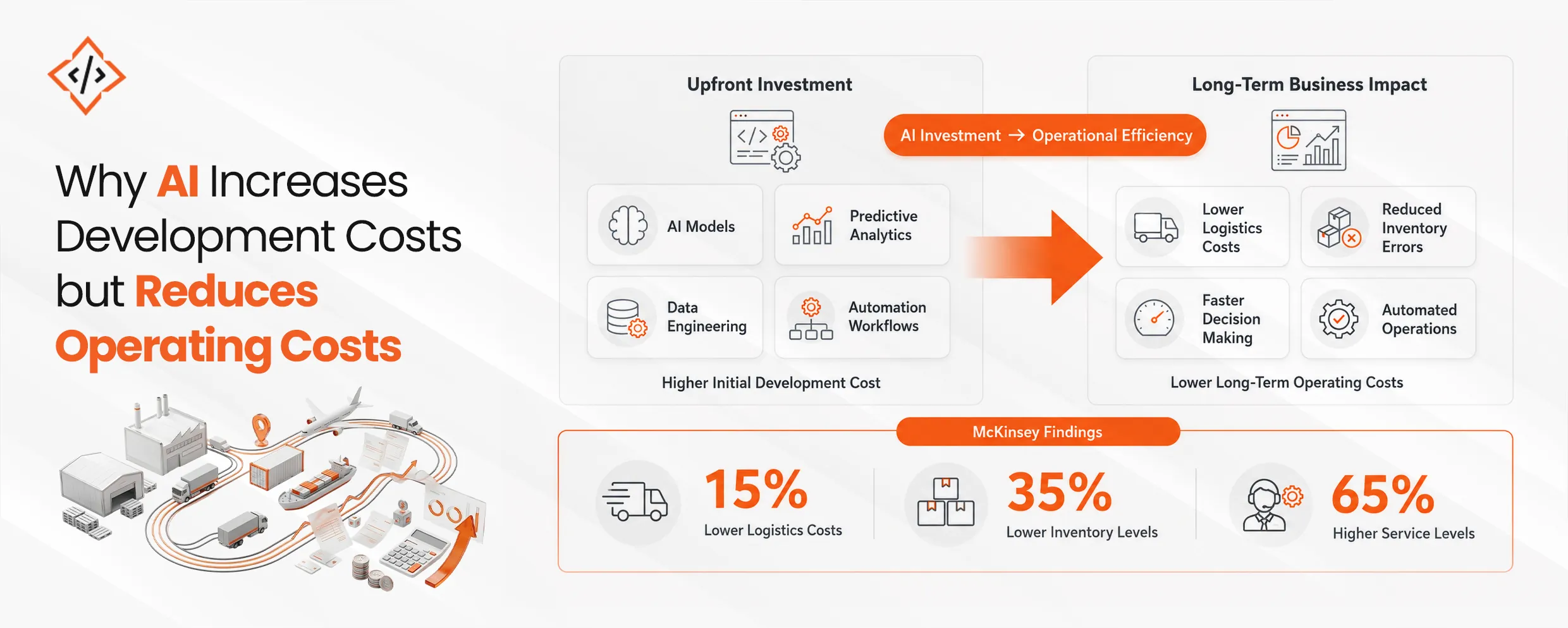
Implementing artificial intelligence requires significant initial capital but ultimately transforms global logistics networks into highly profitable operational assets.
Integrating advanced AI in supply chain management dramatically changes how organizations approach their long-term predictive planning. Developing sophisticated demand forecasting software allows operations executives to anticipate global market fluctuations before they occur.
Furthermore, intelligent inventory optimization ensures that international warehouses maintain exact stock levels safely. Automated procurement planning actively eliminates expensive manual ordering errors across the distribution network.
Proactive risk detection mechanisms often justify the higher custom supply chain software development investment. Powered by Custom AI Software Development, automated supplier disruption alerts notify operations teams when sourcing, manufacturing, or logistics risks emerge.
According to McKinsey, organizations that successfully deploy AI across supply chain operations can reduce logistics costs by 15% and inventory levels by 35% while improving service levels by 65%. Modern systems also support shortage prediction and delivery delay forecasting, helping businesses respond to disruptions before they affect customers
Implementing autonomous supply chain automation software revolutionizes daily administrative tasks across the enterprise. Intelligent system algorithms handle routine purchase approvals without requiring constant human executive oversight.
Procurement teams deploy continuous replenishment automation to maintain optimal warehouse stock levels securely. Furthermore, advanced exception handling instantly resolves minor logistical deviations before they escalate. Ultimately, artificial intelligence increases upfront development costs but consistently reduces long-term operational expenses.
This operational matrix directly details the structural trade-offs between investing in tailored platforms and purchasing commercial packaged systems.
| Comparison Factor | Custom Software Development | Off-the-Shelf Solutions |
|---|---|---|
| Initial Cost | Requires a higher upfront Supply Chain Management Software Development Cost. | Offers a lower entry expense with instant deployment. |
| System Flexibility | Tailored entirely to your exact logistics and supply chain software rules. | Demands altering your internal workflows to fit software limitations. |
| Network Scalability | Expands naturally without user seat limits to support enterprise supply chain software growth. | Forces businesses into restrictive and expensive higher subscription tiers. |
| Integration Depth | Features deep connections built during custom supply chain management application development. | Relies heavily on fragile third-party middleware or generic APIs. |
| Ownership Value | Eradicates recurring corporate licensing fees to lower the long-term supply chain management system cost. | Creates permanent overhead costs that scale upward as headcount increases. |
Multinational corporations should expect enterprise supply chain software to cost between $200,000 and $500,000 or substantially higher.
Managing international logistics requires complex architecture that seamlessly connects regional distribution centers and global suppliers. Connecting multiple warehouses securely increases the total supply chain management system cost because developers must configure real-time geographical data syncing.
Corporate systems rely heavily on sophisticated approval workflows to function effectively across diverse international borders. Supply chain automation software actively handles daily exception management. According to a 2026 Gartner report, 60 percent of supply chain disruptions will be resolved without human intervention by 2031. This continuous operational orchestration significantly raises the required engineering budget.
Custom supply chain management application development provides deep operational visibility through interactive real-time dashboards. Executive reporting modules powered by Machine Learning Development consolidate critical financial data accurately for corporate leadership. Implementing complex predictive analytics and AI in supply chain management directly dictates the final Supply Chain Management Software Development Cost.
Strategic planning and strict scope management actively prevent massive financial overruns during custom software engineering projects.
Prioritizing core workflows immediately lowers the initial Supply Chain Management Software Development Cost. Executives must actively avoid unnecessary features, such as immediate Mobile App Development, to keep the primary engineering budget tightly controlled.
Corporate teams should launch a minimum viable product first to validate foundational logistics operations. Scope expansion remains one of the most common reasons software projects exceed budgets, which is why phased implementation is often recommended for complex supply chain platforms. Organizations should expand gradually and validate each new capability before introducing additional workflows, integrations, or automation requirements.
Engineering teams must connect business-critical systems first to establish a reliable internal data baseline. Development leaders should delay non-essential integrations until the primary enterprise supply chain software operates perfectly.
Corporate leaders must work with an experienced supply chain software development company to execute complex technical architectures smoothly. Navigating these early strategic decisions properly prevents expensive future corrections. Ultimately, most budget overruns occur because project requirements expand significantly after actual development begins.
Modern logistics and supply chain software is transforming into core operational infrastructure rather than a basic supporting tool. Advanced AI in supply chain management and complex tracking will continue shaping future enterprise investments.
Forward-looking businesses must focus heavily on long-term operational value rather than selecting the lowest development quote. The right software blueprint always depends on specific workflow complexity, integration requirements, and future corporate growth plans.
Executing a comprehensive supply chain digital transformation requires deep alignment with your daily operational strategy. Tailored distribution network management platforms provide a sustainable competitive advantage over rigid commercial platforms.
Every technical component directly impacts the total Supply Chain Management Software Development Cost. Establishing an accurate supply chain management system cost involves evaluating your feature scope early. Managing these variables requires deep technical insight.
CodeTrade operates as a premium supply chain software development company specializing in high-performance architecture. The engineering team delivers tailored enterprise supply chain software to manage intricate global workflows. Deep industry experience in supply chain management application development ensures your custom project delivers maximum operational return.

 Chand Prakash
 Chand Prakash
 Chand Prakash
 Chand Prakash
 Chand Prakash