




AI
Odoo Development
 Hardik Soni
29 July 2026
Hardik Soni
29 July 2026
Odoo AI in 2026: The Complete Guide to Native AI in Odoo 19 & 20
 Hardik Soni
Every so often, a model release actually moves the goalposts, and Claude Fable 5 is one of those. For teams that run high-stakes automation, it marks the point where a Large language models stops acting like a conversational assistant and starts behaving like a system component, one that can take a goal and work toward it without someone watching every step.
This guide walks through what that shift means in practice: what the model does, how it is priced, how to wire it into existing infrastructure, and where it earns its keep. It is written for the engineering leaders and system architects who have to make the call.
The short version is that Claude Fable 5 is the first generally available Mythos-class model from Anthropic, and it is more than a routine version bump. It is an agentic engine, built for the kind of long-horizon work that used to need a human checking in at every stage.
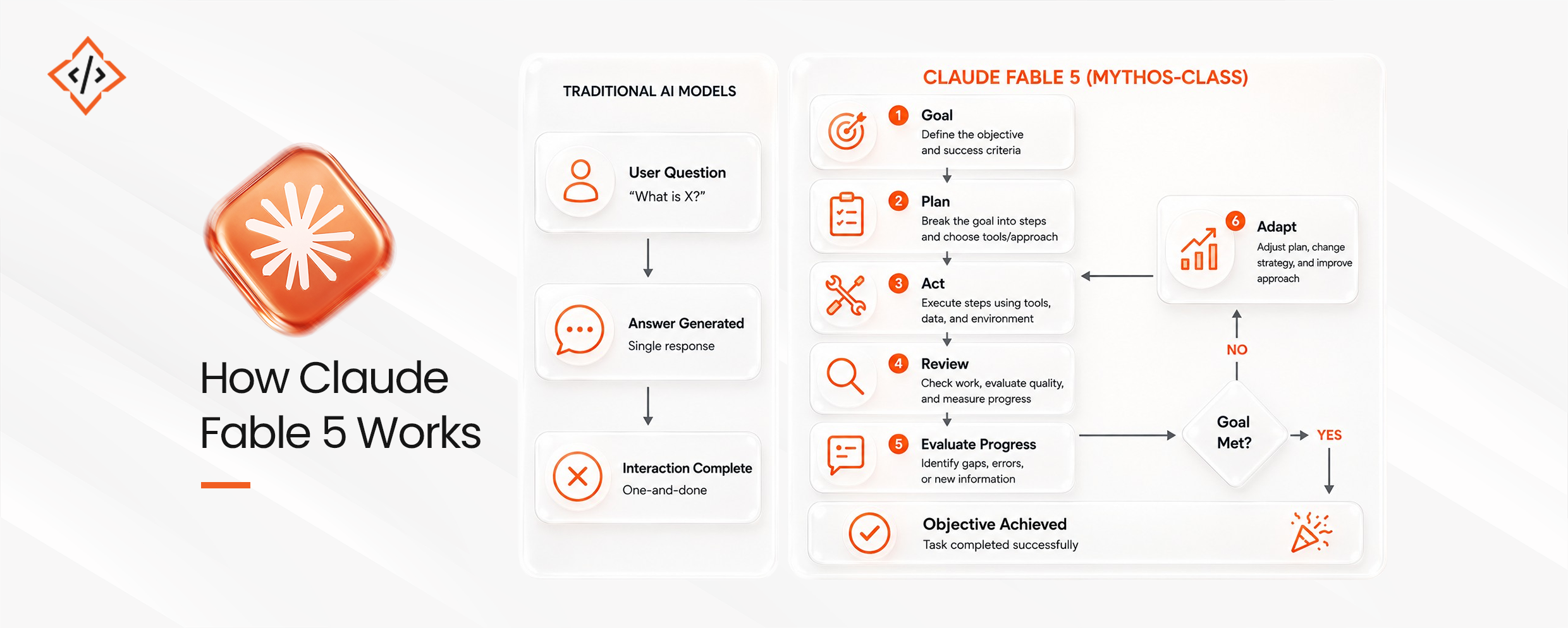
What sets it apart is persistence. Most models are good at answering a question and then forgetting it. Fable 5 is designed to stay on a task. It plans, acts, checks its own output, and changes course when the feedback tells it to.
Mythos-class is a new tier, and the label is doing real work. Standard frontier models are tuned for short, transactional requests, the kind that start and finish in a single exchange. Fable 5 is built to hold context and logic state across hours of computation, which is why it currently sets the bar for autonomous agent development.
Before getting into pricing and integration, it helps to understand what the model is doing under the hood, because that is what justifies everything else.
So, to begin with, let’s answer the question:
The headline feature is what Anthropic calls Adaptive Thinking. Instead of writing out an answer in one straight line, Fable 5 runs a loop it calls Pause-Reason-Verify.
Note that Adaptive Thinking is a mandatory architectural component of Fable 5 and cannot be disabled via API flags; this ensures consistency across high-complexity agentic tasks.
In plain terms, the model works in three moves:
It reads the full set of constraints before doing anything, rather than reacting to the first instruction it sees.
It works through more than one possible solution path instead of committing to the obvious one.
It checks its own output and fixes mistakes before it commits to a final action.
That self-correction is the whole point. It is what lets the model run for a long stretch without quietly drifting off course.
The second thing that makes those long runs possible is raw capacity, meaning how much the model can keep in front of it at any one moment. That figure is worth pinning down precisely.
Fable 5 has a 1-million-token context window and a 128,000-token output limit.
In practical terms, that is enough to load an entire code repository, a tangled legacy codebase, or years of manufacturing logs into a single prompt, so there is no need to prune the data down just to make it fit. Among long-context AI models, it sits right at the high end of what is available today.
All of that capacity is really in service of one job, the one Fable 5 was built for in the first place.
Yes, and for serious work, it is currently the default choice. Fable 5 can hold context across a long task, plan a sequence of steps, and hand work off to parallel sub-agents, which is exactly the combination that autonomous agent development depends on.
One thing does trip people up at selection time, because two very similar names sit right next to each other in the lineup.
The two names cause a fair amount of confusion, so it is worth being clear about which is which:
It is the public version, and it ships with safety classifiers for cybersecurity, biology, and chemistry. Moreover, Fable 5 is the one meant for general enterprise use.
It is the same underlying base model, but without those classifiers. Anthropic keeps it restricted to government, cybersecurity, and vetted research partners.
Capability claims are easy to make, so it is worth looking at where the numbers actually land.
The Claude Fable 5 benchmarks show the clearest gains in tasks that involve multi-step reasoning and tool orchestration.
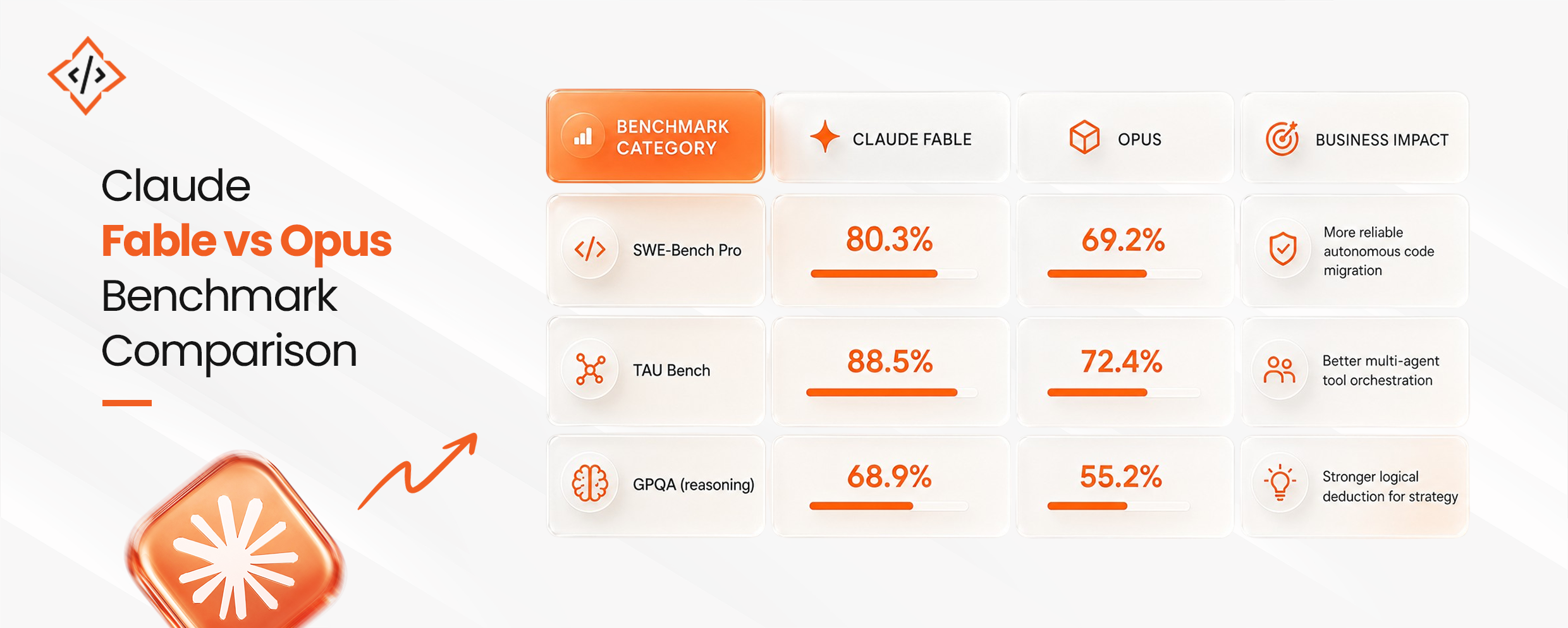
The pattern in that table is the part worth dwelling on.
The gap between the two models is widest on long-horizon tasks, the ones where the model has to push through many steps without losing the thread.
Standard AI model benchmarks are fine for ranking models side by side, but the number that really matters for Fable 5 is its first-shot success rate, and that is, how often it finishes a complex task without needing several rounds of correction.
So, what is the pricing of Claude Fable 5? Well, that’s the most important question for everyone reading this blog.
Fable 5 costs $10 per million input tokens and $50 per million output tokens, which works out to roughly a 2x premium over Claude Opus 4.8.
On paper, that looks expensive. The reason it often is not comes down to how the cost is measured.
Judging the model on its per-token price alone is where a lot of teams go wrong.
On a genuinely hard task, a cheaper model that needs three attempts to get it right ends up costing more than the Fable 5, which gets it in one pass. There are really two costs to weigh against each other:
One concrete way to keep the bill down is prompt caching for static content like documentation or repository structure. Cached input tokens get a 90% discount on later requests, which takes a real bite out of the cost of long-running agent loops.
Once the case for the model is settled, the next question is a practical one: how does the thing actually get up and running?
Reaching the model is the easy part. Fable 5 runs through the Anthropic API with the model string claude-fable-5, and it is also available on AWS Bedrock, Google Cloud Vertex AI, and Microsoft Foundry.
Getting it wired in well takes a few more decisions, and they tend to fall into a clear order.
Use the Anthropic API directly for the newest features, or go through Bedrock, Vertex AI, or Foundry if the rest of the workload already lives on one of those clouds. Either way, the model string stays the same.
This is the step most teams skip, and it is the one that protects the budget. Rather than treating Claude Fable 5 API integration as a wholesale swap for every model call, run an AI gateway that scores each request by complexity and sends it to the model that fits, which keeps the expensive model reserved for the work that genuinely needs it:
This part matters for anything running unattended. Fable 5 has a graceful degradation step built in.
So when a request trips a safety guardrail, say a cybersecurity or life science risk, the API quietly reroutes it to Claude Opus 4.8 instead of returning an error. The pipeline keeps moving rather than stalling.
Charges follow whichever model actually does the work. Anything handled by Opus 4.8 is billed at Opus rates, not Fable 5 rates.
To maintain accurate billing reconciliation and cost-tracking, ensure your observability stack is configured to log the final Model ID used for each response.
Done in that order, integration ends up resilient and affordable at the same time, which is the whole goal.
All the talk of routing and resilience is ultimately in service of outcomes, which raises the obvious question, like, what are the best use cases for Claude Fable 5? Where does the model actually pay off?
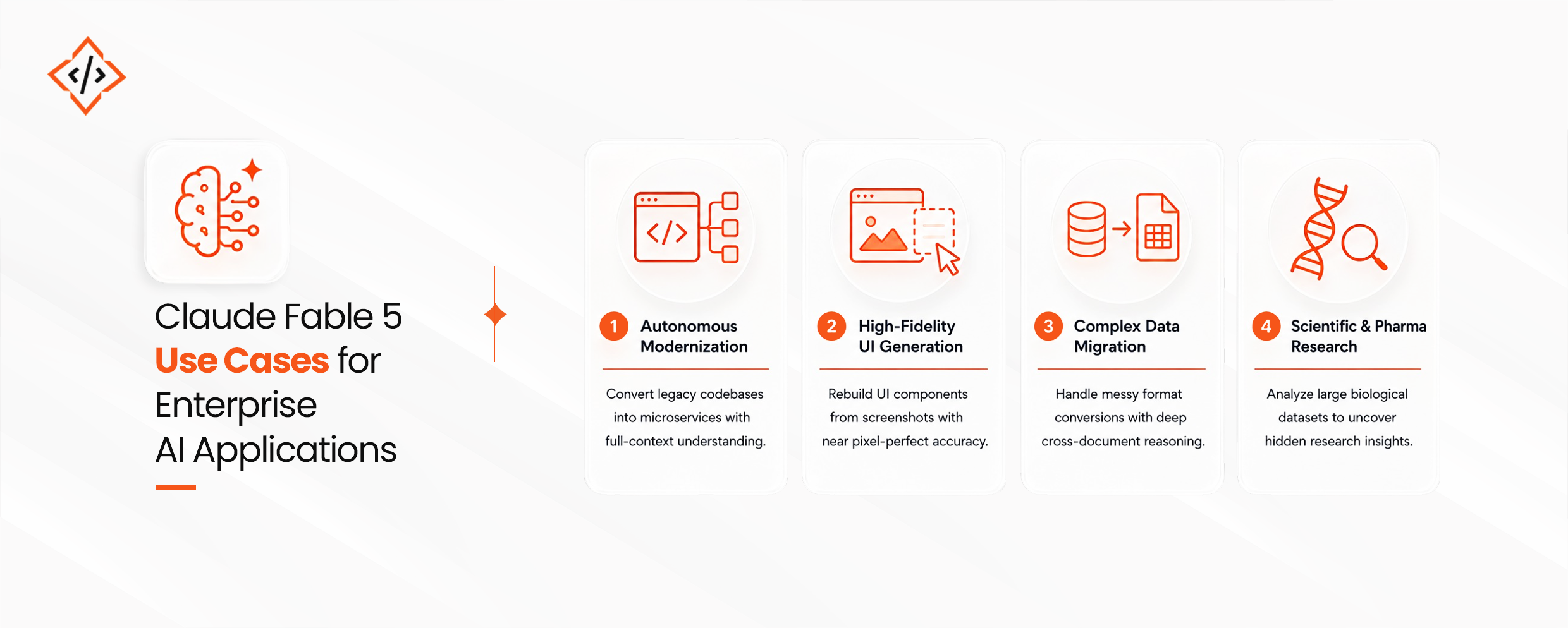
Fable 5 is built for high-leverage work, the sort that runs as infrastructure rather than sitting in a sandbox as a demo. Four use cases stand out:
Teams use Fable 5 to convert monolithic legacy codebases, including old Java or COBOL, into microservices. Because it can hold the whole codebase in context, it maps the full dependency tree before it proposes a single change.
In frontend work, Fable 5 can rebuild UI components straight from a screenshot with close to pixel accuracy, something earlier models could only roughly approximate.
Fable 5 is strong at the messy format conversions that need cross-document reasoning, which improves how well business process automation platforms perform.
Research teams point Fable 5 at large biological datasets to surface hypotheses that would otherwise stay buried in the literature.
Taken together, Claude Fable 5 is a real step forward for enterprise AI applications. It brings the reliability, context, and reasoning depth that large-scale automation has been waiting for. The catch is that none of it pays off without the right setup around it. A routing-first approach, where each request goes to the model that matches its complexity, is what keeps the capability affordable as it scales.
For technical leadership, the path is fairly clear. Audit the agentic pipelines already in place, find the high-complexity tasks where current models stall, and bring Fable 5 in where it gives the most leverage. The architecture around the model, the caching, routing, and governance, is ultimately what decides whether the deployment works.
That groundwork is also the part most teams underestimate. Standing up the routing, caching, and governance layer that turns Fable 5 from a capable API into a dependable production system is a project in its own right, and it is usually what separates a rollout that holds up from one that quietly runs over budget.
That layer is exactly what CodeTrade builds. For anyone scoping an autonomous system on Fable 5, it is worth a conversation before the first production call goes out.

 Hardik Soni
 Chand Prakash
 Chand Prakash
 Chand Prakash
 Chand Prakash