







AI
Odoo Development
FinTech & Banking
 Chand Prakash
31 August 2026
Chand Prakash
31 August 2026
How AI Agents for Accounts Payable Reduce Expensive Exception Handling Costs?
 Chand Prakash

On 2 August 2026, EU AI Act compliance under Article 50 became fully enforceable.
This mandate requires that any system interacting directly with natural persons must inform users they deal with artificial intelligence unless obvious. Your standard support chatbot falls squarely into scope today.
Most media coverage focused heavily on Digital Omnibus amendments pushing high-risk provisions back by over a year. Many engineering teams read those headlines and mistakenly stood compliance work down. Others continue sprinting at a regulatory deadline that actually moved. Both interpretations share a common mistake by treating August 2 as a single monolithic date. The legislation has always operated across four separate commencement tracks.
Misunderstanding this schedule causes companies to either pause binding duties or chase non-urgent requirements. This guide separates live rules from deferred mandates to streamline your operational planning. For structural delivery choices, consulting a custom AI agent development guide helps clarify technical builds.
The original Act set August 2, 2026, as the binding date for EU AI Act high-risk AI obligations. This covered Articles 9 through 17 for providers and Article 26 for deployers. Industry pushback remained sustained and mostly technical.
Required harmonized compliance standards were never published. This left companies completely unable to demonstrate conformity even in good faith. Therefore, the Digital Omnibus moved these specific deadlines.
| Obligation | Original date | Revised date | Status today |
|---|---|---|---|
| Prohibited practices (Article 5) | 2 Feb 2025 | Unchanged | In force |
| AI literacy duties (Article 4) | 2 Feb 2025 | Unchanged | In force |
| General-purpose AI model rules | 2 Aug 2025 | Unchanged | In force |
| Article 50 transparency duties | 2 Aug 2026 | Unchanged | In force since 2 Aug 2026 |
| Commission GPAI enforcement powers | 2 Aug 2026 | Unchanged | In force since 2 Aug 2026 |
| High-risk, stand-alone (Annex III) | 2 Aug 2026 | 2 Dec 2027 | Deferred |
| High-risk, embedded in regulated products (Annex I) | 2 Aug 2027 | 2 Aug 2028 | Deferred |
Legal analysis from Holland & Knight and Gibson Dunn emphasizes one crucial point regarding EU AI Act 2026 timelines. The deferral only changes when exact conformity must be demonstrated. It never changes whether the underlying system remains high-risk.
A recruitment-screening model running in Frankfurt today operates as an Annex III system. The specific AI Act compliance requirements for documentation simply arrive later.
Solid compliance markers remain completely in force today. The Digital Omnibus formally deferred dashed timeline markers.
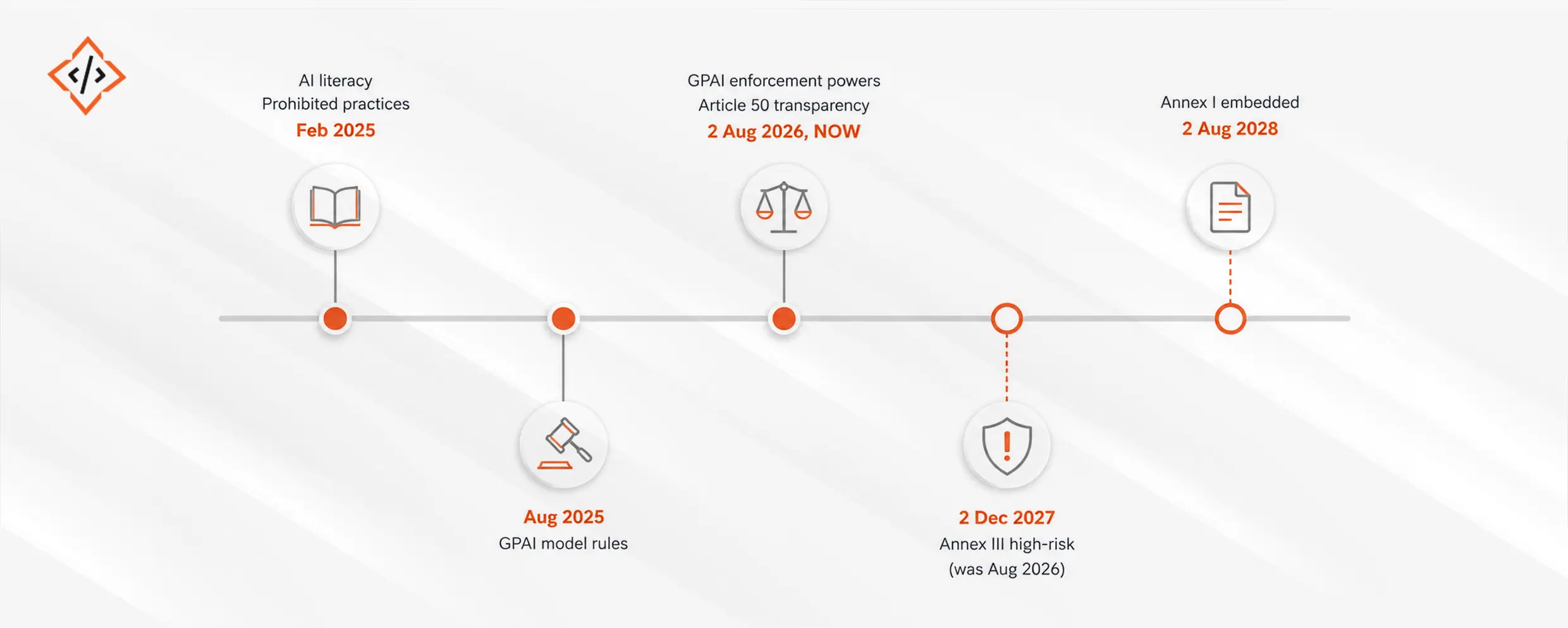
EU AI Act Article 50 is brief and highly likely to catch an ordinary enterprise deployment. It creates four distinct disclosure duties. None of these specific duties depend on a system being classified as high-risk.
Any AI system interacting directly with natural persons requires clear design disclosures. Users must know they are dealing with artificial intelligence. The legal exception remains extremely narrow. It only applies when this fact is obvious to a reasonably well-informed person. A public support chatbot sits squarely in scope for AI Act compliance requirements.
Providers generating synthetic audio, image, video, or text must mark their output clearly. This requires a machine-readable format indicating artificially generated content. This remains a strict provider duty rather than a deployer duty. Still, your procurement team must ask vendors to evidence this during EU AI Act enterprise compliance checks.
Deployers publishing deep fake audio, image, or video content must explicitly disclose its artificial generation. The same rule applies to AI-generated text published for matters of public interest. This applies unless a human reviewer intervenes and someone holds clear editorial responsibility. This transparency forms a core part of strict AI risk management.
Deployers using emotion-recognition or biometric-categorisation systems must properly inform exposed individuals. Note that specific emotion-recognition uses are prohibited outright under Article 5. This includes deployments within workplaces and educational institutions. These strict prohibitions have been fully in force since February 2025.
This is the critical element catching American engineering leaders. The answer has nothing to do with your corporate incorporation.
The regulation reaches providers placing an AI system on the Union market regardless of their geographic location. It also affects providers and deployers outside the Union where system output is used within Europe. This output test creates extensive extraterritorial jurisdiction for EU AI Act for US companies.
Consider a concrete scenario. Suppose you build a résumé-screening model running purely on American infrastructure without an EU office. If those automated decisions filter candidates for an Irish role, the output lands in the Union. You fall directly under EU AI Act compliance.
Three factors decide your overall exposure:
If you are evaluating technical engineering partners, test their regulatory competence during initial vendor assessments. The buyer’s guide to choosing an AI development company covers how to evaluate them properly.
If your only AI exposure is a feature embedded in a third-party SaaS product, you do not need an AI development company in USA. Your external software vendor acts as the primary provider in this scenario. You only need two items: a signed vendor statement regarding their Article 50 position and a risk register entry.
The same logic applies if you have no European customers, no regional users, and no data crossing into the Union. Avoid engaging an external AI development company in this situation. Document clearly why your organization sits outside legal scope, date the record, and revisit when expanding into European territories.
Technical partnership becomes necessary once you deploy proprietary in-house systems, transmit output to Europe, and lack an enterprise AI governance framework.
Regulatory deferral is really useful for engineering teams. It only helps if you turn it into solid technical infrastructure rather than delay. An actionable AI Act compliance checklist requires four immediate initiatives.
Classification cannot be automated away. It cannot start until a complete inventory exists across your enterprise. Most organizations find more AI in production than central technology teams realized. Embedded SaaS features, departmental automations, and API-connected spreadsheet macros all count as AI systems. Every deployment counts under the law.
For each system, record the business purpose and Annex III mapping. Document whether you operate as provider or deployer. Identify where output is consumed and who owns the system internally.
High-risk articles demand technical documentation, automated logging, human oversight, and post-market monitoring. These represent core engineering requirements with long implementation lead times. Logging model version, input provenance, and human review identities costs far less during custom AI agent development than bolting on later.
This technical rigor overlaps directly with good production engineering. Proper agent monitoring satisfies much of this evidentiary requirement automatically.
EU AI Act Article 50 transparency duties are live and straightforward to implement. Disclosure text on chat interfaces and provenance marking on generated assets fit inside a standard release cycle. Documenting human-review steps for published AI-assisted text is equally manageable.
Most enterprise governance teams organize around the NIST AI risk management framework. They then present SOC 2 and ISO 27001 as external evidence buyers request. Maintaining one internal AI governance framework avoids managing parallel control sets for European and American obligations. These global requirements diverge far less than they appear.
Here is an unresolved operational ambiguity across the evolving regulatory landscape. The Digital Omnibus passed, but enforcement discretion remains with national market surveillance authorities. Whether Dutch and Italian regulators interpret transparency exceptions identically is unknown until initial cases arise. The first legal enforcement actions will define standard practices far more than the statutory text does.
A live debate also surrounds whether this regulatory deferral permanently holds. The legislative process was politically contested, making further amendments before December 2027 entirely possible. Neither factor changes necessary enterprise preparation, as system inventories remain valuable for overall AI risk management. Anyone claiming regulatory timelines are completely settled is merely speculating without empirical legal evidence.
Penalties under the regulation are tiered, and top-tier fines fundamentally change board-level risk tolerance. Prohibited-practice violations carry the highest exposure across the framework. Breaches of EU AI Act high-risk AI rules follow closely behind in financial severity. Supplying incorrect operational information to supervisory authorities also triggers substantial fines.
The more immediate exposure remains commercial. European enterprise buyers actively demand evidence of EU AI Act enterprise compliance during standard vendor assessments. A software supplier unable to answer basic system classification questions risks losing major enterprise deals immediately.
This dynamic reflects GDPR deployment in global markets. Commercial contractual requirements arrived years before formal regulatory enforcement began.
Treat the mid-2026 regulatory timeline adjustments with measured precision. High-risk conformity obligations moved to December 2027 for Annex III and August 2028 for Annex I. Meanwhile, EU AI Act Article 50 transparency duties and GPAI enforcement powers are active today. Prohibited practices have been fully enforceable since February 2025.
The practical work required in the interim is largely structural and operational. Engineering teams must inventory every production system and complete an AI Act compliance checklist. Organizations must map each deployment against Annex III criteria immediately. Closing transparency disclosure gaps this quarter establishes strong EU AI Act compliance. Building rigorous data logging into AI software development protects systems when formal conformity assessments arrive.
Executing these foundational steps ensures December 2027 arrives without operational disruption. Ignoring these mandates risks repeating the costly public missteps seen during previous major regulatory rollouts.
 Chand Prakash
 Bhavesh Kachadiya
 Chand Prakash
 Chand Prakash
 Chand Prakash