






AI
AI/ML
 Chand Prakash
07 October 2026
Chand Prakash
07 October 2026
Multi-Agent Orchestration Patterns for Enterprise Workflows
 Chand Prakash
Artificial Intelligence is no longer something companies experiment with on the side. It now sits at the core of operations, right from customer support to decision-making. But while adoption is growing fast, one question still holds businesses back. What is the actual cost of artificial intelligence in 2026?
AI costs depend on your implementation method, scale, and customization level. Cloud APIs cost the least; enterprise solutions the most. The actual price ranges from hundreds to millions annually, determined by whether you build, buy, or outsource your AI system.
This blog breaks down the real AI cost in 2026, including pricing models, implementation ranges, and key statistics, so that you can estimate your investment with clarity.
Let’s dive a little deeper into all those details.
As already mentioned, the cost of artificial intelligence is not fixed. It is heavily influenced by several layers that shape how complex and resource-intensive your solution becomes.
Here are the key factors that define AI development cost 2026:
Type of AI being used
The kind of AI you choose has a direct impact on cost. Rule-based systems are relatively simple and affordable, while advanced systems such as machine learning and generative AI require more compute power, expertise, and time to build and maintain.
Data availability and quality
AI systems rely on data to function effectively. If your data is incomplete, unstructured, or scattered across systems, it requires significant effort to clean, organize, and prepare before it can be used. This increases both time and cost.
Model complexity and customization
Using pre-trained models can reduce development time and cost. However, if your use case requires a highly customized model tailored to your business logic, the cost increases due to additional training, testing, and fine-tuning.
Infrastructure choice
Cloud-based AI solutions reduce upfront investment and offer flexibility, while on-premise infrastructure requires higher initial costs for hardware and setup. The choice depends on your scalability, security, and performance needs.
Integration with existing systems
AI does not work in isolation. It needs to connect with your existing tools, such as CRM, ERP, or internal workflows. This integration adds to the overall AI implementation cost and often requires specialized expertise.
Ongoing maintenance and scaling
AI systems are not a one-time setup. They need continuous monitoring, updates, and retraining to stay accurate and relevant. As your usage grows, scaling the system also adds to long-term costs.
AI implementation cost varies by use case, model complexity, and deployment scale. Factors include data volume, processing power, and customization requirements. Businesses find AI ROI improves after initial investment across applications like customer support and decision-making. Proper cost planning based on specific needs is essential.
Moreover, according to IBM, a large portion of the effort in AI projects goes into preparing data, as most enterprise data is not immediately usable for AI systems. This makes data preparation and integration one of the most resource-intensive stages of the entire lifecycle. As a result, many businesses underestimate the true cost of artificial intelligence, focusing only on development while overlooking the effort required to make data AI-ready.
Understanding the AI cost breakdown helps you avoid surprises and plan better. Most high-ranking competitors explain this, but often in a scattered way. Here is a clearer structure.
Data Collection and Preparation (30–50%) is consistently the most resource-intensive phase. It requires time, equipment, and expertise to clean, classify, and organize raw data, particularly when it is spread across several platforms.
Model Development (20–30%) covers algorithm selection, training, and testing. Whether you are creating a new model from scratch or fine-tuning a pre-trained one is the main cost variable here, as the latter is substantially less expensive.
Infrastructure Costs (10–20%) reflect cloud compute usage on platforms like AWS, Azure, or GCP. Large model training requires GPU-intensive workloads, which can rapidly increase these expenses.
Deployment and Integration (10–15%) involves connecting AI to live workflows and business tools. This is where companies often turn to AI integration services to avoid compatibility issues and delays.
Maintenance and Scaling (15–25%) is where budgets most often go wrong. Models need constant observation, retraining, and drift over time. Companies underestimate maintenance expenses by up to 40%, according to McKinsey.
How you pay for AI is just as important as how much you pay. Four of the most common models in 2026 are:
Pay-per-use (API-based): You pay per API call, token, or request. This works well for startups and businesses still experimenting, since there is no large upfront commitment. OpenAI’s token-based pricing is the most widely recognized example.
Subscription-based: A flat monthly or annual SaaS fee. Predictable, easy to budget for, and common in tools like Microsoft Copilot ($30 per user per month, plus a Microsoft 365 license).
Custom development pricing: A project fee plus ongoing maintenance. Most enterprises use this model when building proprietary systems through AI development services. It is the most flexible but also the hardest to estimate upfront.
Usage plus infrastructure hybrid: A base subscription combined with variable compute charges. Common in enterprise environments where both platform access and consumption need to be managed.
According to Fortune Business Insights, API-based AI usage is growing, and in 2026, it is expected to reach $85.43 billion with high SME adoption. Furthermore, at present, composable AI architectures, which mix several AI APIs to produce customized and modular solutions, are also receiving more attention in the industry.
Here are realistic cost ranges for the most common AI projects in 2026:
| Use Case | Estimated Cost Range |
|---|---|
| Basic AI chatbot | $5,000 – $25,000 |
| Predictive analytics system | $20,000 – $100,000 |
| Computer vision solution | $50,000 – $250,000 |
| Generative AI applications | $30,000 – $300,000 |
| Enterprise AI systems | $100,000 – $500,000+ |
These estimates show that AI implementation costs vary widely depending on the complexity of the use case, the level of customization, and how deeply the solution integrates with existing systems.
That is why businesses should start with a clearly defined use case and scope before committing to development. In many cases, working with an experienced generative AI consulting partner can help refine requirements, avoid unnecessary features, and keep the project within budget.
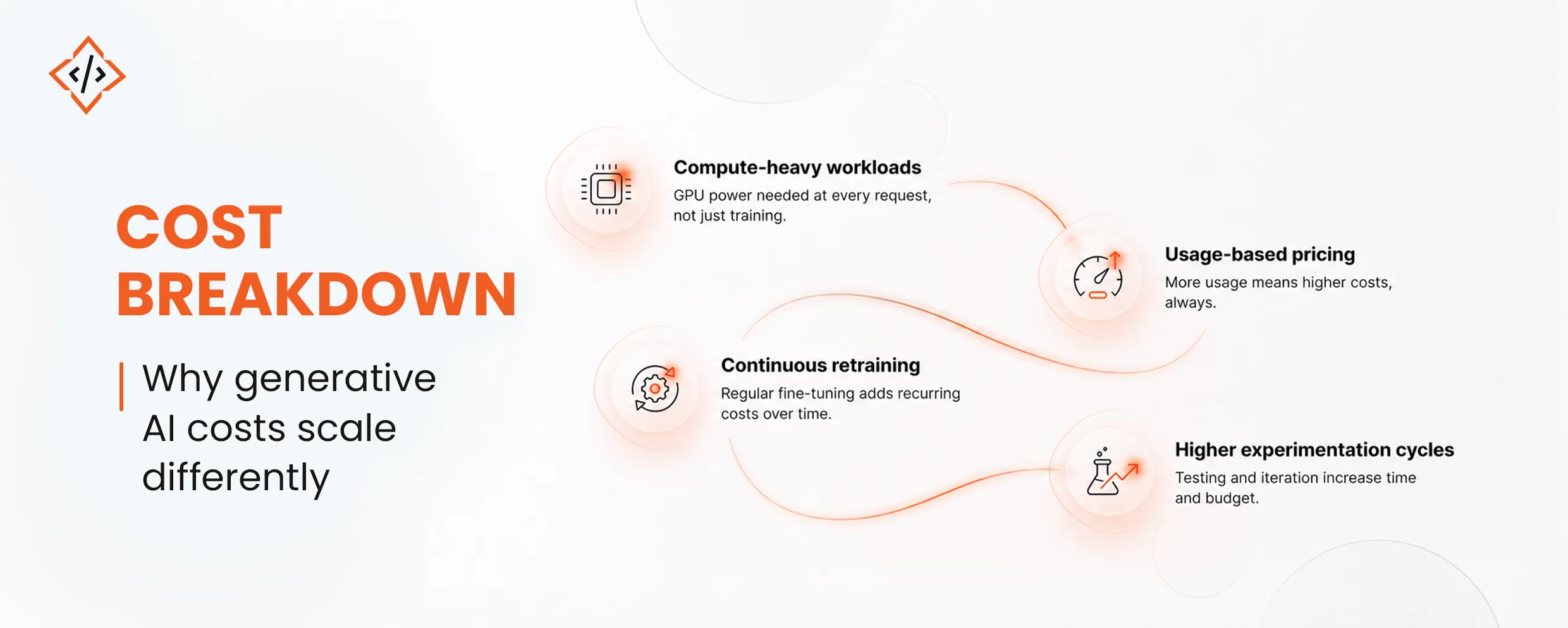
Generative AI follows a very different cost structure compared to traditional AI systems. While most AI projects involve a one-time development cost with periodic maintenance, generative AI introduces continuous usage-based expenses that grow with scale.
The biggest difference comes from how these systems are built and used in real-world environments.
Compute-heavy workloads
Generative AI models rely on high-performance GPUs for both training and inference. Even after deployment, every user request requires compute power, which directly adds to ongoing costs.
Usage-based pricing models
Unlike fixed-cost systems, generative AI typically follows token-based or request-based pricing. This means the more your application is used, the higher your costs become. What starts as a small expense during testing can scale quickly in production.
Continuous optimization and retraining
Generative models often need fine-tuning to improve accuracy, adapt to new data, or align with business-specific use cases. This adds recurring development and infrastructure costs over time.
Higher experimentation cycles
Building generative AI applications involves multiple iterations, testing prompts, refining outputs, and improving performance. This increases both time and budget before reaching a stable version.
For example, a basic AI chatbot with predefined responses may cost a few thousand dollars to build and maintain. In contrast, a generative AI-powered assistant that handles dynamic queries, content generation, or decision support can scale into six figures due to ongoing usage and infrastructure demands.
This is why generative AI cost behaves differently. The amount of use is just as important as what you build. Businesses need to plan not only for development but also for long-term usage, scaling, and optimization to avoid unexpected cost spikes.
AI cost in 2026 goes beyond just about the technology you choose. It is heavily influenced by the industry you operate in, because each sector comes with its own data challenges and compliance requirements, as well as operational complexity.
Finance
AI in finance is used for fraud detection, credit scoring, and risk modeling. These systems handle sensitive financial data and must comply with strict regulations. This adds layers of security, validation, and auditing, which increases the overall implementation cost. This is why AI in fintech projects is typically more resource-intensive.
Healthcare
Healthcare applications include diagnostics, patient data analysis, and predictive care. Since these systems deal with highly sensitive personal data, they require strict compliance with privacy standards. This increases both development time and cost due to additional testing, security measures, and approvals.
Retail and E-commerce
AI is used for recommendation engines, demand forecasting, and customer behavior analysis. While compliance requirements are lower, these systems must handle large volumes of real-time data and scale efficiently. Costs here are driven more by infrastructure and performance optimization.
Manufacturing
In manufacturing, AI is applied to predictive maintenance, quality control, and process automation. These systems often need to integrate with IoT devices and legacy systems, which increases integration complexity and cost.
Logistics and Supply Chain
AI is used for route optimization, inventory planning, and demand forecasting. The challenge lies in connecting multiple systems and handling real-time data flows. This is where AI in logistics and supply chain requires careful architecture to scale without increasing costs rapidly.
Across industries, a clear pattern emerges. Highly regulated sectors like finance and healthcare tend to have higher AI implementation costs due to compliance and data security.
On the other hand, industries like retail and logistics face higher costs from scaling, infrastructure, and system integration.
The difference between small business and enterprise AI pricing is significant, and understanding this will help you set realistic expectations from the start.
Small businesses
Most small businesses spend between 5,000 and 50,000 dollars on AI solutions. These are usually built using SaaS tools or API-based models, which reduce development time and upfront investment. The focus is on solving specific problems without heavy customization.
Enterprises
Enterprise AI systems typically cost anywhere from 100,000 to over 1 million dollars. These projects involve custom-built solutions, deep integration with existing systems, and scalability across multiple teams or regions. The complexity increases as the system needs to handle larger data volumes and more use cases.
According to Deloitte, enterprises spend three to five times more on integration than on model development. This shows that enterprise AI pricing is not just about building models but about making them work seamlessly across the organization.
Many businesses focus only on upfront development costs and overlook the expenses that come after deployment. This is one of the main reasons AI projects exceed their budgets.
Some of the most commonly overlooked costs include:
In many cases, AI projects do not fail because they are too expensive. They fail because the ongoing costs were not planned properly. Understanding these hidden factors early helps avoid unexpected financial pressure later.
The cost of artificial intelligence can seem high at first, but the value it delivers often outweighs the investment when implemented correctly.
Businesses typically see benefits such as the following:
McKinsey reports that companies using AI experience efficiency gains of 20 to 30 percent.
This is why AI ROI for businesses is not just about cost savings. It is about long-term growth and competitive advantage. When aligned with the right use case, AI becomes a value driver rather than just an expense.
AI pricing is evolving quickly, and understanding these trends can help businesses make better investment decisions.
These trends clearly show that the AI cost in 2026 is moving toward more flexible, usage-based models where businesses pay based on value and scale. As adoption increases, companies are becoming more strategic about how they invest in AI, focusing on solutions that deliver measurable outcomes rather than just technical capabilities.
Reducing AI development costs in 2026 comes down to making the right decisions at the right time. Small choices early in the process can have a significant impact on the overall budget and long-term scalability.
Here are some practical ways to keep costs under control:
When approached strategically, these steps help keep spending efficient while still ensuring the system performs well and scales as your business grows.
There is no single answer to the cost of artificial intelligence. It depends on your use case, the level of customization, and how deeply the solution integrates into your business.
For most companies, AI implementation costs fall between 10,000 and 300,000 dollars. Larger enterprises may invest significantly more depending on scale and complexity. The key is not just to focus on cost but to understand the value AI can create over time.
If you are planning to adopt AI, start with a clear understanding of your problem and expected outcomes. This makes it easier to estimate costs and avoid unnecessary investment.
If you want to explore what AI trend could look like for your business, the team at CodeTrade can help you define the right approach, choose the right AI pricing models, and build a roadmap that aligns with your goals without adding unnecessary complexity.
 Chand Prakash
 Chand Prakash
 Chand Prakash
 Chand Prakash
 Chand Prakash