






AI
Healthcare Solutions
 Chand Prakash
10 September 2026
Chand Prakash
10 September 2026
Why Standard SOC 2 compliance for AI systems Fails During Healthcare Procurement?
 Chand Prakash
Digital transformation is no longer a future initiative for UAE companies. It has become a business requirement tied directly to growth, efficiency, and long-term competitiveness. Across industries, organizations are rethinking how they operate as customer expectations continue to evolve.
AI in UAE businesses is becoming more common, while cloud transformation is helping companies modernize systems without increasing operational complexity. This shift is also driving broader digital transformation across organizations. Many businesses are turning to enterprise platforms like Odoo ERP to modernize workflows and support growth.
According to the International Monetary Fund (IMF), the UAE Digital Economy Strategy targets doubling the digital economy’s contribution to non-oil GDP to 20% by 2031. This will be achieved by scaling digitalization across both public and private sectors.
As digital transformation in the UAE continues to progress, businesses need a clear strategy with defined objectives. The goal is to turn digital innovation into measurable business outcomes through structured execution.
The pace of change in the UAE market has increased significantly over the past few years. Customers expect faster service, employees expect connected systems, and leadership teams expect real-time visibility into business performance.
These expectations are exposing the limitations of manual workflows and disconnected software across many organizations. At the same time, national initiatives continue to support technology investment across both public and private sectors.
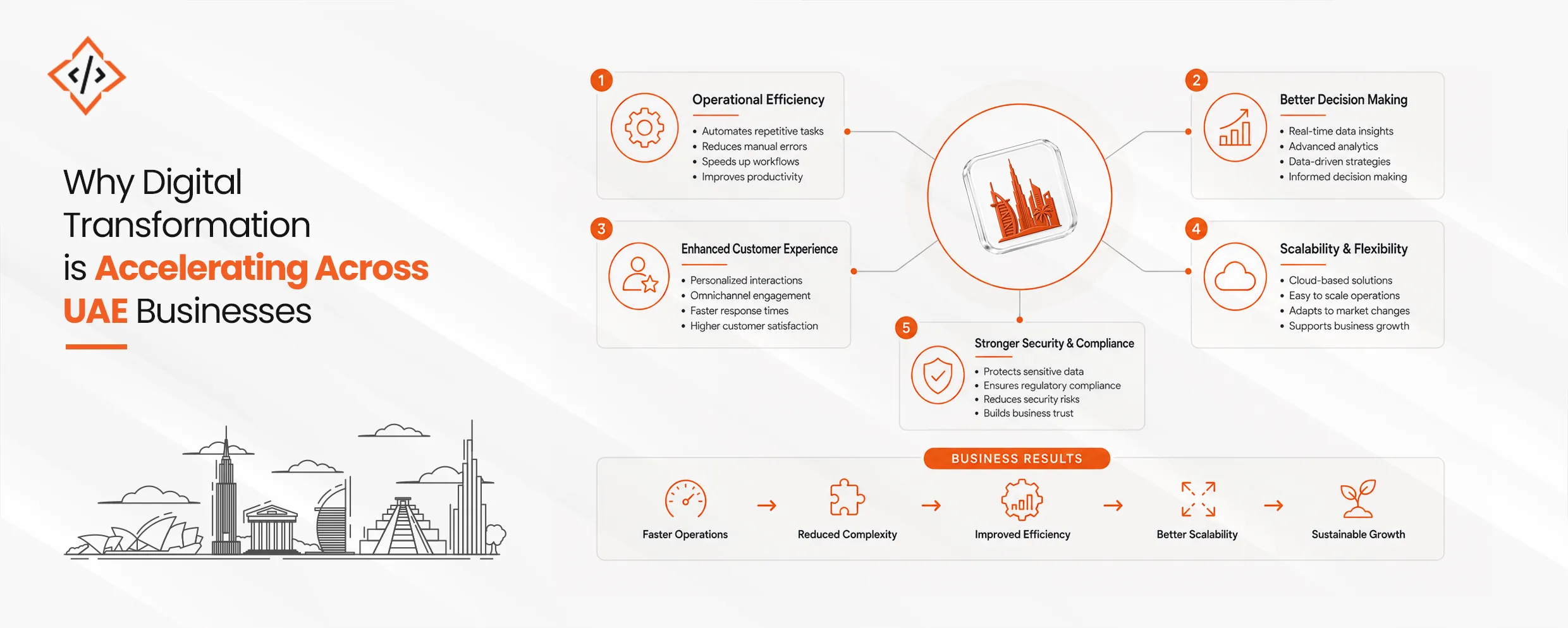
With competitive pressure increasing, businesses are treating digital transformation strategy as an operational priority rather than a technology initiative. The focus is on implementing business automation to build organizations that can respond faster, operate more efficiently, and scale without increasing complexity.
Many businesses confuse digitization with digital transformation, but they are not the same. Digitization converts physical information into digital formats. Digitalization improves existing workflows through technology.
Digital transformation in UAE businesses goes further by redesigning processes, decision-making frameworks, and business models to support long-term growth and changing market conditions.
Successful transformation depends on more than software adoption. From backend operations to consumer-facing retail solutions, it requires connected processes, reliable data, stronger customer experiences, and modern technology infrastructure. Cloud transformation often supports this shift by improving accessibility and system performance. Many organizations also invest in digital transformation services to align technology decisions with operational goals.
The objective is not technology adoption alone but measurable business outcomes. A clear digital transformation strategy helps improve operational efficiency and reduce unnecessary costs. It also creates greater agility when market conditions change. As organizations continue investing in digital innovation, they are better positioned to scale operations and respond to future business demands.
In the UAE, technology investments are helping firms improve efficiency, strengthen decision-making, and create more connected operations across teams.
AI in UAE businesses is moving beyond experimentation and becoming part of daily operations. Dedicated investment in internal AI development allows organizations to automate repetitive tasks, improve service delivery, and better understand customer behavior. These capabilities help teams operate more efficiently while improving visibility into customer needs and business performance.
Cloud transformation enables businesses to modernize systems without significant infrastructure investment. It supports scalability as operations grow and helps teams access information more efficiently. Cloud platforms also strengthen security through centralized controls and regular updates that reduce operational risk.
Reliable data platforms help businesses move from reactive decisions to informed planning. Real-time reporting improves visibility across departments and highlights operational trends as they emerge. This allows organizations to make decisions using current information rather than historical assumptions.
According to Gartner, software spending in the Middle East and North Africa region is projected to grow by 13.9%, reaching $20.4 billion by 2026. This growth is being driven by the rapid adoption of generative AI and intelligent automation capabilities. This massive surge mirrors how extensively the region’s enterprises are leaning into data-driven operations to safeguard long-term resilience and digital agility.
ERP modernization connects key business functions through a unified system. Odoo ERP implementation helps organizations bring finance, sales, inventory, and customer operations together within a single environment. This improves process visibility, reduces information silos, and supports more consistent decision-making across the organization.
AI is also playing a role in helping businesses improve customer engagement, streamline day-to-day operations, and make quicker decisions, mainly by using real time business insights.
Many organizations are using AI in UAE businesses to improve customer interactions across digital channels. AI-powered support systems resolve common queries faster and remain available beyond standard business hours. Personalization tools also help businesses deliver more relevant recommendations that improve customer satisfaction and retention.
AI is reducing manual work across departments by automating routine processes and improving resource allocation. Teams spend less time on repetitive tasks and more time on higher-value responsibilities. This improves efficiency while helping organizations manage increasing workloads without adding operational complexity.
The original text accurately referenced PwC Middle East’s landmark statistic regarding the $320 billion AI contribution by 2030. Enterprises integrate advanced predictive analytics services to capitalize on this projected market growth. This figure is drawn from their highly cited regional economic impact assessment report, which remains available via their official digital publication depository.
The content has been rewritten to align with primary source material and maintain an objective and credible narrative. It avoids third-party interpretations and follows professional corporate publishing standards.
Successful transformation depends on clear business priorities, structured execution, and continuous improvement across people and processes.
Every digital transformation strategy should begin with clearly defined business goals. Organizations need measurable outcomes tied to efficiency, customer experience, or revenue growth. These objectives help leadership teams evaluate progress and ensure technology investments remain aligned with business priorities.
Technology alone cannot resolve inefficient processes. Businesses should first identify operational bottlenecks, workflow delays, and areas where manual effort creates unnecessary friction. This assessment provides a stronger foundation for future technology decisions and implementation planning.
Choosing the right platforms is critical for long-term success. Whether deploying off-the-shelf applications or choosing custom AI software development, technology should support business requirements rather than introduce additional complexity. Many organizations evaluate cloud transformation and enterprise platforms based on scalability, integration capabilities, and operational requirements.
Employee adoption is often a deciding factor in the success of transformation initiatives. Training, communication, and stakeholder involvement help teams adapt to new systems. When employees understand the value of change, adoption becomes more consistent across the organization.
Digital transformation is an ongoing business initiative, not a one time project. Regular performance reviews help organizations track results, find improvement opportunities, and optimize processes as business requirements keep evolving.
A winning transformation strategy relies on connected systems that improve visibility, reduce inefficiencies, and enable business growth, all at once.
Many businesses struggle when critical information is spread across multiple systems. Odoo ERP implementation brings finance, inventory, CRM, and HR processes together within a unified environment. This improves coordination between departments and helps teams work with more consistent information across daily operations.
Manual processes often create delays, increase errors, and add unnecessary administrative work. From specialized real estate solutions to corporate workflows, Odoo helps automate routine activities such as approvals, reporting, and data updates. This allows employees to focus on strategic responsibilities while improving operational consistency across the organization.
Business growth often introduces new operational challenges and process complexity. A flexible ERP foundation helps organizations expand without constantly replacing systems. This supports long-term planning and gives businesses the structure needed to manage increasing workloads efficiently.
Timely decisions depend on access to accurate business information. Real-time reporting provides visibility into performance, operations, and financial activity. Leadership teams can identify issues earlier and make decisions based on current business conditions rather than outdated information.
The biggest challenge facing UAE businesses is no longer access to technology. Most organizations already have cloud platforms, AI tools, and modern business applications. The difference lies in how effectively these technologies are integrated into daily operations.
Businesses that approach transformation as an ongoing operational initiative are more likely to achieve measurable improvements than those focused solely on technology adoption.
At CodeTrade, the focus is on helping businesses turn transformation plans into practical outcomes. Every engagement is guided by a clear objective: helping organizations operate more efficiently, scale with confidence, and create sustainable long-term value. This includes everything from digital transformation and AI initiatives to enterprise platform implementations.
As UAE digital transformation continues to evolve, organizations that execute effectively today will be better prepared for future market demands.
 Chand Prakash
 Chand Prakash
 Chand Prakash
 Chand Prakash
 Chand Prakash