







Open edX Development
Hire Developers
 Chand Prakash
08 September 2026
Chand Prakash
08 September 2026
Hire Open edX Engineers: Tutor, DevOps & Technical Skills
 Chand Prakash
Auditors frequently demand highly specific details regarding employee training records during corporate remediations. They want to know exactly how long learners spent inside specific assessment modules. They check whether struggling employees failed assignments twice before finally passing. They also strictly verify that internal systems genuinely recorded those exact timestamps.
A standard completion report answers absolutely none of these rigorous questions. It merely states that specific individuals finished a required course. Standard reporting never confirms whether learners skipped sequences or if completion dates remain trustworthy. The platform can actually provide all these precise technical answers. As detailed in our Open edX vs Moodle vs Canvas analysis, standard configurations simply cannot accomplish this strict tracking by default.
The fundamental reporting mechanism utilizes standard Open edX xAPI architecture. This protocol describes continuous learning activity as a detailed stream of behavioral statements. This comprehensive guide explains how to build that specific Open edX event pipeline correctly. It covers configuring a valid Learning Record Store for robust compliance LMS analytics.
Both represent fundamental learning standards. Organizations frequently treat them as competing options when they actually function as perfect complements.
SCORM strictly represents a content packaging and launch standard. It defines how courses bundle together. It dictates how the system launches content and retrieves basic completion results. Engineers designed this standard when educational content remained completely self-contained within single systems.
Conversely, xAPI functions entirely as a behavioral reporting standard. It defines a strict actor-verb-object statement format. It establishes protocols for transmitting these detailed statements securely. It makes zero assumptions regarding where actual learning activity happens. This flexibility allows external xAPI integration for recording simulations or independent document reading.
| Dimension | SCORM | xAPI |
|---|---|---|
| Primary purpose | Package and launch content | Report activity |
| Data granularity | Completion, score, total time | Every discrete interaction |
| Where activity can occur | Inside the LMS | Anywhere |
| Storage | LMS database | Learning Record Store |
| Offline capability | No | Yes, with queued statements |
| Answers “did they finish?” | Yes | Yes |
| Answers “what did they do?” | No | Yes |
| Open edX support | Via plugin | Via event pipeline |
For corporate environments, this technical consequence remains incredibly direct. SCORM simply tells an auditor that a record exists. Proper xAPI implementation lets technical teams defend that record completely.
Already running SCORM content? Keep it. The SCORM in Open edX guide covers that side, and adding xAPI doesn’t replace it.
Every architectural segment possesses specific failure modes requiring careful evaluation before construction begins. This pipeline involves four explicit stages. Vocabulary decisions made during stage two completely determine whether final reporting remains trustworthy.
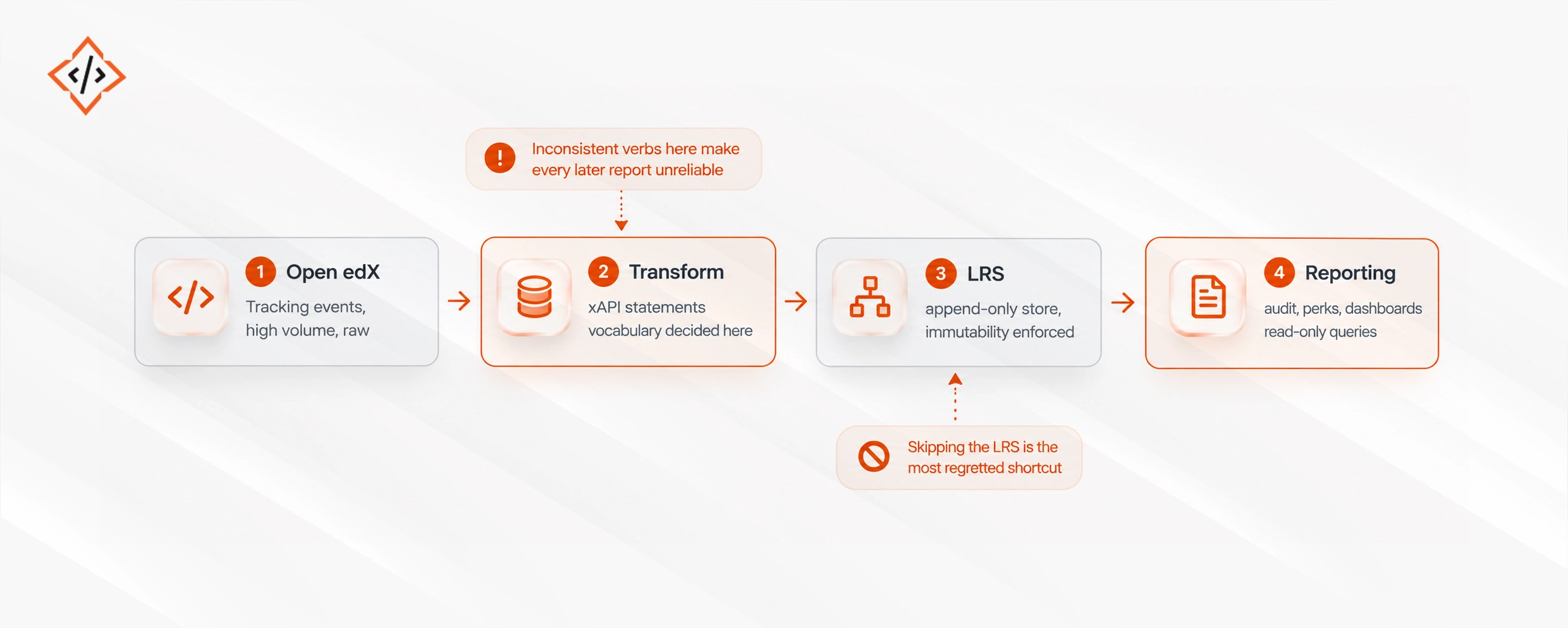
The system emits detailed internal tracking event streams constantly. These streams cover navigation, video interactions, problem attempts, and enrollment changes. This raw data volume remains incredibly substantial. Most captured events lack genuine relevance for strict Open edX compliance training.
The critical architectural design decision involves precise data selection. Pushing everything blindly creates an expensive storage environment. This bloated store becomes notoriously difficult for technical teams to query. Engineers must actively choose specific events answering direct audit questions.
Internal system events must transform into standardized statements utilizing consistent vocabulary. Most xAPI in Open edX projects fail exactly here. Interestingly, this frequent architectural error never involves underlying technical limitations. One course might emit a completed status while another emits passed. This semantic inconsistency makes every single cross-course report highly unreliable.
Technical leaders must fix verb and activity vocabularies immediately. Complete this mandatory standardization before instrumenting the very first course. Document everything meticulously and treat subsequent vocabulary changes as breaking changes.
This dedicated environment provides conformant storage featuring standard query APIs. Teams face strong temptations to write statements directly into existing data warehouses. Organizations executing this specific technical shortcut without professional Open edX development services usually regret it. The dedicated store earns its place through three distinct operational benefits.
It strictly enforces continuous technical statement validity. The system rejects malformed data instantly during write operations. This prevents teams from discovering massive data errors during final reporting. This environment remains strictly append-only by architectural design.
This fulfills the exact data immutability property rigorous compliance auditors test. Furthermore, it successfully exposes a universally standard query interface. Consequently, your Open edX learning analytics platform completely avoids coupling with fragile bespoke schemas.
Organizations serve two distinct consumers possessing entirely different reporting needs. Compliance officers demand complete data attribution and clean system exports. This requirement demands one fully defensible evidence pack per learner. Conversely, pure xAPI learning analytics require high-level behavioral aggregates and operational trends.
These broad statistical insights help instructional designers improve the overall curriculum. Engineers must build these as entirely separate read paths over shared storage. Conflating these two disparate operational requirements produces confusing dashboards satisfying neither consumer.
Auditors never evaluate visual analytics sophistication. They strictly test a short list of specific data properties. Each property represents an early architectural design decision.
The recurring technical lesson remains completely clear. Legal compliance requirements directly equal pipeline reliability requirements. A standard analytics pipeline dropping two percent of events is fine. A rigorous compliance pipeline doing the exact same thing is absolutely unacceptable.
Do not build this architecture if standard completion reports fully satisfy your legal compliance obligations. Stop immediately if your auditor never asks complex follow-up questions. A robust xAPI LMS integration represents real technical infrastructure possessing actual running costs. Purchasing this complex system against hypothetical future audits remains highly premature.
Talk to your provider first if you utilize a managed host lacking a dedicated engineering relationship. Several vendors offer this specific configuration option natively today. Paying them directly remains significantly cheaper than hiring external Open edX developers for parallel construction.
Specialized engineering partners become valuable when auditors ask questions your current Open edX analytics cannot answer. They also prove essential for organizations operating within regulated sectors anticipating these rigorous reporting demands.
A focused event set easily answers most audit questions without creating an unmanageable data store.
Two critical things to actively avoid during xAPI integration. Do not instrument raw video scrubbing or per-keystroke interactions into your compliance store. This massively inflates data volume while answering absolutely nothing an auditor asks.
Furthermore, never derive completion metrics inside the final reporting layer. Emit completion directly as an explicit xAPI statement. This ensures historical records remain immutable when future reporting logic inevitably changes.
Adding artificial intelligence tutoring capabilities alongside this architecture? Interactions with Open edX AI tutors represent highly instrumentable activities themselves. The dedicated Open edX AI tutors stack guide covers this specific Open edX tracking and analytics capability thoroughly.
The industry lacks a settled consensus regarding statement flexibility. This inherent flexibility remains both a major strength and a significant weakness. The specification describes almost any activity perfectly. Consequently, two organizations instrumenting identical courses produce completely incomparable statement sets during xAPI implementation.
Specific data profiles like cmi5 exist to strictly constrain this technical behavior. However, widespread industry adoption remains incredibly patchy. This flexibility costs absolutely nothing when building systems exclusively for internal audits.
Organizations might eventually hand data to external regulators or partner platforms. The lack of widely adopted profiles poses a genuine operational risk. The ultimate industry resolution remains entirely unclear.
The most pragmatic approach involves following standard cmi5 conventions wherever possible. Voluntarily constraining data formats upfront remains significantly cheaper than converting historical records later. This conservative strategy represents a protective hedge rather than an official architectural recommendation.
Corporate Open edX compliance training easily outgrows basic completion flags. Strict auditors always ask complex questions that simple flags cannot answer. Proper Open edX xAPI integration closes this dangerous reporting gap completely. The system meticulously records exactly what learners did during their sessions.
Technical teams must build this robust architecture in four distinct stages. Fixing activity vocabulary during the second stage guarantees trustworthy final reports. Experienced LMS development services always utilize a dedicated Learning Record Store instead of existing warehouses. This specific environment provides the exact data immutability properties auditors test. Instrument a highly focused event set to prevent massive storage bloat.
Teams must monitor this Open edX event pipeline as a strict compliance control. A single dropped statement instantly creates a completely missing legal record. This exact architectural precision builds a truly defensible Open edX enterprise LMS.
 Chand Prakash
 Chand Prakash
 Chand Prakash
 Chand Prakash
 Chand Prakash