Open edX Development 21 August 2026Why Are US Universities Choosing Open edX in 2026?
Key Takeaways:
- Open edX for US universities eliminates the financial penalty of per-seat SaaS licensing models.
- A headless open source LMS for universities allows institutions to decouple backend infrastructure from front-end user experiences.
- Open edX customization enables the deployment of highly specialized micro-credential and executive education portals.
- Multi-tenant capabilities provide a scalable LMS for higher education capable of supporting entire state university networks from a single codebase.
- Partnering with Open edX implementation services ensures secure cloud deployment and seamless LTI 1.3 integrations with existing campus ERPs.
Introduction
US universities are actively migrating away from rented, monolithic learning platforms toward owned, scalable digital infrastructure. The traditional per-user licensing model actively penalizes universities for expanding their enrollment reach, especially as institutions pivot toward high-volume, non-degree certificates.
Gartner forecasts that global enterprise IT spending in education and government will reach $861.4 billion in 2026. This immense financial pressure forces academic CIOs to partner with an experienced Open edX development company for predictable software ownership.
An Open edX LMS for universities solves this by treating the platform as a customizable asset rather than a leased utility. The Open edX higher education platform enables IT leaders to deploy multi-tenant cloud environments. This scalable LMS for higher education supports massive open online courses without triggering punitive vendor fees.
A flexible LMS for universities allows institutions to decouple backend infrastructure from front-end user experiences. Ultimately, adopting an open source LMS for higher education gives full architectural control back to the institution.
Why Are US Universities Choosing Open edX in 2026?
Academic IT leaders choose this platform because it provides unrestricted architectural control, multi-tenant scalability, and immunity from arbitrary vendor price hikes. US universities are actively moving away from rented educational software. They need versatile platforms that adapt to their specific academic requirements without friction.
Open edX for US universities delivers exactly this level of adaptability and financial predictability. The system shifts control from external vendors directly back to the university IT department.
Predictable Cost Forecasting
The Open edX higher education platform operates on an infrastructure-only cost model to eliminate unexpected vendor invoices. Legacy SaaS models create immense financial friction for higher education institutions today. The traditional per-user licensing approach actively penalizes universities for expanding enrollment, and institutions face massive invoice spikes during peak enrollment seasons.
A 2025 survey by EDUCAUSE reports that 42% of IT leaders anticipate budget decreases in the 2025 to 2026 academic year. This forces CIOs to find more predictable financial models quickly.
- An Open edX LMS for universities allows scaling from 10,000 to 100,000 learners.
- Institutions only pay for flat and predictable cloud hosting server expenses.
- Universities can forecast their five-year IT budgets with absolute mathematical certainty.
- There are no arbitrary licensing tiers to restrict academic growth initiatives.
- Financial resources are redirected from software licenses to actual student success.
Micro-Credentialing Infrastructure
The platform is natively built for high-volume MOOC delivery and asynchronous micro-credentials. US higher education is experiencing a massive strategic pivot right now. Students heavily demand skills-based bootcamps and specialized executive certificates, forcing traditional academic calendars to accommodate highly flexible online learning timelines. A scalable LMS for higher education must support these non-traditional tracks natively.
- This architecture is the premier choice for launching new digital certificate programs.
- The Open edX learning management system handles high-volume global enrollments flawlessly.
- Universities can deploy multiple micro-credential portals without stressing the core infrastructure.
- Open edX benefits for universities include rapid deployment of specialized short courses.
- Adult learners receive a premium user experience tailored to continuous education.
Multi-Tenant Architecture
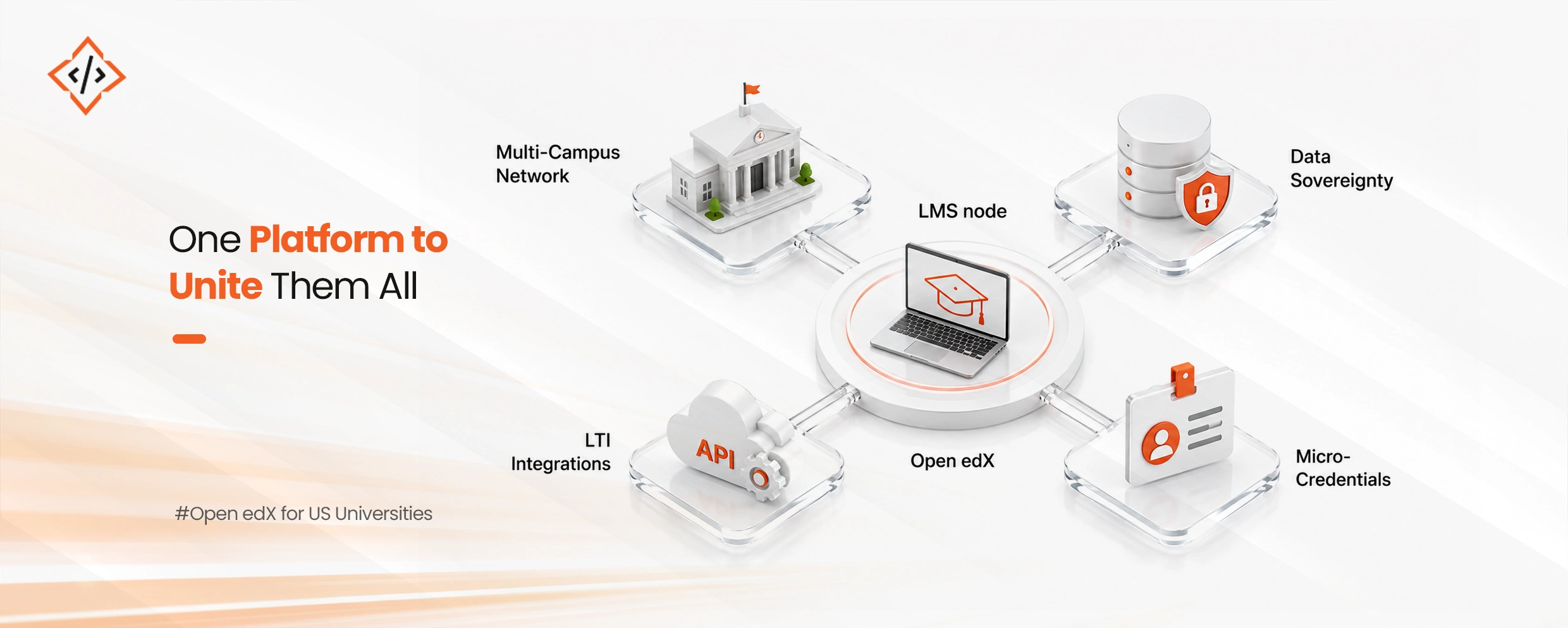
Open edX supports multi-tenancy to give individual campuses their own branded and isolated learning environments. Massive state university systems often struggle with highly fragmented digital environments. The SUNY or UC networks typically manage multiple disjointed software installations across campuses, creating massive administrative overhead for central IT departments. Open edX for higher education solves this fragmentation elegantly and efficiently.
- A central IT department can host a single unified software instance centrally.
- Administrators can spin up isolated environments for different university campuses easily.
- This consolidation massively reduces technical debt across the entire state university network.
- It simplifies cross-campus administration while maintaining localized school branding and identity.
- Security patches and system upgrades are applied once across all active tenants.

Evaluate how your current fragmented LMS infrastructure compares to a centralized open-source model. Talk to the CodeTrade team to map out a multi-tenant Open edX architecture that permanently eliminates redundant administrative overhead.

Data Sovereignty Compliance
Deploying an open source LMS for higher education guarantees the institution retains total ownership of telemetry data. The regulatory landscape surrounding student data privacy is escalating very rapidly.
Institutions face strict compliance requirements under FERPA and state privacy laws, making proprietary data commercialization a growing legal liability. The Open edX LMS USA deployment methodology strictly prioritizes student data security.
- Hosting the platform on a private AWS or Azure cloud is highly recommended.
- Universities never have to share learning analytics with third-party software vendors.
- Campus IT teams maintain full governance over every single database transaction.
- Institutions can configure highly specific regional data storage rules very easily.
- Internal auditors can verify compliance without relying on external vendor reports.
Headless LMS Capabilities
A headless architecture allows universities to embed course content directly into custom mobile apps via API. Traditional learning systems tightly couple the backend database with the frontend interface. This limits how institutions present learning materials to modern remote students, but a flexible LMS for universities breaks this limitation entirely. The frontend presentation layer is completely decoupled from the complex backend logic.
- Developers can build highly customized student portals from scratch very easily.
- The Open edX university LMS adapts flawlessly to existing campus portal frameworks.
- Institutions can design specific user interfaces for entirely different academic departments.
- This decoupled approach prevents the digital platform from feeling outdated over time.
- Universities can update the visual design without disrupting the core learning database.
XBlock Ecosystem Expansion
The XBlock architecture offers a distinct technical advantage over rigid and limited proprietary plugins. STEM and medical faculties require highly specialized digital teaching tools constantly. Standard learning platforms often lack support for complex scientific grading algorithms, whereas Open edX customization thrives in these demanding academic environments.
- Developers can build and plug in custom Python-graded assignments very easily.
- Medical faculties can integrate virtual reality simulations directly into the daily coursework.
- Chemistry departments can add complex 3D molecular modeling tools absolutely seamlessly.
- Professional Open edX development for universities makes these advanced pedagogical integrations possible.
- Expert Open edX implementation services ensure these complex custom blocks deploy securely.

How Does Open edX Customization Support Pedagogy?
Open edX customization moves institutions past generic templates, allowing instructional designers to dictate the platform’s behavior directly. A flexible LMS for universities ensures the technology adapts to the specific curriculum rather than forcing instructors to navigate rigid software constraints.
Many legacy systems restrict how educators present complex information to their modern online students. Open edX for higher education changes this dynamic completely by giving faculties the architectural freedom to build highly interactive, specialized coursework. This pedagogical adaptability is exactly why leading academic institutions trust this open-source framework over closed proprietary alternatives.
LTI Integration Standards
Adopting Learning Tools Interoperability (LTI) 1.3 standards is an absolute necessity for operating a modern digital campus today. An open source LMS for universities relies heavily on these standardized protocols to connect external applications securely without exposing sensitive student information.
- Universities wire the platform directly into highly specific external tools without writing expensive custom code.
- Academic departments can integrate Turnitin to run automated plagiarism detection across all submitted assignments instantly.
- The Open edX learning management system connects directly to enterprise Zoom accounts for synchronized live lectures.
- Administrators can embed specialized proctoring software easily to maintain strict academic integrity during remote digital exams.
- This secure standardization prevents campus IT departments from maintaining fragile API integrations over long periods.
- Instructors manage all these external applications directly from a single unified course dashboard efficiently.
Advanced Learning Analytics
The administrative focus has officially shifted from basic historical gradebooks to highly proactive predictive analytics. A 2025 EDUCAUSE report highlights that real-time predictive analytics enable professionals to quickly identify and intervene with at-risk students. This exact data-first capability heavily defines modern academic retention strategies for forward-thinking universities.
- Custom dashboards tap directly into the platform’s continuous event logs and daily student activity streams.
- Academic advisors receive real-time intervention triggers when a student’s engagement metrics drop below a certain threshold.
- Instructors can pinpoint the exact moment where students struggle within a specific video lecture or module.
- The Open edX higher education platform provides dynamic visual data maps to optimize future course design.
- Institutions can deploy targeted academic support resources exactly when the telemetry data indicates a learner is failing.
- This immediate feedback loop significantly improves overall student outcomes and boosts institutional graduation rates.
What Do Open edX Implementation Services Include?
Enterprise Open edX implementation services bridge the gap between raw open-source code and a highly secure production-ready university deployment. Moving to a scalable LMS for higher education is never just a simple software installation. Institutions need specialized engineering teams to configure complex cloud architectures and migrate historical databases correctly.
A professional deployment ensures that the digital learning environment meets rigorous academic performance standards from day one. These engineering experts handle every technical detail, completely eliminating the operational risks associated with platform migration.
- Implementation teams deploy the platform using advanced Kubernetes container orchestration explicitly.
- Kubernetes ensures the digital learning environment autoscales dynamically based on real-time student traffic.
- The system allocates extra server resources instantly during midterm and final exam traffic surges.
- Once high-traffic periods conclude, the infrastructure scales down automatically to minimize hosting expenses.
- This architectural elasticity prevents catastrophic system crashes when thousands of remote students log in simultaneously.
- Professional teams configure these resilient cloud environments securely across AWS, Google Cloud, or private university data centers.
Transitioning away from a legacy system also requires safely moving decades of highly sensitive academic records. Universities cannot simply copy and paste historical information into a brand new database architecture.
- Data engineers build automated ETL (Extract, Transform, Load) pipelines for this exact purpose.
- These pipelines extract historical course materials directly from legacy systems like Canvas or Blackboard.
- The extracted raw data is carefully transformed to match the unique database structure of Open edX.
- Engineers securely load decades of historical course data without losing any critical institutional knowledge.
- Implementation teams systematically migrate sensitive student grading rubrics, past assignments, and valuable faculty video assets.
- Professional Open edX development for universities guarantees a completely uninterrupted transition for students and teaching staff.
Conclusion
The era of monolithic and locked-in educational software is definitively ending. Relying on rigid proprietary platforms is a massive liability for modern higher education growth. Adopting Open edX for US universities is a highly strategic maneuver. It allows institutions to regain absolute control over digital architecture, student data, and operational budgets.
Campus IT leaders must now conduct a comparative TCO audit of their current learning systems. They should measure this expenditure against an open-source deployment roadmap to future-proof their digital campuses profitably. Navigating this complex architectural transition requires professional LMS development services from a trusted engineering partner.
CodeTrade provides premium Open edX development for universities to ensure flawless platform migration. Specialized technical teams build highly secure multi-tenant cloud environments that scale instantly. CodeTrade integrates a flexible LMS for universities directly into existing campus infrastructure without disruption. This expert deployment effectively transitions institutions from rigid software renting to permanent digital asset ownership.
Compare your current proprietary LMS expenditure against the predictable costs of a custom open-source deployment. Talk to the CodeTrade team to plan your Open edX migration and safely transition your university to full digital asset ownership.
FAQs
US universities choose Open edX in 2026 to escape punitive per-user SaaS fees and eliminate vendor lock-in. The platform provides predictable infrastructure costs and complete data sovereignty across multi-campus networks.
Open edX delivers flat cloud infrastructure expenses, unrestricted multi-tenant scalability, and complete institutional ownership of student data. It also supports specialized XBlock integrations for custom grading algorithms, virtual reality simulations, and interactive lab modules.
Yes, Open edX is purpose-built for higher education to manage massive student enrollments and non-degree micro-credentials effectively. Its headless architecture and predictive learning analytics offer superior pedagogical flexibility compared to rigid proprietary systems.
Yes, universities can fully customize the Open edX codebase to match their specific branding, pedagogical models, and workflows. Development teams can build bespoke XBlocks and integrate external tools via LTI 1.3 standards without vendor restrictions.
CodeTrade provides end-to-end Open edX implementation services, including Kubernetes cloud orchestration and secure ETL legacy data migration. Specialized engineering teams build custom XBlocks, configure multi-tenant environments, and deliver ongoing maintenance to ensure peak system performance.
Chand Prakash founded CodeTrade India and continues to lead it as CTO, shaping the technical direction of the company since its early days. He has spent his career solving hard engineering problems and building teams that ship reliable software, with a focus on ERP, e-commerce, and custom enterprise platforms.






 Chand Prakash
09 September 2026
Chand Prakash
09 September 2026 Chand Prakash