







AI
Education & eLearning
 Chand Prakash
22 September 2026
Chand Prakash
22 September 2026
Future of Generative AI in Education: Use Cases and Trends
 Chand Prakash
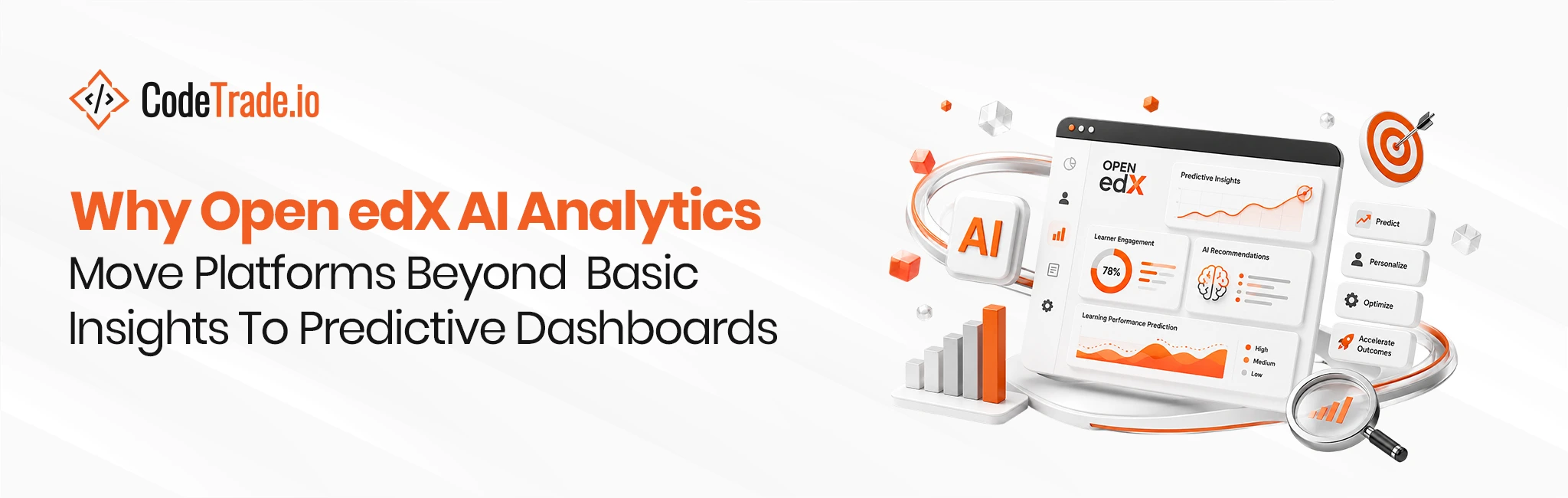
AI-powered learning analytics solve the critical data latency problem in modern digital education. They apply machine learning to real-time behavioral streams. Instead of waiting for a failed midterm to trigger a warning, these systems forecast failure weeks in advance. Legacy LMS platforms operate as mere data repositories.
They trap valuable information in isolated silos and offer only delayed insights. Traditional descriptive analytics simply report what already happened. In contrast, predictive student analytics reveal exactly what will happen next. This shift from retrospective reporting to proactive intelligence is a technical necessity.
A July 2026 Gartner report projects worldwide spending on AI platforms will hit $64 billion. This massive enterprise investment reflects the urgent demand for smarter institutional frameworks. Scaling enterprise education requires predictive analytics solutions that identify risk early. These intelligent platforms trigger automated interventions without requiring manual administrative oversight. Deploying LMS predictive analytics transforms raw platform data into immediate action.
Technical leaders can finally utilize an Open edX predictive dashboard to monitor progress. Learner engagement analytics process micro-interactions continuously to spot early dropout indicators.
At-risk student prediction becomes a seamless background workflow rather than a manual administrative chore. This architecture actively protects your training investments and guarantees higher course completion rates.
Legacy LMS analytics fail because they depend on static, batch-processed data that provides a delayed view of student performance. By the time an administrator reviews a standard spreadsheet export, the learner has usually already disengaged from the platform entirely.
Traditional learning environments depend heavily on lagging indicators. These include final assignment submissions and weekly quiz scores. This historical data only surfaces after a student struggles.
The operational cost of this delay is severe. Faculty members waste valuable time on damage control. They react to failing grades instead of providing proactive coaching.
True AI analytics for Open edX solve this exact problem. These systems process behavioral micro-interactions continuously. They monitor video pauses, reading times, and forum clicks. This continuous tracking completely eliminates reporting delay. Predictive learner analytics process these signals in real time. Instructors can finally intervene before a student officially fails.
Legacy reporting also fails due to fragmented data storage. Older platforms trap valuable student metrics across disconnected tools.
Any experienced AI development company knows this fragmented structure prevents comprehensive student evaluation. A 2025 analysis by McKinsey reveals that educational institutions spend 70% of their IT capacity simply maintaining disconnected legacy systems. When data sits in isolation, administrators cannot see the full picture.
An integrated Open edX data analytics framework fixes this architecture. It dismantles these isolated databases entirely. The software pipes all fragmented metrics into a unified data lake. This centralization allows LMS AI analytics to function correctly. The AI engine can finally evaluate complete student profiles. This structure gives leaders the accurate forecasting required for enterprise success.
AI-driven learning insights are powered by a three-layer architecture consisting of real-time data ingestion protocols, machine learning classification models, and dynamic visualization interfaces. This structure allows the system to continuously update a student’s probability of success based on their daily interactions.
Following an AI in Open edX guide requires moving away from legacy SCORM frameworks. Modern educational platforms utilize advanced xAPI and Caliper Analytics standards. These protocols capture granular Open edX data analytics continuously. They record vital micro-interactions precisely across the entire learning environment.
This continuous tracking fuels Open edX learning analytics effectively. It creates a rich data stream for immediate behavioral analysis. Administrators no longer wait for weekly batch exports to understand engagement.
The second layer applies sophisticated algorithms to the ingested data. LMS predictive analytics utilize neural networks and Random Forest classifiers. These specific tools establish baseline behavioral patterns for large student cohorts.
Once baseline patterns exist, at-risk student prediction works automatically. The AI detects subtle deviations from normal cohort engagement metrics. For example, a sudden drop in forum reading time triggers immediate alerts.
A 2026 report from Mordor Intelligence highlights this technological shift. It notes that predictive tools captured 57.12% of the learning analytics market share in 2025. Institutions clearly prioritize proactive AI analytics for Open edX over traditional methods. Predictive learner analytics ensure no student slips through the cracks unnoticed.
The final layer translates complex algorithmic output into readable formats. An education analytics dashboard acts as the central administrative hub. It presents abstract mathematical risk indicators in an accessible visual format.
Administrators use the Open edX AI dashboard to manage large cohorts. Faculty members digest complex behavioral data instantly through clear visualizations. This clarity transforms Open edX student analytics into actionable intelligence. Educators no longer guess which students need immediate academic support. They rely on the learning analytics dashboard to guide their daily outreach.
AI improves student retention by automating early intervention triggers, mapping engagement heat metrics, and delivering adaptive content tailored to individual knowledge gaps. These targeted actions stop the compounding effect of falling behind in a digital curriculum. Proactive system intelligence fundamentally changes how large institutions support struggling learners. Educators shift from retroactive grading to continuous, data-informed coaching.
Modern educational infrastructure requires immediate action to prevent early disengagement. LMS predictive analytics connect directly to institutional communication APIs to streamline this outreach process. Faculty members no longer need to monitor massive data spreadsheets manually.
This automated communication loop ensures no participant falls through the cracks. It delivers the right support at the precise moment a student begins to struggle.
Effective retention strategies must also evaluate the core curriculum itself. Institutions use learner engagement analytics to identify exact points where students lose interest. This shifts the focus from blaming the individual learner to auditing the structural course material.
Fixing a confusing technical module benefits the entire cohort instantly. This proactive structural improvement prevents future students from stumbling over the exact same academic hurdles. Continuous curriculum optimization becomes a standard operational procedure.
The final retention mechanism involves adjusting the digital curriculum for individual users. True predictive learner analytics alter the learning path based on real-time performance probability. The machine learning engine recognizes when a student struggles with foundational concepts. It automatically recommends supplementary remedial materials before the next major assessment occurs.
A July 2026 Market Research Future report confirms the measurable impact of this technology. Institutions utilizing learning analytics to enhance retention strategies achieve a 15% reduction in overall dropout rates. The educational system actively adapts to the learner instead of forcing them to adapt. This dynamic content delivery keeps students engaged and moving forward successfully toward graduation.
Implementing Open edX learning analytics requires a structured phase-in approach. Institutions must start with a comprehensive audit of their existing data pipelines. Only then can teams configure external predictive algorithms and custom visualization interfaces effectively. This phased strategy ensures technical stability across the entire digital ecosystem. A rushed integration will simply amplify existing structural flaws.
Clean data engineering is strictly mandatory before any AI modeling begins. Institutions must build reliable ETL processes to organize raw information. An Open edX student analytics model requires properly structured baseline metrics to function. The system will only generate accurate predictions if historical data is correctly formatted. Without this preparation, the artificial intelligence will simply process digital noise.
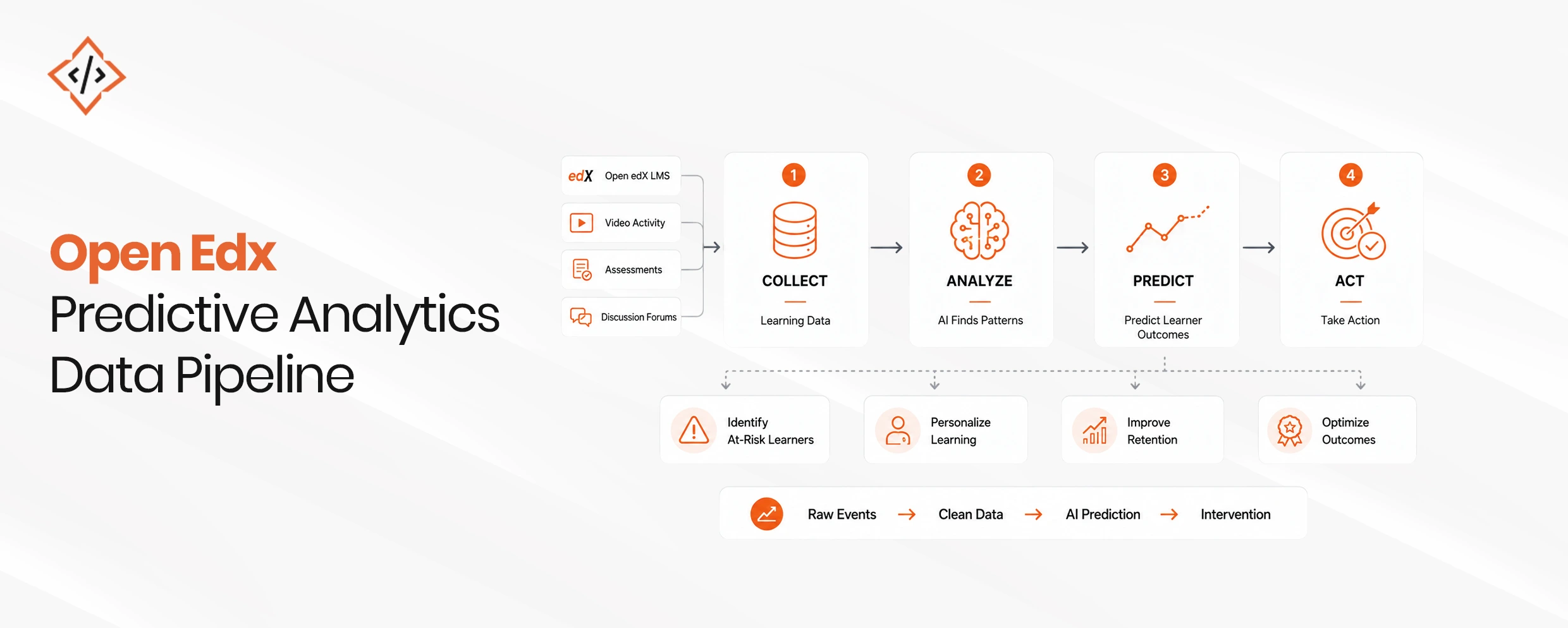
The next technical step involves plugging machine learning endpoints into the LMS architecture. IT teams connect AI analytics for Open edX via secure API gateways. This integration allows the learning platform to communicate smoothly with external intelligence engines. System architects must choose between two distinct deployment paths. This decision directly impacts both project budgets and overall system precision.
The final rollout phase grants academic administrators access to the visual interface. Technical teams deploy the Open edX predictive dashboard across the entire institution. This new education analytics dashboard requires strict role-based access control configurations. Privacy compliance remains a top priority during this final software release. Proper RBAC ensures users only see metrics relevant to their specific administrative permissions.
The future of EdTech architecture belongs to autonomous platforms. Institutions relying on retrospective reporting will soon struggle to compete. Educational leaders must audit their current data readiness immediately. They should consult with integration experts to map a transition toward an AI-driven LMS infrastructure. This technical shift builds a solid foundation for genuine predictive learner analytics.
Moving from static metrics to proactive intelligence through custom Open edX development services requires highly specialized technical execution. Finding the right engineering partner guarantees a stable system deployment.
CodeTrade provides comprehensive Open edX development services to modernize your digital learning environment completely. Our engineering teams integrate advanced LMS predictive analytics directly into your existing architecture. We build the exact Open edX AI analytics infrastructure needed for sustainable enterprise scale.
 Chand Prakash
 Chand Prakash
 Chand Prakash
 Chand Prakash
 Chand Prakash