





Odoo Development
 Hardik Soni
17 November 2026
Why Your Odoo Products Keep Getting Disapproved on Google Shopping (And How to Fix It)
 Hardik Soni

Odoo pricing starts with a per-user subscription. But the fee is only one part of what an Odoo ERP project costs.
The full budget also depends on the plan, the hosting setup, the country of sign-up, and how much custom work is needed.
This guide breaks down each cost, including the new rates and the Odoo 20 upgrade. As a result, finance and IT teams can plan a real first-year and five-year budget before they sign.
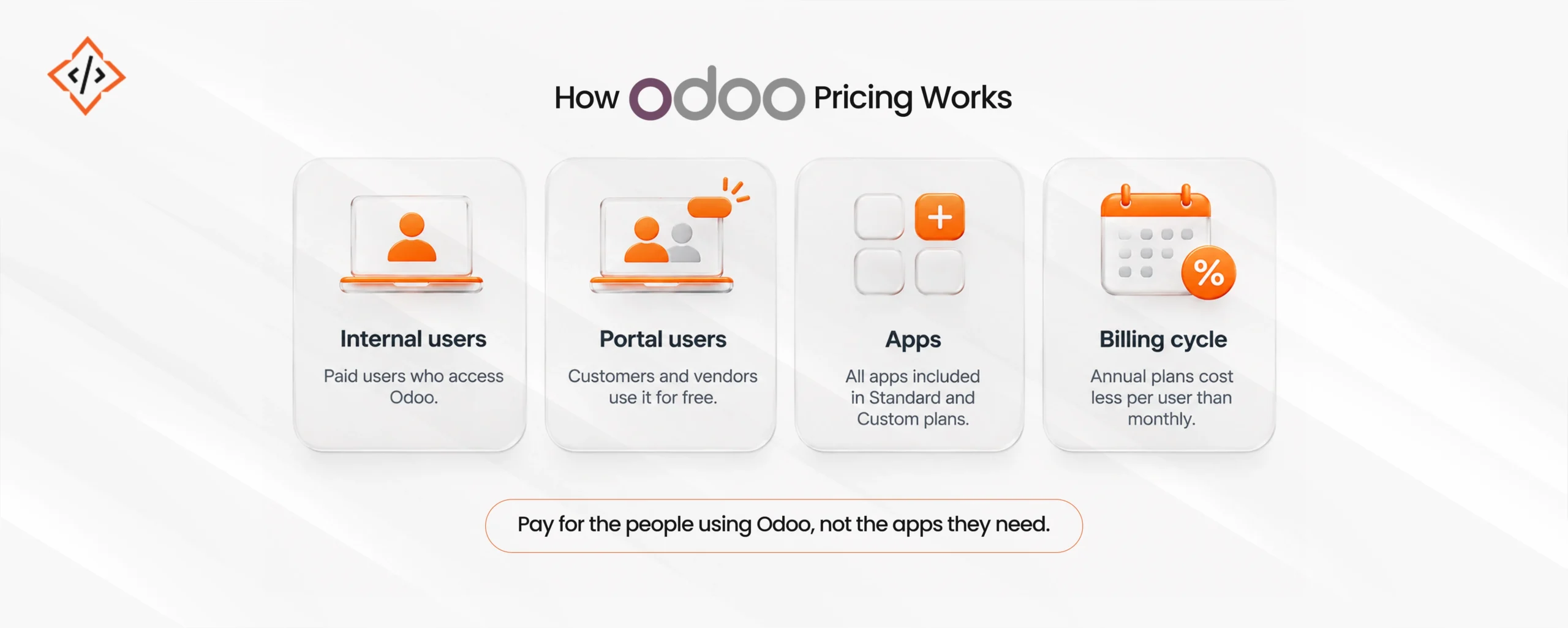
Odoo bills by user, not by app.
So a company pays the same per-user rate whether a user works in one app or ten. The bill grows with headcount, not with the number of apps in use.
Odoo offers three plans. The table below shows US list prices per user per month as published on odoo.com in October 2026.
Since Odoo changes rates from time to time, check the official pricing page before a budget is signed off.
| Plan | First-year rate (annual) | Regular rate (annual) | Monthly billing | What it covers |
|---|---|---|---|---|
| One App Free | $0 | $0 | $0 | One app and its dependencies, unlimited users, Odoo Online |
| Standard | $24.90 | $31.10 | $38.90 | All apps, Odoo Online hosting, support, upgrades |
| Custom | $49.00 | $61.00 | $76.20 | Everything in Standard plus Odoo Studio, multi-company, external API, custom modules, Odoo.sh, or on-premises |
Odoo also sets prices by country and currency.
For example, a company signing up in the UAE or Saudi Arabia sees a different rate from a company in the US. So groups with offices in several regions should check which office holds the plan.
Two changes from Odoo Experience 2026 shape every Odoo budget for 2027. The first is new pricing.
According to The Brussels Times, the euro basic plan stays at €19.90 per user per month, the enterprise plan moves from €29 to €35, and a new light user seat costs €7.90 per month when at least one full user is on the plan.
The second is Odoo 20, released in September 2026, which affects both new projects and upgrades.
Odoo Community is the free, open-source edition.
In contrast, Odoo Enterprise is the edition behind the Standard and Custom plans. The license gap is clear. Yet the real cost gap depends on what each edition leaves the business to handle.
For this reason, Community suits teams with in-house Python and server skills. Most other firms find Enterprise cheaper once staff time is counted.
Implementation is often the biggest line in the first-year budget.
In Panorama Consulting’s ERP Report, 33% of ERP projects ran over budget, and 51% of those overruns came from technology needs that were not in the original scope.
Similarly, Gartner’s April 2026 forecast puts 2026 IT services spending, which includes application implementation, at $1.87 trillion, ahead of the $1.44 trillion spent on software.
The cost of implementing Odoo ERP depends on a few clear drivers:
A structured Odoo implementation plan defines these drivers during discovery, so scope changes show up early, not on the invoice.
Customization comes in two forms.
First, Odoo Studio lets teams add fields, views, and simple automations without code, but only on the Custom plan.
Second, anything beyond Studio needs Python development.
Every custom module also has a future cost. Each one must be updated at every Odoo version upgrade.
Skilled Odoo development services keep custom code lean and well-documented. That lowers the future upgrade bill.
When it comes to hosting, its cost depends on the deployment model.
Several costs sit outside the pricing table. So they often show up only after the first invoice or the first renewal.
Migration covers two different jobs.
The first is moving data from a legacy ERP, accounting tool, or spreadsheets into Odoo. The second is upgrading Odoo itself, since Odoo releases a new major version every year, with Odoo 20 released in September 2026.
Odoo’s included support covers bugs in standard features.
In other words, it does not cover custom modules, new features, or process changes. Most businesses therefore keep a partner on a monthly support plan after go-live.
Alternatively, teams with ongoing development needs hire Odoo developer on a dedicated basis, which gives them a fixed monthly cost and steady product know-how.
A pricing page cannot show a company’s own numbers. The worksheet below turns each cost into a calculation, so the budget reflects real users, scope, and hosting choices.
| Line item | How to calculate | Recurs yearly |
|---|---|---|
| Full user licenses | Full users × plan rate × 12 | Yes |
| Light user licenses | Light users × light rate × 12 | Yes |
| Year-two renewal uplift | Users × (regular rate minus first-year rate) × 12 | Yes |
| Odoo.sh hosting | (Workers + staging + storage) × 12, Custom only | Yes |
| Implementation | Partner estimate for discovery, setup, and testing | No |
| Customization | Development hours × hourly rate | Partly |
| Integrations | Build estimate per connector, plus upkeep | Partly |
| Data migration | Cleanup hours plus import and validation | No |
| Training | Sessions × user groups | Partly |
| Support and maintenance | Monthly support hours × rate × 12 | Yes |
| IAP credits and paid apps | Expected credit use plus App Store purchases | Yes |
| Version upgrade | Porting hours for custom modules | Yes |
| Contingency | A buffer sized to project risk | No |
For a five-year Odoo ERP total cost of ownership, multiply each recurring line by five and add the one-time lines once.
On license cost alone, Odoo usually costs less than SAP or NetSuite.
Even so, a cheaper license does not mean a cheaper project. The total cost still depends on scope, customization, and partner rates. A fair comparison therefore uses the same five-year worksheet for every option.
Odoo pricing looks simple on the pricing page.
Still, most of the real budget sits in setup, hosting, custom work, migration, and support. In addition, the new rates and the Odoo 20 release make 2027 planning more important than before.
Teams that work out every line in advance can pick the right plan and avoid surprises mid-project.
 Hardik Soni
 Chand Prakash
 Hardik Soni
 Hardik Soni
 Hardik Soni