AI, eCommerce 02 November 2026Agentic Commerce for Fashion Ecommerce: How Brands Can Prepare for AI-Driven Shopping
Key takeaways:
- Agentic commerce lets AI agents search, compare, and buy fashion on a shopper’s behalf, so product data now has to work for machines as well as people.
- Open protocols such as Google’s UCP and OpenAI’s ACP decide how agents talk to online stores, and fashion brands should plan for more than one of them.
- Fit and size data matter more in fashion than in most categories, because a wrong AI recommendation quickly turns into a costly return.
- Brands need a plan for third-party shopping agents and a separate plan for their own branded AI stylist.
- A phased roadmap works better than a big rebuild, since many agentic AI projects fail when the business value is unclear.
Online fashion shopping has always depended on a person doing the work. The shopper types a query, scrolls a category page, opens a few products, checks the size chart, and decides. That model is now changing. AI shopping assistants inside ChatGPT, Gemini, and Google’s AI Mode can take a full request in plain language, find matching items across many stores, and in some cases complete the checkout too.
This shift is called agentic commerce, and fashion is one of the categories it affects most. Clothing is bought on fit, fabric, style, and occasion, which are exactly the details an AI agent needs to read correctly. As a result, agentic commerce for fashion ecommerce is now a practical question for every brand: can an AI agent understand a brand’s catalog, trust its data, and complete a sale without a human clicking through the site?
This guide covers what agentic commerce means for fashion, the protocols behind it, the data and technical work brands need, and a realistic roadmap to get ready.
What agentic commerce means for fashion brands
Agentic commerce is shopping where AI agents act for the customer. A regular chatbot answers questions. An agent, in contrast, takes a goal such as “find a linen shirt for a beach wedding under $120 in size M” and then searches, compares, shortlists, and sometimes pays within limits the shopper sets.
For fashion, this happens at three levels of autonomy:
- AI-assisted discovery: The agent finds and compares products, and the shopper buys on the brand’s site.
- Agent-assisted checkout: The agent builds the cart and the shopper confirms payment inside the AI app.
- Agent-led buying: The agent buys on its own within a set budget, brand list, and size profile, which suits repeat items like basics, socks, or innerwear.
Most fashion shopping today sits at the first level. However, the second level is growing fast, and the money involved is large. According to McKinsey, AI agents could orchestrate up to $1 trillion in US retail revenue by 2030, and between $3 trillion and $5 trillion globally.
Key numbers at a glance
- 4,700% growth: Shopping-related generative AI searches grew 4,700% between July 2024 and July 2025, according to The State of Fashion 2026 by McKinsey and The Business of Fashion. Discovery is moving, even if checkout is slower to follow.
- 32% and 9%: Accenture’s 2026 Consumer Pulse research found 32% of consumers would let an agent decide what to buy if they confirm payment, while only 9% accept fully autonomous buying (Accenture). Therefore, human approval will stay part of most fashion purchases for now.
- Challengers show up more: McKinsey’s State of Fashion 2026 discussion notes that some large brands appear less often in AI assistants than smaller challenger brands. Brand size alone does not guarantee AI visibility.
In short, brands that treat AI agents as a new sales channel, backed by solid AI development services, will be easier to find than brands that wait.
The protocols that connect AI agents to fashion stores
An AI agent cannot buy from a store it cannot talk to. For this reason, the industry is building shared standards, called protocols, that let agents read catalogs, build carts, and pay in a safe, consistent way. Fashion teams do not need to code these themselves. Still, they should know which ones exist, because each one shapes where their products can be sold.
- Universal Commerce Protocol (UCP): Google launched UCP in January 2026 with Shopify, Etsy, Wayfair, Target, and Walmart. It covers the full journey from discovery and checkout to order tracking and returns, and it powers buying inside AI Mode and Gemini.
- Agentic Commerce Protocol (ACP): OpenAI and Stripe released ACP in September 2025. It powers Instant Checkout inside ChatGPT, so a shopper can buy without leaving the chat.
- Agent Payments Protocol (AP2): Google’s payment standard proves that a shopper actually approved what the agent buys, which matters for fraud and disputes.
- Model Context Protocol (MCP): Anthropic’s open standard lets AI agents connect to tools and data, such as a brand’s product catalog or inventory system.
Meanwhile, card networks are adding their own layers. Visa Intelligent Commerce and Mastercard Agent Pay help banks and merchants recognize trusted agents and approve their payments.
The practical lesson is simple. No single protocol has won, and some will likely work side by side. Fashion brands should therefore build one clean product and order data layer that can plug into several protocols, instead of rebuilding for each new AI app.
Product data and fit: the foundation agents depend on
AI agents choose products mainly on structured data. A shopping agent compares attributes, checks stock, and filters by size. As a result, a dress with no fabric or fit details often gets skipped, even if it is the best match.
Fashion brands should make sure every product carries clear, structured data:
- Core attributes: Category, color, material, pattern, neckline, sleeve, length, and occasion, using one fixed vocabulary across the catalog.
- Variant accuracy: Separate price, stock, and identifiers for each size and color, since an agent always buys one specific variant.
- Commercial facts: Live price, delivery time, return window, and return cost, because agents compare these before recommending.
- Structured markup and feeds: Product schema, Google Merchant Center feeds, and catalog APIs that always match what the product page shows.
Fit deserves special attention. Fashion has one of the highest return rates in ecommerce, and size issues drive a large share of those returns. When an agent picks the wrong size, the brand pays twice: once for reverse logistics, and again in lost trust with the agent and the shopper.
To reduce this risk, brands can add garment measurements, fit notes (slim, regular, relaxed), model size details, and size-recommendation data from past orders. Furthermore, machine learning development can turn return reasons and review text into fit signals that an agent can read, such as “runs small in the shoulders.” This is the area where most fashion catalogs fall furthest behind.
Letting good agents in and keeping bad bots out
Many fashion sites block automated traffic to stop scrapers, sneaker bots, and fraud. That protection made sense for years. However, the same rules can now block legitimate AI shopping agents, which means the brand disappears from AI results without knowing it.
To fix this, brands should review three areas:
- Bot and firewall rules: Check robots.txt, CDN settings, and bot management tools to see which AI crawlers and shopping agents are blocked by default.
- Agent identity: Prefer verified agents that identify themselves through signed requests or network programs such as Visa Intelligent Commerce and Mastercard Agent Pay, instead of opening the door to all automated traffic.
- Payment and approval rules: Decide which purchases an agent can complete, what spending limits apply, and when the shopper must confirm. Tokenized payments and clear consent records also make chargebacks easier to handle.
In addition, policies need updating. Return, exchange, and dispute terms should clearly cover orders placed by an AI agent, so customer service teams know how to respond when a shopper says, “my agent ordered the wrong size.”
Third-party agents vs a brand’s own AI agent

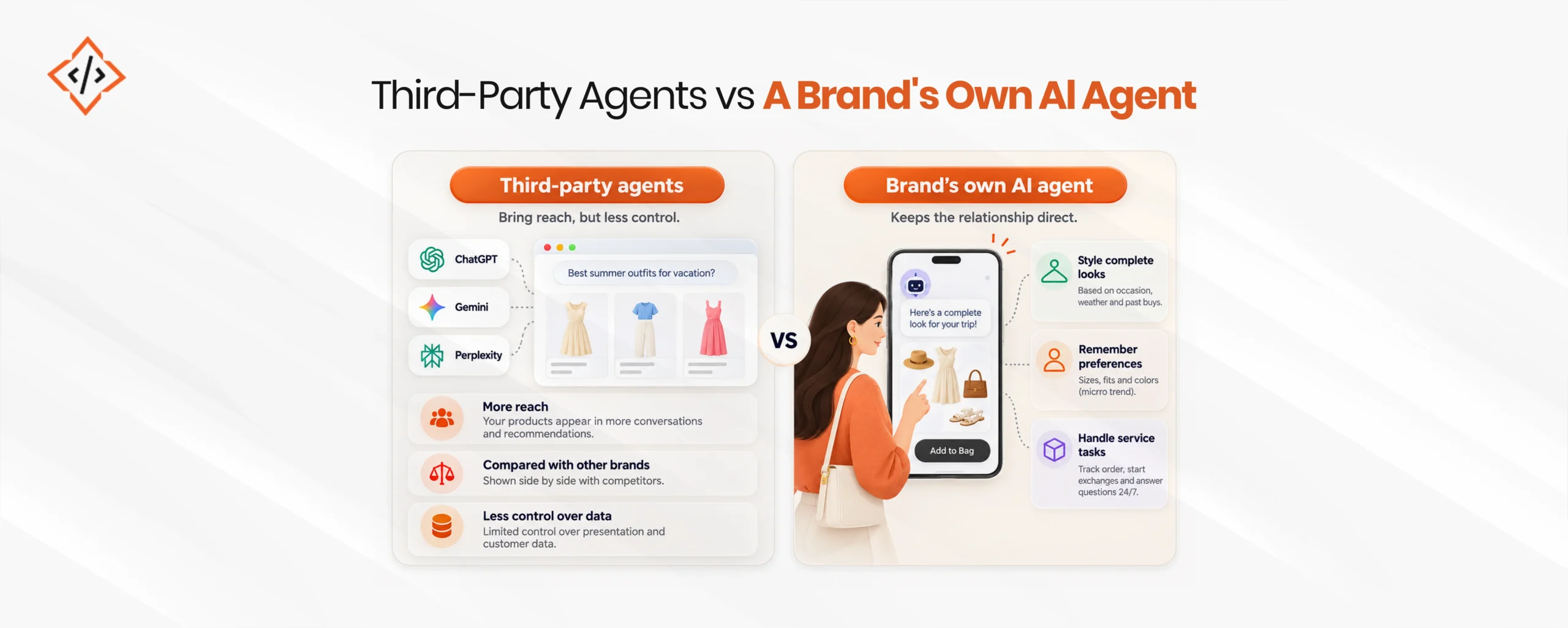
Fashion brands face two separate jobs in agentic commerce. The first is to be the preferred choice of third-party agents such as ChatGPT, Gemini, and Perplexity. The second is to offer their own AI shopping assistant on their site and app.
Third-party agents bring reach. On the other hand, they compare brands side by side, so the brand loses some control over presentation and customer data. Accenture’s 2026 research found that 56% of consumers would tell their agent which brands to consider, yet 37% of brand-loyal shoppers would let an agent switch brands for a better fit (Accenture). In other words, loyalty is now earned at the data level as well as the brand level.
A brand’s own AI agent, by contrast, keeps the relationship direct. A well-built fashion agent can:
- Style complete looks: Suggest outfits from the brand’s catalog based on occasion, weather, and items the shopper already bought.
- Remember preferences: Recall sizes, favorite fits, and colors with the shopper’s consent, which makes repeat buying faster.
- Handle service tasks: Track orders, start exchanges, and answer sizing questions at any hour.
Building such an assistant usually relies on generative AI development for natural, on-brand conversation, connected to the catalog, inventory, and order systems behind it. Personalization here must stay transparent. Shoppers should see what the agent remembers and be able to delete it, especially under privacy laws such as GDPR.
A phased roadmap for agentic commerce readiness
Preparing for agentic commerce for fashion ecommerce does not require rebuilding everything at once. A phased plan lowers risk and shows results early.
- Phase 1, get found: Audit product attributes, size data, feeds, and bot rules. Then test 20 to 30 real shopping prompts in ChatGPT, Gemini, and Perplexity, and note which products appear and which facts are wrong.
- Phase 2, get bought: Connect the catalog to agent checkout through the ecommerce platform, for example Shopify’s agentic storefront features or a UCP or ACP integration. Set approval rules, payment tokens, and return terms for agent orders.
- Phase 3, own the relationship: Launch a branded AI stylist on the site and app, with consent-based memory. Specialist AI agent development services help connect this assistant to real actions, such as cart building, exchanges, and order updates.
At each phase, track a small set of metrics:
- Visibility: Share of test prompts where the brand’s products appear, and how accurately they are described.
- AI traffic and revenue: Referral sessions, conversion rate, and order value from AI platforms, measured separately from search and social.
- Data health: Attribute completeness, feed errors, and how often price or stock data goes out of date.
- Return rate on agent orders: The clearest sign of whether fit data is good enough for AI-driven fashion personalization.
Common risks and mistakes to avoid
Agentic AI ecommerce trends move fast, and hype often runs ahead of results. Gartner predicts that over 40% of agentic AI projects will be canceled by the end of 2027, mainly due to rising costs, unclear business value, or weak risk controls. Fashion brands can avoid the same fate by watching for these mistakes:
- Starting with a chatbot: A chat window on the homepage cannot fix missing size data or stale stock levels.
- Betting on one AI platform: Today’s leading assistant may lose ground next year, so the data layer should stay platform-neutral.
- Ignoring returns: Agent orders with poor fit data can push return costs higher than the extra sales are worth.
- Automating without guardrails: Agents need spending limits, human approval for high-value orders, and clear audit logs.
- Leaving operations behind: Faster orders put pressure on inventory, fulfillment, and support. AI-powered business automation helps back-office teams keep pace with agent-driven demand.
Conclusion
AI shopping assistants are becoming a real sales channel for clothing, footwear, and accessories. Most shoppers still want to approve the final payment, yet discovery is already shifting to AI agents. Consequently, the brands that win will be the ones whose product, fit, and stock data an agent can read and trust.
The path forward is practical. First, clean the catalog and fit data. Next, let verified agents in and connect checkout through open protocols. Finally, build a branded AI agent that keeps the customer relationship direct. Taken step by step, agentic commerce for fashion ecommerce becomes a manageable upgrade instead of a disruption.
FAQs
Agentic commerce in fashion ecommerce is shopping where AI agents search, compare, and buy clothing for a shopper. The agent works within the budget, size, and brand rules the shopper sets.
Start with complete product, size, and fit data, accurate stock, and clean feeds. Next, open access to verified agents and connect checkout through protocols such as UCP or ACP.
Brands should structure category, color, material, fit, size measurements, and occasion, along with live price, stock, delivery time, and return terms. Each size and color variant also needs its own accurate data.
No, structured data helps AI systems read product facts, yet it cannot guarantee a mention or recommendation. Visibility also depends on accurate feeds, product depth, reviews, and how each AI platform selects results.
Most stores can stay on their current platform, since all three support product feeds, APIs, and growing agent integrations. The bigger priority is cleaning product data and connecting inventory and order systems properly.
An AI agent cannot try on clothes, so it relies entirely on measurements, fit notes, and sizing history. Weak fit data leads to wrong sizes, higher return costs, and less trust from shoppers.
Brands should track how often their products appear in AI prompts, AI referral traffic, conversion rate, and order value. Return rates on agent orders also show whether product and fit data are working.
Agentic commerce adds a new discovery path alongside search, social media, and marketplaces. Shoppers will keep using search engines, but more of their research and comparison will start inside AI assistants.
Brand websites will stay important for discovery, storytelling, and loyal customers. However, a growing share of product searches and some purchases will begin inside AI shopping assistants instead.
Google's Universal Commerce Protocol and the Agentic Commerce Protocol from OpenAI and Stripe are the main options today. Brands should keep their data layer flexible, since standards are still evolving.
Not at first, because visibility in ChatGPT, Gemini, and other assistants brings faster returns. A branded AI stylist makes more sense once catalog data and traffic can support it.
Chand Prakash founded CodeTrade India and continues to lead it as CTO, shaping the technical direction of the company since its early days. He has spent his career solving hard engineering problems and building teams that ship reliable software, with a focus on ERP, e-commerce, and custom enterprise platforms.




 Hardik Soni
29 October 2026
 Hardik Soni