






Magento
Web Development
eCommerce
 Chand Prakash
12 October 2026
Chand Prakash
12 October 2026
Headless Magento: When PWA Studio Earns Its Cost
 Chand Prakash
Evaluating Blazor vs React often comes down to team composition and hosting constraints rather than pure framework capability. Both options build competent software, but planning for line-of-business applications requires looking beyond simple component libraries. The real deciding factor is your existing engineering structure and specific infrastructure limits.
A tight integration with a .NET backend gives Blazor a clear advantage. It keeps one language and one type system across the stack, which removes contract drift when you hire .NET developers. React wins where the frontend is a distinct discipline with its own hiring pipeline. React offers massive ecosystem depth and a much larger developer pool. Before settling on a solution, teams must also evaluate the hosting model.
Choosing Blazor Server or WebAssembly is a critical step that many overlook. Selecting the right enterprise frontend frameworks demands aligning team economics with deployment reality.
Establishing adoption rates early matters because they shape hiring pipelines and library availability more than technical merit. React for enterprise applications remains the dominant choice. Around 44.7% of professional developers report using React in the Stack Overflow Developer Survey. This makes it the most widely adopted option worldwide. Blazor sits at roughly 7%, which shows real growth from a much smaller base of 4.46% in 2022.
Two critical readings follow from these statistics, and both hold true. First, the talent pool for React is roughly six times larger, so hiring is faster and replacing developers is easier. Any React developer represents a partial hire, whereas Blazor requires C# expertise plus Blazor-specific knowledge.
Second, Blazor’s growth is concentrated exactly in the segment under discussion. Blazor enterprise development excels for internal tools, admin interfaces, and applications on a .NET backend. This is exactly where its single-language advantage pays off.
Ultimately, popularity serves as a hiring input rather than a quality signal. A 7% framework backed by Microsoft with LTS alignment is a safe bet for line-of-business applications.
Teams frequently select Blazor and defer the hosting model decision. This order creates problems because the two hosting options function like completely different products. Any meaningful Blazor vs React comparison must account for where and how the application executes.
| Feature | Blazor Server | Blazor WebAssembly | React (SPA) |
|---|---|---|---|
| Where code runs | Server | Browser | Browser |
| Initial download | Very small | Large (runtime + app) | Moderate |
| First interaction | Fast | Slow on first load | Moderate |
| Requires constant connection | Yes (SignalR) | No | No |
| Offline capability | None | Possible | Possible |
| Server resource per user | Persistent | Minimal | Minimal |
| Latency sensitivity | High, every interaction is a round trip | Low | Low |
| Secrets stay server-side | Yes | No | No |
| Scaling model | Concurrent connections | Static hosting | Static hosting |
Blazor Server fits users on reliable networks near the data center where persistent server resource usage is acceptable. Blazor WebAssembly handles variable connectivity, offline needs, and large concurrent user counts without taxing backend memory. Evaluating these infrastructure constraints early prevents architectural mismatch in enterprise line-of-business applications.
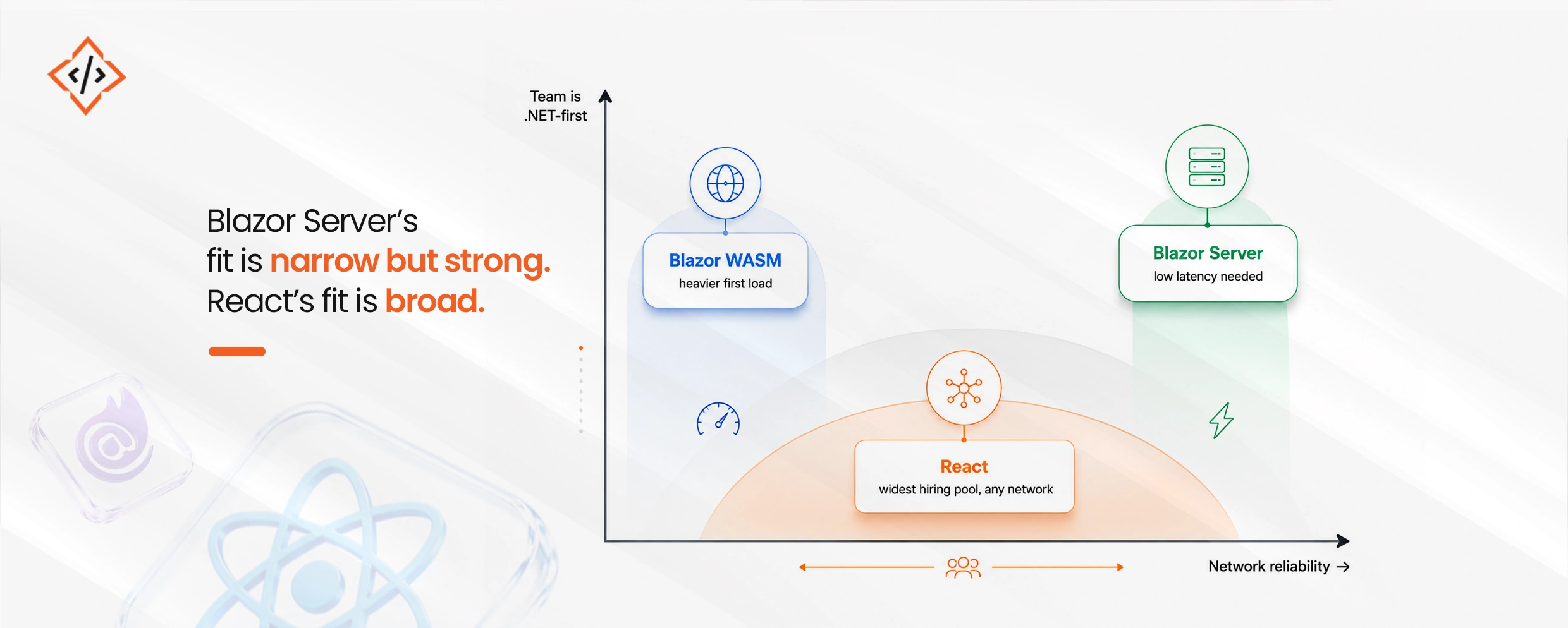
Blazor for enterprise applications provides a clear advantage across four specific situations that frequently occur in corporate environments.
Sharing validation logic and domain models between server and client removes contract drift. You eliminate OpenAPI generation steps and mismatches between TypeScript interfaces and C# records. This unified Blazor vs React architecture creates substantial savings for teams fighting boundary bugs.
Backend engineers can easily maintain the frontend. Many internal tools belong to teams lacking dedicated frontend specialists. These teams ship faster in C# than in ecosystems requiring complex bundler configuration or state library selection. This setup makes Blazor for enterprise applications highly efficient.
Secrets and core logic remain safely server-side. Application logic never reaches the browser when using the Blazor Server hosting model. This represents a meaningful architectural property for applications handling highly sensitive business rules.
The framework aligns perfectly with the .NET support calendar. Blazor ships directly with the core runtime. Its lifecycle exactly matches the LTS schedule covered in .NET 10 LTS for enterprise. Your engineering team avoids planning a completely separate framework upgrade cycle.
React remains the better choice across four critical scenarios. React for enterprise applications provides clear benefits for teams prioritizing talent availability and ecosystem depth. These specific constraints consistently shape the final Blazor vs React decision.
A six-fold larger developer pool drastically changes how quickly a vacancy gets filled. Any React enterprise development team carries significantly less key-person risk. Replacing developers is fundamentally easier when you pull from the largest frontend community worldwide.
Complex data grids and scheduling components have mature React implementations. The framework provides battle-tested solutions for charting and rich text editing. Blazor equivalents exist and are improving steadily. However, the Blazor selection remains narrower and commercial options often carry license costs.
Reusing existing assets usually outweighs the benefits of strict language consistency. Many organizations already maintain a detailed design system or component library. Staying with React is the logical choice when a functional React web application already exists.
Neither Blazor variant is the ideal choice for public and SEO-sensitive pages. Server-rendered markup through Next.js or conventional ASP.NET Core MVC beats both frameworks. Same boundary as in Flutter web and WebAssembly: application UI behind a login is a different problem from indexable content.
If your organization already has an established React team and component library, do not switch to Blazor purely for language consistency. The consistency is real, but it carries less value than your existing team expertise and component ecosystem.
If the application is public and requires search engine visibility, this Blazor vs React comparison is the wrong evaluation. Implement server-rendered markup first, then re-evaluate when building the authenticated application layer.
If you consider Blazor Server simply because it demos smoothly on office networks, analyze where your end users actually work. That deployment decision performs well in demonstrations, but it often fails in distributed branch offices with variable network latency.
Making the final choice requires asking four straightforward questions to evaluate your team dynamics and specific hosting limitations. The first two questions usually settle the Blazor vs React comparison.
Who maintains the application in two years? A .NET team with no frontend specialist strongly points to Blazor. A dedicated frontend team makes React the better choice.
Where do users sit relative to the server? A corporate head office network easily supports Blazor Server. Variable connectivity or wide geographic spread completely rules it out.
Does any part of the application need indexing? If yes, that specific surface requires server-rendered markup. This rule applies regardless of what runs behind the secure login.
Which specialist UI components are required? Always check component availability and price the licenses before committing. Discovering a missing data grid late in development costs your team disproportionately.
One practical note on migration Applications moving off WebForms face this framework decision at a difficult moment. The entire presentation layer is already being completely rebuilt. Blazor remains highly attractive here because it keeps your team writing C#.
However, the specific hosting model still requires an explicit decision. Your total .NET modernization cost reflects exactly how much that presentation layer contributes.
A clear difference exists between managing corporate risk and optimizing for team velocity.
For large enterprises, technical leadership must weigh talent availability heavily. A six-fold larger talent pool enables faster hiring and reduces key-person risk. This operational reality frequently steers recommendations toward React enterprise development, even when internal architecture suits Blazor.
For a lean .NET team, Blazor enterprise development remains the more practical choice. Two backend engineers working in C# deliver line-of-business applications faster in Blazor than in React. The hiring risks that concern enterprise leadership become secondary when a stable internal team manages the product.
Both strategies remain fully defensible. The distinction stems from risk exposure rather than technical capability. When an enterprise chooses Blazor and encounters hiring bottlenecks later, leadership feels that friction directly. When a team adopts React and builds slightly slower, the trade-off remains largely invisible.
Resolving this requires addressing the trade-off directly during early architecture reviews. Bringing this hiring asymmetry to light ensures decision-makers choose the framework that fits their operational trajectory.
Both frameworks successfully power modern software, meaning technical capability alone does not dictate the final outcome. Team composition and hosting constraints remain the true deciding factors. Opt for Blazor when your engineering team is already .NET-first and unified type safety eliminates contract drift. Blazor for enterprise applications works best when users operate on stable corporate networks close to servers.
Conversely, choose React when hiring flexibility, mature third-party components, or existing frontend assets take priority. Most importantly, never commit to Blazor without defining your hosting model in the same planning session. Blazor Server and Blazor WebAssembly introduce completely different infrastructure requirements.
Deferring that architecture decision risks deploying the wrong capacity model for your line-of-business applications. Evaluating enterprise frontend frameworks requires balancing initial build speed against long-term maintenance. Aligning existing developer talent with real deployment constraints ensures a sustainable Blazor vs React implementation.

 Chand Prakash
 Bhavesh Kachadiya
 Bhavesh Kachadiya
 Bhavesh Kachadiya
 Bhavesh Kachadiya